
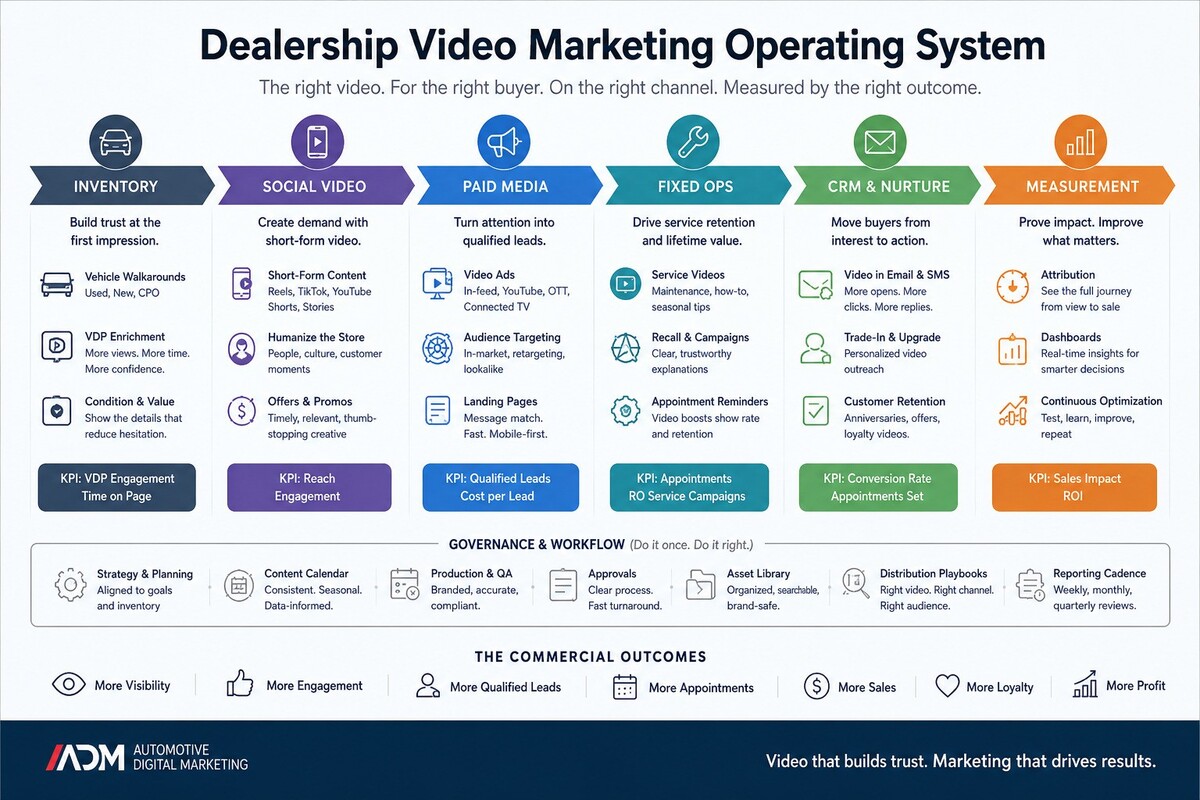
Automotive video marketing helps dealerships turn inventory, service expertise, customer proof and local credibility into measurable demand. The strongest dealership video programs do not chase views for their own sake. They use video to improve shopper confidence, increase qualified traffic, support vehicle merchandising, strengthen fixed-ops retention and give sales teams better conversion assets.
Quick answer: dealership video works when the business goal, audience, creative format, distribution path, landing page and measurement model are aligned. A walkaround, service explainer, testimonial or short-form social clip should have a clear job: earn attention, answer a shopper question, move a buyer toward the right page, or help a sales or service team create the next conversation.
This hub is for dealership owners, GMs, dealer group marketers, fixed-ops leaders, automotive agencies, website and inventory vendors, video production partners and software buyers evaluating where video belongs in the dealership growth stack.
Start Here: Automotive Video Marketing Routes
| Video marketing task | Best starting point | Use it when |
|---|---|---|
| Build the video strategy | Video strategy and operating model | You need a practical plan tied to dealership goals, audiences, channels and internal roles. |
| Merchandise inventory better | Inventory video and vehicle walkarounds | You want stronger VDP engagement, used-car differentiation, aged-unit support or model education. |
| Create short-form video | Short-form social and staff content | You need a repeatable system for Reels, Shorts, TikTok, paid social and local proof. |
| Use video in paid media | Paid video, YouTube and CTV | You are planning awareness, retargeting, conquest, offer or inventory campaigns. |
| Support service retention | Fixed-ops and lifecycle video | You need service explainers, maintenance education, seasonal campaigns or CRM reactivation. |
| Measure commercial impact | Video measurement and attribution | Leadership needs a credible view of traffic quality, leads, appointments and assisted outcomes. |
| Choose a partner | Video vendor and agency selection | You are comparing production vendors, automotive agencies, paid media partners or platform providers. |
What Automotive Video Marketing Includes
Automotive video marketing includes more than polished brand commercials. Dealership programs can include vehicle walkarounds, model comparisons, used-car condition videos, trade-in explainers, financing education, service maintenance clips, technician content, customer testimonials, delivery moments, staff introductions, paid social creative, YouTube campaigns, CTV, retargeting video and CRM follow-up assets.
- Inventory video: walkarounds, feature explanations, used-vehicle differentiation, model comparisons and offer-specific creative.
- Short-form content: vertical clips for social, paid media, staff expertise, customer questions and local relevance.
- Brand and trust video: customer stories, community proof, dealership culture and leadership visibility.
- Fixed-ops video: maintenance education, inspection explanations, seasonal campaigns and technician credibility.
- Paid video: YouTube, CTV, paid social, retargeting and campaign-specific creative testing.
- Lifecycle video: lease maturity, equity mining, reactivation, appointment reminders and post-sale ownership content.
- Sales enablement: personalized replies, appointment confirmations and follow-up assets for BDC and sales teams.
Dealership Video Marketing Bottleneck Map
| If the bottleneck is | Video focus | What to inspect first | Commercial signal |
|---|---|---|---|
| Weak inventory engagement | Vehicle walkarounds and VDP video | Coverage rate, video quality, VDP placement, aged units, CTA paths and merchandising priorities | VDP engagement, calls, form starts, return visits and vehicle-level lead quality |
| Low local trust | Staff, customer and community proof | Reviews, delivery content, staff visibility, local stories and response to common concerns | Branded search, engagement quality, profile actions and assisted conversion signals |
| Paid creative fatigue | Short-form testing and paid video assets | Creative refresh rate, hooks, audience segments, offer relevance and landing pages | Qualified traffic, view-through engagement, cost per opportunity and appointment influence |
| Service retention is underdeveloped | Maintenance and technician education | Seasonal offers, service intervals, appointment flow, CRM segments and local service proof | Service booking starts, completed appointments and reactivation performance |
| Sales follow-up lacks differentiation | Personalized and reusable sales video | BDC workflow, response time, templates, CRM adoption and ownership | Contact rate, appointment set rate and show rate |
| Reporting is superficial | Measurement architecture | UTMs, landing pages, media platform data, calls, forms, appointments and CRM feedback | Qualified opportunities, assisted outcomes and budget reallocation decisions |
Video Strategy and Operating Model
A dealership video strategy begins with operational choices, not a production wish list. Decide which audiences matter, which business problems deserve video, where the content will appear and who owns the workflow. A practical program usually has a small set of repeatable formats rather than an endless calendar of one-off ideas.
A useful operating model separates three layers: evergreen assets for recurring shopper questions and service education; inventory and offer assets for active merchandising priorities; and trust assets that show real staff, customers and local dealership credibility. Each layer needs clear approval rules, filing standards, platform ownership and a way to retire stale material.
Core Video Content Pillars
| Content pillar | Examples | Business use |
|---|---|---|
| Inventory confidence | Walkarounds, feature demonstrations, used-vehicle condition notes, comparisons | VDP engagement, used-car differentiation, aged inventory and buyer confidence |
| Ownership education | Maintenance explainers, tire and brake guidance, recall or warranty education | Service retention, fixed-ops trust and appointment demand |
| Local proof | Customer stories, delivery moments, staff expertise, community events | Reputation, brand trust and paid social creative |
| Shopping guidance | Finance, trade-in, EV, model comparison and buying-process explanations | Lead quality, conversion support and sales enablement |
| Offer and campaign creative | Seasonal offers, model campaigns, lease maturity and trade-in acquisition | Paid media, retargeting and CRM activation |
Inventory Video and Vehicle Walkarounds
Vehicle video should make a shopper more confident about the specific car, truck or SUV they are considering. It does not need cinematic production for every unit. It needs truthful coverage, good audio, useful detail, a repeatable format and an obvious next step.
For used inventory, the best videos often reduce uncertainty: vehicle condition, equipment, reconditioning highlights, cargo space, tires, technology, ownership history context and a human explanation of why the unit deserves attention. For new inventory, video can explain trims, capability, charging, towing, safety technology and differences that standard OEM imagery does not make clear.
Vehicle Video Quality Checklist
- Begin with the shopper question the vehicle can answer.
- Use a clear, consistent opening and show the specific unit early.
- Cover the features that change purchase confidence, not only generic exterior shots.
- Keep audio understandable and avoid unsupported claims about condition, savings or availability.
- Link video to the correct VDP, model page or appointment path.
- Refresh or remove videos when inventory is sold, pricing changes materially or content becomes misleading.
Short-Form Social and Staff Content
Short-form video is useful when it makes the dealership feel credible and current. The strongest clips usually begin with a specific question, an objection, a local insight or a visual proof point. Staff do not need to become influencers; they need simple formats that make their expertise easier for customers to understand.
Repeatable concepts include a 30-second trim comparison, a technician explaining a maintenance warning, a delivery specialist showing a feature, a salesperson answering a trade-in question, a used-car manager highlighting a vehicle detail, or a service advisor explaining what happens during an inspection. The value comes from consistency, clarity and actual dealership knowledge.
Paid Video, YouTube and CTV
Paid video should be selected for its role in the journey. YouTube and CTV can build reach and awareness, while paid social video can support targeting, retargeting and rapid creative testing. The mistake is treating completed views as the business outcome. Campaign design should connect audience, creative, offer, landing page and conversion event.
For dealership buyers, inspect how the vendor handles audience exclusions, frequency, geographic logic, offer approval, inventory availability, creative refresh, brand safety and post-click paths. Video can create value before a form fill, but the program still needs evidence that it is generating better traffic, stronger engagement or measurable assisted demand.
Fixed-Ops and Lifecycle Video
Video can improve fixed-ops marketing because service is often easier to explain visually than through a coupon alone. Technician-led education, seasonal maintenance reminders, tire and brake explanations, inspection walkthroughs and service advisor clips can help customers understand why an appointment matters.
Lifecycle video also supports lease maturity, equity mining, post-sale onboarding and dormant-customer reactivation. The content should be paired with the correct CRM segment and action path. A video reminding a customer about seasonal service is useful only when the appointment experience is simple and the dealer can see whether the campaign influenced booked work.
Video Measurement and Attribution
Video reporting should distinguish attention metrics from business metrics. Impressions, views, completion rate, watch time and engagement matter because they reveal creative performance. They do not, on their own, prove commercial value.
A mature dealership measurement model connects video to website visits, VDP activity, calls, forms, appointment starts, service booking behavior, CRM lead quality and—where possible—assisted outcomes. Use clean campaign naming, UTMs, landing pages that match creative intent, media-platform reporting and dealer-owned data access.
| Metric layer | What it answers | Examples |
|---|---|---|
| Attention | Did the creative earn viewing? | Impressions, view rate, completion rate, watch time, thumb-stop rate |
| Engagement | Did viewers take the next action? | Clicks, profile visits, VDP visits, channel subscriptions, repeat viewing |
| Conversion | Did the program create an identifiable opportunity? | Calls, forms, chat starts, appointment starts, service bookings |
| Quality | Were the resulting opportunities useful? | Lead response, appointment set rate, show rate, CRM disposition, sold or RO feedback |
| Business impact | What should leadership scale or stop? | Incremental demand signals, assisted outcomes, cost per qualified opportunity, retention lift |
How to Choose an Automotive Video Marketing Vendor or Agency
The right video partner can be a production shop, automotive agency, paid media specialist, inventory-video platform, website provider or internal content team. The decision should start with the operating need. A dealership that needs 200 used-car walkarounds per month has a different requirement from a dealer group that needs paid-video creative, CTV campaigns and governance across rooftops.
Automotive Video Marketing Vendor Scorecard
| Category | What a strong partner shows | What to ask for |
|---|---|---|
| Dealership relevance | Understands inventory, fixed ops, lead response, local trust and dealer workflows | Examples tied to dealership outcomes, not generic brand reels |
| Production system | Repeatable process for filming, approvals, editing, asset storage and refreshes | Workflow map, turnaround standards and staffing model |
| Inventory fit | Can support vehicle-level merchandising without creating an unsustainable process | Coverage approach, VDP integration and sold-unit process |
| Paid-media capability | Understands channel choice, audience structure, creative testing and landing paths | Sample media plan, testing logic and reporting view |
| Fixed-ops capability | Can create service education and retention assets that fit dealership operations | Service campaign examples and appointment measurement |
| Measurement | Separates views from qualified opportunities and business outcomes | Sample report with traffic, lead and appointment signals |
| Ownership | Dealer keeps raw footage, finished assets, accounts, audiences and reporting data | Written asset, account and transition policy |
| Compliance | Uses a defined review process for offers, claims, disclosures and OEM rules | Approval workflow and escalation path |
First 90 Days of a Strong Dealership Video Program
| Period | Work | Dealer input | Output |
|---|---|---|---|
| Days 1–15 | Audit current assets, channels, inventory priorities, paid creative, website paths, service opportunities and measurement | Account access, brand rules, inventory priorities, CRM goals and approval process | Baseline and prioritized video operating plan |
| Days 16–30 | Define formats, scripts, templates, production roles, asset naming, distribution map and measurement requirements | Staff availability, offer calendar, compliance inputs and landing-page access | First production sprint and 30-day publishing plan |
| Days 31–60 | Launch inventory, social, paid and service content; test hooks, lengths, CTAs and landing paths | Sales/service feedback, approvals and inventory changes | Creative learning log and early performance review |
| Days 61–90 | Scale the formats that produce qualified attention, improve weak handoffs and plan next-quarter campaigns | CRM lead quality, appointment feedback and operating constraints | 90-day scorecard and roadmap |
Automotive Video Marketing Red Flags
- The vendor sells “cinematic content” without a plan for distribution, landing pages or measurement.
- It reports views but cannot discuss traffic quality, appointments, service bookings or lead feedback.
- It treats every dealership need as a branding problem and ignores inventory or fixed ops.
- It does not explain who owns footage, finished assets, channels, ad accounts or audiences.
- It creates content without a realistic approval process or refresh plan.
- It promises viral performance instead of defining repeatable formats and commercial goals.
- It cannot show how paid video, organic video and CRM video fit together.
Questions to Ask a Dealership Video Marketing Partner
- Which dealership bottlenecks does video solve best for us?
- What formats would you launch first, and why?
- How do you handle inventory changes, sold units and content refreshes?
- How do you connect video to VDPs, landing pages, paid media and CRM?
- What does your production and approval workflow look like?
- How do you measure qualified traffic, leads, appointments and assisted outcomes?
- How do you support fixed ops and service retention?
- Who owns raw footage, finished assets, channels, ad accounts and reporting data?
- How do you handle offer claims, pricing disclosures and OEM requirements?
- What would make our dealership a poor fit for your approach?
Related Automotive Marketing Guides
- Automotive Social Media Marketing for Dealerships
- Automotive PPC for Car Dealerships
- Automotive Inventory Ads
- Dealer Website SEO
- Service Retention Marketing
- Dealership Lead Management
- Dealer Vendor Selection
Final Verdict
The best dealership video marketing program is a commercial operating system: it makes inventory easier to understand, gives local buyers stronger proof, supports service retention, improves paid-media creative and helps sales teams create better conversations. Build the workflow before buying more production.
Frequently Asked Questions About Automotive Video Marketing
What is automotive video marketing?
Automotive video marketing uses vehicle, dealership, service, customer and campaign video to support dealership awareness, shopper confidence, inventory merchandising, lead generation, service retention and sales follow-up.
What types of video work best for car dealerships?
Useful formats include vehicle walkarounds, model comparisons, used-car condition videos, staff expertise clips, service explainers, customer stories, delivery videos, short-form social clips, paid-video creative and personalized sales follow-up.
Should every vehicle have a video?
Not necessarily. The right coverage depends on inventory volume, staffing, merchandising priorities and the expected commercial value. Used inventory, aged units, high-consideration vehicles and complex models often deserve priority.
How should a dealership measure video marketing?
Measure attention metrics such as view rate and completion rate alongside website visits, VDP engagement, calls, forms, appointments, service bookings, CRM quality and assisted outcomes. Views alone are not enough.
Is YouTube or paid social better for dealership video?
They serve different roles. YouTube can support search-adjacent demand capture and video reach; paid social supports targeting, retargeting and rapid creative testing. The best choice depends on the audience, creative, offer and conversion path.
What should a dealership own when hiring a video vendor?
The dealership should retain raw footage, finished assets, channel access, ad accounts, audiences, reporting data and a documented transition process.