
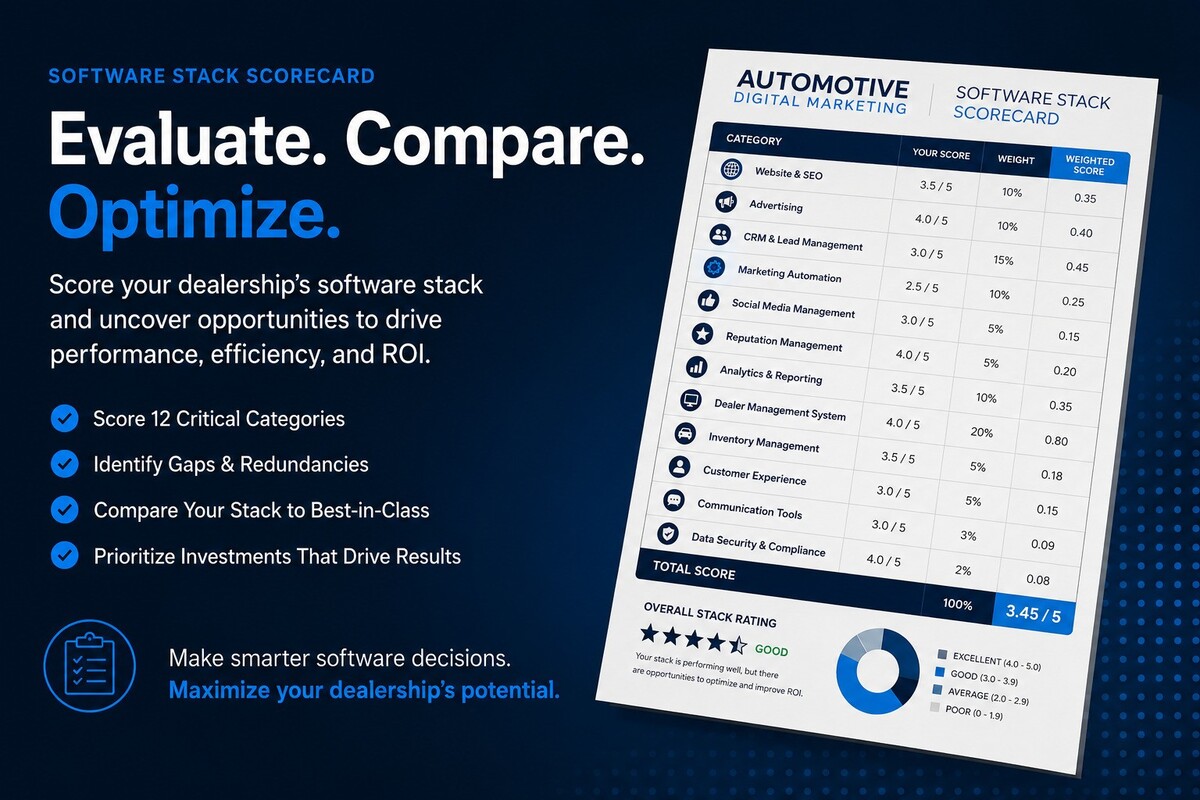
Last updated: June 12, 2026. Last reviewed by the Automotive Digital Marketing editorial team.
The ADM Dealership Marketing Software Scorecard helps dealerships compare marketing software before demos, renewals and vendor changes. Use it to score CRM, website, attribution, call tracking, inventory advertising, reputation, AI, reporting and retention tools against the store’s actual bottleneck, owner, workflow and renewal standard.
Fast use: download the printable PDF, score every category from 1 to 5, then use the total score to choose keep, replace, consolidate, test or renegotiate.
Quick answer: how to use the ADM software scorecard
Score each vendor from 1 to 5 across attribution reliability, CRM workflow fit, data ownership, user adoption, integration quality, reporting clarity, vendor support and total cost overlap. The strongest tool is the one that fixes a real dealership bottleneck, has an internal owner, connects to the CRM or reporting workflow and proves value before renewal.
Use the scorecard before your next vendor demo or renewal review. Print the worksheet, score each vendor from 1 to 5 and use the weighted total to choose one decision: keep, replace, consolidate, test or renegotiate.
Download the ADM scorecard
Use the scorecard as a working vendor review sheet before demos, renewals, software changes and consolidation decisions.
ADM rule for dealership software decisions
ADM rule: measurement first, bottleneck second, software third, renewal last.
A dealership should understand the data, define the problem, choose the tool and review the renewal in that order.
ADM Dealership Marketing Software Scorecard
Formula: weighted points = category score ÷ 5 × category weight. A score of 5 earns the full category weight. A score of 3 in a 15% category earns 9 points. The maximum total score is 100.
Score scale
Use the same 1–5 scale for every category so managers compare vendors consistently instead of debating what each number means.
| Score | Meaning |
|---|---|
| 1 | Broken, unclear or unusable. |
| 2 | Inconsistent and hard to manage. |
| 3 | Usable, but dependent on manual work or limited adoption. |
| 4 | Strong, adopted and useful for management decisions. |
| 5 | Proven, trusted, portable and tied to dealership outcomes. |
| Scorecard category | Weight | What to verify | Score 1 means | Score 5 means |
|---|---|---|---|---|
| Attribution reliability | 15% | Calls, forms, chats, VDP actions and CRM source reporting match real outcomes. | Sources are unclear or disputed. | Managers trust the source and outcome data. |
| CRM workflow fit | 15% | Sales, BDC, service and management teams can use the workflow without manual cleanup. | The workflow creates extra work. | The workflow improves response, notes, tasks or appointments. |
| Data ownership | 15% | The dealership can export clean reports, source data and performance history. | Data is locked inside the vendor platform. | Data is portable, clear and useful after renewal or cancellation. |
| User adoption | 15% | The tool appears in weekly work, manager reviews and training. | Few users log in or follow the workflow. | The tool is part of normal dealership operations. |
| Integration quality | 10% | The platform connects with website, CRM, DMS, inventory, call tracking or reporting systems. | Manual exports or disconnected reports are required. | The connection supports the store’s workflow and reporting. |
| Reporting clarity | 10% | Reports help leadership decide what to keep, fix, replace or cancel. | Reports show activity without decisions. | Reports support budget, vendor and process decisions. |
| Vendor support | 10% | Implementation, training, issue resolution and business reviews have clear ownership. | Support is slow or unclear. | Support ownership and business reviews are useful. |
| Total cost and overlap | 10% | The tool does not duplicate another vendor without a clear reason. | Cost overlaps with existing tools. | Cost is justified by workflow value or consolidation. |
How to score a vendor
Score each category from 1 to 5 based on evidence, not sales claims. Use CRM reports, call data, export samples, adoption reports, support history and renewal terms. Do not score a vendor higher because the demo is polished.
Example score calculation
If a call tracking vendor scores 4 in attribution reliability, that category earns 12 points because 4 ÷ 5 × 15 = 12. If the same vendor scores 3 in CRM workflow fit, that category earns 9 points because 3 ÷ 5 × 15 = 9. Add every weighted category to create the total vendor fit score out of 100.
Evidence to collect before scoring
- CRM source report
- Call tracking report
- Website conversion report
- Vendor export sample
- Usage or login report
- Support ticket history
- Renewal terms and cancellation requirements
Scoring rules
- Score each category from 1 to 5.
- Multiply each category score by its weight.
- Add the weighted scores to create a vendor fit score.
- Compare the score to the dealership’s current bottleneck and renewal deadline.
- Assign one decision: keep, replace, consolidate, test or renegotiate.
Decision thresholds
| Total score | Decision guidance | Management action |
|---|---|---|
| 85–100 | Strong fit | Keep, expand or standardize if adoption and reporting are proven. |
| 70–84 | Conditional fit | Keep only with a clear improvement plan, owner and review date. |
| 55–69 | Weak fit | Compare alternatives, renegotiate scope or consolidate overlapping tools. |
| Below 55 | Poor fit | Prepare replacement, cancellation or process redesign before renewal. |
What to do after scoring
| Result | Action | Owner |
|---|---|---|
| Strong fit | Keep, standardize or expand the workflow. | GM or marketing owner |
| Conditional fit | Set a 30-day improvement plan before renewal. | Vendor owner |
| Weak fit | Compare alternatives and request export samples. | Marketing or operations lead |
| Poor fit | Prepare replacement, cancellation or consolidation. | GM or group leadership |
Questions to ask before a dealership software demo
- Which exact dealership bottleneck does this tool solve?
- Which CRM fields, call events, forms, chats or inventory signals does it need?
- What data can the dealership export if the vendor relationship ends?
- Which manager owns adoption after launch?
- What report proves value before renewal?
- Which existing tool could this replace or consolidate?
- What proof can the vendor show using a real dealership workflow?
Example use case
A store with high call volume and weak appointment visibility should score call tracking, CRM workflow, manager review and reporting before buying another advertising tool. If attribution and call review are weak, the next budget decision should improve measurement and lead handling before adding more traffic.
Related ADM software and vendor guides
| Need | ADM guide | Use it for |
|---|---|---|
| Build the software category map | Best Automotive Marketing Software and Tools | Stack layers, software categories and examples to demo. |
| Compare broader vendors | Dealer Vendor Selection | Vendor criteria, procurement questions and evaluation process. |
| Choose an agency | Car Dealer Advertising Agency Scorecard | Agency fit, red flags, onboarding and performance proof. |
| Review website vendors | Dealer Website Platforms | Website conversion, inventory merchandising and provider requirements. |
Frequently asked questions
What is a dealership marketing software scorecard?
A dealership marketing software scorecard is a weighted evaluation tool that helps a store compare vendors by attribution, CRM workflow, data ownership, adoption, integration quality, reporting, support and total cost overlap.
When should a dealership use this scorecard?
Use it before software demos, renewals, vendor changes, budget reviews, website migrations, CRM changes or consolidation projects.
Who should complete the scorecard?
The best review includes the GM, marketing owner, CRM or BDC manager, service leader when relevant, and the person responsible for vendor reporting.
What score means a vendor should be replaced?
A low score does not automatically mean replacement. It means the dealership should document the gap, ask for a fix, compare alternatives and decide before the renewal deadline.
What is the ADM rule for dealership software decisions?
The ADM rule is measurement first, bottleneck second, software third, renewal last. A dealership should understand the data, define the problem, choose the tool and review the renewal in that order.