
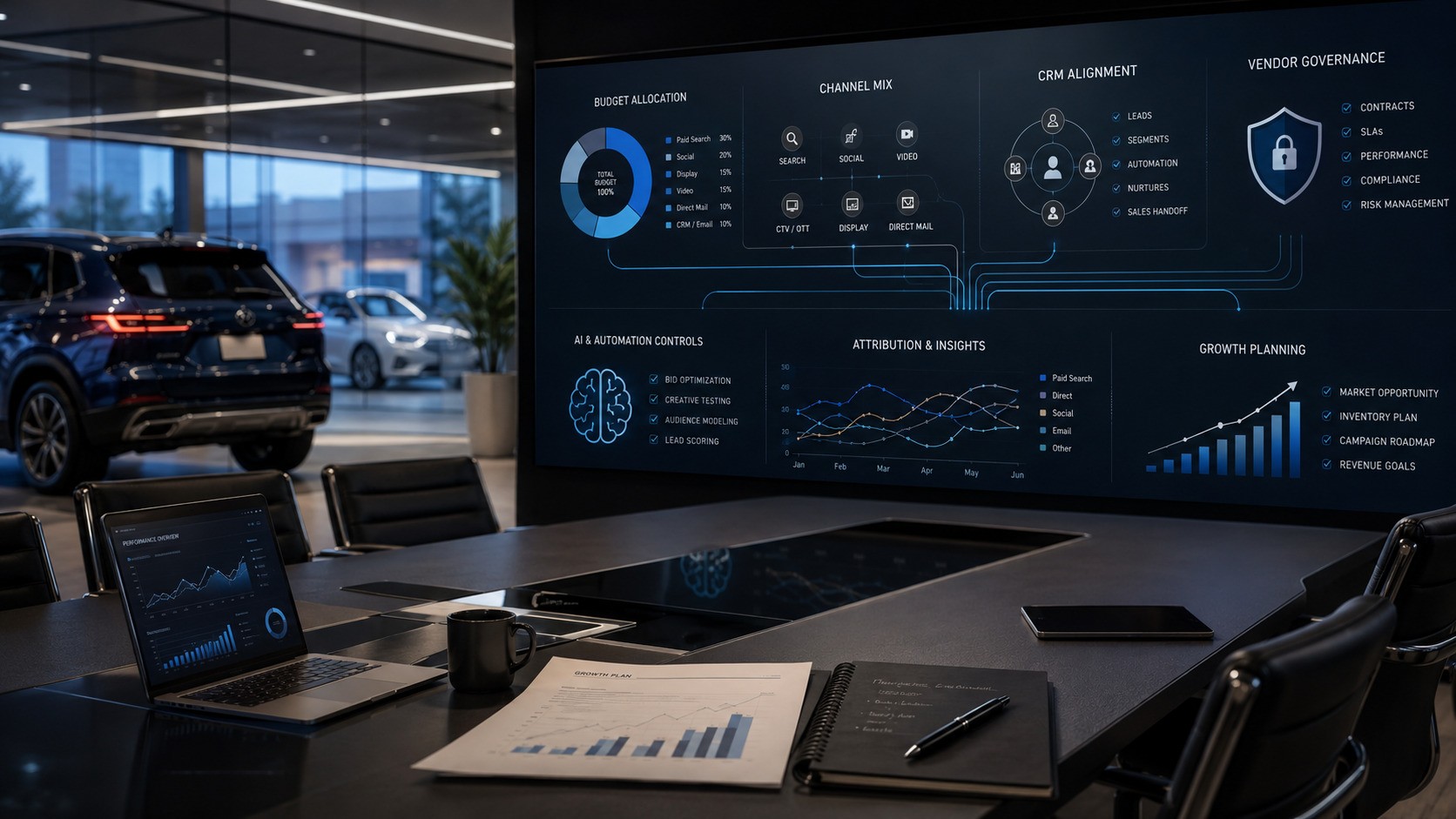
Automotive marketing strategy is the dealership decision system that connects business goals, inventory, service capacity, customer demand, budget, channels, website conversion, CRM execution, vendors and measurement. Its job is to identify the constraint that limits profitable growth, fund the work most likely to change it and define the evidence required for the next decision.
A 2026 dealership strategy guide for outcomes, budget allocation, inventory and market signals, customer lifecycle, proof assets, CRM and BDC execution, vendor governance, AI, attribution and quarterly planning.
Quick answer: define the economic outcome, identify the limiting constraint, repair measurement and fulfillment capacity, capture existing local demand, scale incremental acquisition only when downstream economics hold, then fund retention and lifecycle growth. Every channel, vendor and proof asset needs one job, one owner and one measurable outcome.
2026 automotive marketing strategy demand
Google Ads Keyword Planner data for the United States, English language and Google Search shows steady demand for dealership strategy guidance.
| Keyword | Average monthly searches | High top-of-page bid |
|---|---|---|
| automotive marketing strategy | 90 | $6.69 |
| car dealership marketing strategy | 70 | Not reported |
2026 dealer strategy evidence snapshot
C-4 Analytics surveyed dealers across the United States and Canada in early 2026. Respondent monthly digital advertising budgets ranged from under $5,000 to more than $30,000, with many stores between $5,000 and $29,999 per month. Current 2026 strategy guides also converge on lifecycle management and live operating data: DealerSmart emphasizes customer stages through service and reactivation; Catalyst IQ ties media decisions to units sold, turn rate, days on lot and market share.
| Evidence signal | Strategic implication |
|---|---|
| Dealer budgets vary widely | Budget size cannot substitute for allocation discipline and constraint diagnosis. |
| Trust in data and partners is uneven | Leadership needs shared definitions, source-of-truth rules and vendor accountability. |
| Inventory and market conditions change quickly | Media and merchandising decisions should respond to stock, age, demand and market position. |
| Customer value extends past the sale | Service, retention, equity, lease maturity and reactivation require explicit strategy. |
Dealership marketing strategy decision routes
| Strategic question | Best route | Decision supported |
|---|---|---|
| How do we turn strategy into a 90-day plan? | Car dealership marketing plan | Audit, owners, checkpoints and implementation sequence |
| How should organic demand be captured? | Automotive SEO | Local, model, inventory and fixed-ops search visibility |
| How should paid demand be managed? | Automotive PPC | Bidding, testing and budget governance |
| How should live inventory shape paid media? | Automotive inventory ads | Vehicle Ads, feed truth, VDPs and sold-unit controls |
| How should the conversion layer be evaluated? | Dealer website platforms | Website ownership, conversion, migration and platform fit |
| How should CRM and lifecycle execution fit? | Automotive CRM | Lead handling, lifecycle communication and outcomes |
| How should public trust be governed? | Dealership reputation management | Reviews, recovery and customer intelligence |
| How should AI be governed? | AI for car dealerships | Use cases, data access and human oversight |
| How should vendors be selected? | Dealer vendor selection | Requirements, scoring, contracts and transition risk |
| Which tools support planning and procurement? | Reports and templates | RFPs, worksheets, scorecards and buyer guides |
The 2026 strategy sequence: repair, capture, scale, retain
| Sequence | Decision | Evidence gate |
|---|---|---|
| 1. Repair measurement and truth | Fix conversion definitions, inventory/feed accuracy, source mapping and broken destinations | Primary conversions reconcile with source systems; inventory presented accurately |
| 2. Repair fulfillment capacity | Fix website friction, lead routing, phone handling, BDC response and service capacity | Qualified demand can be contacted, booked and fulfilled |
| 3. Capture existing demand | Strengthen local SEO, high-intent Search, inventory visibility and reputation | Known market demand has useful coverage and conversion paths |
| 4. Scale incremental acquisition | Add paid reach, conquest, social/video and broader automation selectively | Marginal cost and incremental contribution remain acceptable |
| 5. Retain and reactivate | Fund service, declined work, lease maturity, equity and owner lifecycle programs | Retention and reactivation produce measurable completed outcomes |
This sequence prevents a dealership from buying more traffic while inventory, website, tracking or follow-up is leaking the value already available.
1. Define the business outcome and limiting constraint
| Priority | Evidence required | Likely constraint |
|---|---|---|
| New-vehicle growth | Inventory, margin, demand, market share, close rate | Demand, offer, stock or conversion |
| Used-vehicle velocity | Age, turn, VDP activity, price position, source-level sales | Merchandising, pricing or demand |
| Fixed-ops growth | RO mix, capacity, retention, local demand | Capacity, visibility or booking |
| Retention | Ownership stage, service history, declined work, response | Segmentation, consent or follow-up |
| Group efficiency | Store performance, vendor overlap, market differences | Duplication, governance or execution |
2. Build a live market and inventory scoreboard
| Signal | Decision use |
|---|---|
| Units sold / market share | Shift market and model priorities |
| Days on lot / turn rate | Prioritize selected inventory groups |
| Price position / stock depth | Repair offer or merchandising before adding media |
| Service capacity | Increase or throttle fixed-ops acquisition |
| Lead quality / appointment rate | Reallocate channel budget or repair follow-up |
| Retention / reactivation | Fund lifecycle programs |
3. Give every channel one strategic job
| Capability | Strategic job | Business evidence |
|---|---|---|
| SEO/local search | Capture durable non-brand and local demand | Qualified organic/local actions |
| PPC | Capture immediate demand and test incremental acquisition | Qualified outcome cost and incrementality |
| Inventory advertising | Connect live stock with active shoppers | Eligible units, VDP progression, sold feedback |
| Website/digital retail | Convert demand into useful next steps | Intent-matched conversion and progression |
| CRM/email/SMS | Convert, nurture and retain customers | Contact, appointment, sold/service and retention |
| Reputation | Build trust and expose CX failures | Review health, recovery and recurring themes |
| Social/video/content | Build consideration, proof and reusable creative | Qualified assisted demand and proven creative themes |
4. Build proof assets that reduce buyer risk
Current top-performing strategy guides repeatedly use social proof, transparency and useful content as conversion infrastructure. Dealership leadership should manage proof assets with the same discipline used for paid media.
| Proof asset | Required standard | Owner/evidence |
|---|---|---|
| Customer reviews | Recent, legitimate, representative and actively managed | Reputation owner; velocity, themes and response metrics |
| Vehicle proof | Real photos/video, accurate price, condition and availability | Inventory/merchandising owner; VDP/feed parity |
| Process transparency | Clear trade, finance, service and appointment expectations | Department owner; current page/offer review |
| Employee expertise | Named staff explaining real buyer and owner questions | Marketing + department managers; reusable video/content library |
| Community proof | Specific local involvement with verifiable context | Store leadership; dated event/partnership record |
| Offer proof | Current material terms, inventory applicability and expiry | Marketing/compliance owner; approved source record |
Proof rule: every major acquisition campaign should carry at least one relevant trust signal that can be verified by the shopper and traced to an accountable dealership owner.
5. Manage the full customer lifecycle
| Stage | Primary objective | Evidence |
|---|---|---|
| Discovery | Earn visibility and trust | Non-brand visibility, local actions, qualified traffic |
| Shopping | Match demand with inventory and proof | SRP/VDP progression, qualified enquiries |
| Lead/appointment | Create fast relevant follow-up | Response, contact, appointment, show |
| Purchase | Connect source to delivered outcome | Delivered units and source reconciliation |
| Ownership/service | Retain profitable relationships | Bookings, completed ROs, retention |
| Replacement/reactivation | Use ownership stage and history | Lease/equity/reactivation response and sold outcomes |
6. Make website, CRM and BDC execution strategic constraints
| Layer | Minimum standard |
|---|---|
| Website | Fast mobile paths, accurate inventory, clear next steps, measurable conversions |
| Lead ownership | Named owner, escalation path, response expectation |
| Source quality | Channels judged by contact, appointment, show and sold/service outcomes |
| Lifecycle | Sales/service programs use consent, segmentation and ownership-stage context |
| Reporting | Definitions are stable enough to support budget decisions |
7. Govern the vendor and technology stack
- Define the business capability each provider owns.
- Separate media, platform, service, production, data and implementation costs.
- Identify duplicated tools and overlapping attribution claims.
- Require dealer access to accounts, data, audiences, creative and configuration where appropriate.
- Document implementation responsibilities, renewal, termination, export and migration terms.
- Use shared outcome definitions across providers.
8. Adopt AI through explicit use cases
| Use case | Required control |
|---|---|
| Content/merchandising | Human review, factual inventory data, brand standards |
| Lead handling/chat | Escalation, transcript access, outcome monitoring |
| Segmentation | Reliable source data and explainable criteria |
| Reporting | Reconciliation to source systems and clear treatment of estimates |
| Workflow automation | Named owner, exception handling and audit history |
9. Establish a dealership measurement contract
Every executive metric should declare its definition, denominator, source system, time window and action threshold.
| Layer | Measures | Decision |
|---|---|---|
| Demand | Visibility, qualified traffic, local actions | Where demand exists or is missing |
| Conversion | Calls, forms, chat, VDP/SRP progression | Whether the site protects marketing value |
| Lead operations | Response, contact, appointment, show | Whether follow-up protects demand |
| Business outcome | Delivered units, completed ROs, retention | Which investments deserve budget |
| Data quality | Missing calls, duplicates, conflicts, unmatched outcomes | Whether evidence is trustworthy |
10. Apply an incremental unit-economics gate
| Input | Dealer calculation | Decision use |
|---|---|---|
| Incremental outcomes | Delivered units or completed ROs above declared baseline | Separates incremental growth from existing demand |
| Contribution per outcome | Finance-approved contribution gross/service contribution | Sets acquisition-cost ceiling |
| Fully loaded incremental cost | Media + management + platform + production + data + incremental labor | Captures full economic cost |
| Incremental contribution | Incremental outcomes × contribution per outcome − fully loaded incremental cost | Shows whether expansion creates value |
11. Run a quarterly strategy review
- Confirm outcome and limiting constraint.
- Review inventory, market and service-capacity signals.
- Review the repair/capture/scale/retain sequence.
- Review channel jobs and source quality.
- Review proof assets, website, CRM and BDC execution.
- Evaluate vendors, AI, privacy, consent and data risks.
- Review incremental contribution by major investment.
- Reallocate budget and assign owners, dates and evidence gates.
Automotive marketing strategy red flags
- Budget renews without business-outcome review.
- Traffic scales while tracking, website or follow-up leaks remain unresolved.
- Channels lack defined strategic jobs.
- Inventory aging and market position are absent from media decisions.
- Campaigns lack verifiable proof assets.
- Fixed ops and retention receive residual budget.
- CRM source data cannot support allocation decisions.
- Incremental economics are absent from scaling decisions.
- AI is purchased without an approved workflow.
- Account, data and creative ownership remain unclear.
Methodology and sources
This September 2026 revision combines live U.S. Keyword Planner demand data, current dealer-survey research and current top-ranking dealership strategy guides with primary governance sources.
- Demand: Google Ads Keyword Planner, United States, English, Google Search, accessed September 6, 2026.
- Dealer survey: C-4 Analytics 2026 Dealer Digital Marketing Trends Report.
- Current top-result review: DealerSmart, Brainito and AutoFire pages reviewed September 7, 2026; Catalyst IQ and Digital Downforce used as depth checks.
- Governance: FTC automotive/privacy guidance, NIST AI Risk Management Framework and current Google Ads measurement guidance.
Frequently asked questions about dealership marketing strategy
What is an automotive marketing strategy?
It is the decision framework a dealership uses to connect business goals, inventory, customer demand, budget, channels, vendors, website conversion, CRM execution and measurement.
What order should a dealership improve marketing in?
Repair measurement and fulfillment capacity first, capture existing demand next, scale incremental acquisition when economics support it, then expand retention and reactivation.
What should a dealership marketing strategy include?
Business outcomes, limiting constraints, budget allocation, inventory signals, channel roles, proof assets, website and CRM standards, lifecycle marketing, vendor governance, AI controls and measurement rules.
How should a dealership allocate its marketing budget?
Fund the constraint limiting profitable growth and change the allocation when inventory, capacity, lead quality or business outcomes reveal a different constraint.
How should inventory affect marketing strategy?
Use stock depth, age, turn rate, price position, demand and merchandising quality to determine which vehicle groups need visibility or operational correction.
What proof assets should dealership marketing use?
Use legitimate customer reviews, real vehicle media, transparent process and offer information, employee expertise and verifiable community proof tied to accountable owners.
Should dealership marketing continue after the vehicle sale?
Yes. Service retention, declined work, equity, lease maturity, ownership communication and reactivation require explicit goals and budgets.
How should a dealership decide whether to increase marketing spend?
Use incremental delivered units or completed repair orders, contribution per outcome and fully loaded added cost, with operating capacity confirmed before expansion.
How often should strategy be reviewed?
Review quarterly, monitor critical indicators monthly and reopen strategy sooner when inventory, market conditions, vendors, technology or capacity change materially.
How should dealer groups govern marketing vendors?
Define capability ownership, account/data access, implementation responsibilities, shared outcome definitions, reporting, contracts and transition requirements.