
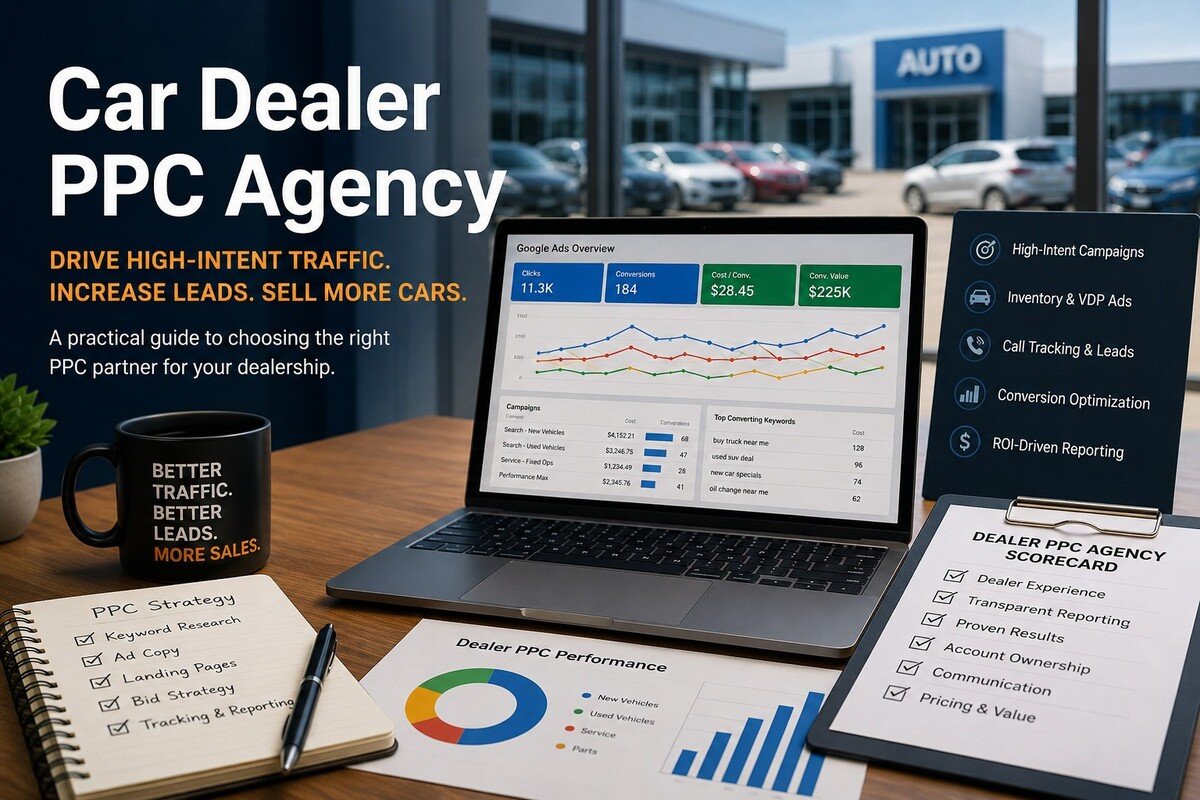
Automotive PPC RFP template helps dealerships and dealer groups compare paid search, inventory advertising and paid media vendors before budget is committed. Use this template when requesting proposals from automotive PPC agencies, dealer marketing platforms, website providers, inventory ad vendors or managed media teams.
Quick answer: a dealership PPC RFP should ask vendors to explain campaign structure, account ownership, conversion tracking, call tracking, inventory advertising, fixed-ops campaigns, budget pacing, landing-page alignment, CRM feedback, reporting and the first 90 days of work. The best responses show how paid media spend becomes qualified calls, forms, appointments, showroom opportunities and sold or serviced vehicles.
Use this before vendor calls: copy the sections below into your RFP document, then score each vendor against ownership, structure, measurement, inventory fit, reporting quality and dealer-specific execution.
Automotive PPC RFP Sections
| RFP section | What to ask | Why it matters |
|---|---|---|
| Dealership context | Rooftops, brands, markets, monthly paid media budget, sales/service mix and current vendor stack | Vendors need operating context before recommending structure or budget. |
| Campaign structure | How the vendor separates brand, non-brand, model, used-car, service, competitor and remarketing intent | Weak structure hides waste and makes lead quality difficult to judge. |
| Inventory advertising | How campaigns support used inventory, aged units, priority models, SRPs, VDPs and feed quality | Dealer PPC should reflect real inventory priorities, not generic traffic goals. |
| Fixed-ops campaigns | How the vendor builds service, maintenance, recall, tire, parts and repair demand | Service demand can be a recurring revenue source and should not be an afterthought. |
| Conversion tracking | How calls, forms, chats, finance starts, trade-in starts, service bookings and appointment signals are tracked | Paid media reports are only useful when conversion actions are clean and meaningful. |
| CRM feedback | How appointment rate, show rate, sold feedback and lead quality influence optimization | Ad-platform conversions do not always equal dealership opportunities. |
| Reporting | What the monthly report includes and how it separates spend, clicks, calls, qualified opportunities and budget changes | Leadership needs decision-ready reporting, not vanity metrics. |
| Account ownership | Who owns ad accounts, audiences, conversion data, creative assets and historical reports | The dealership should avoid being locked out of its own paid media assets. |
| First 90 days | What the vendor will audit, fix, restructure, test and report during days 1–90 | The first quarter reveals whether the vendor has a real operating system. |
Dealer Information to Include in the RFP
- Number of rooftops, brands and markets.
- New, used and fixed-ops revenue priorities.
- Current monthly paid media budget by channel.
- Current website provider, CRM, call tracking and analytics setup.
- Current Google Ads, Microsoft Ads, Meta, YouTube, CTV or inventory advertising vendors.
- Known pain points: weak lead quality, high spend, poor service demand, aged inventory, bad reporting or poor account ownership.
- Business goals for the next 90 days and next 12 months.
- Internal approval, OEM/co-op and compliance constraints.
Core Vendor Questions
- How would you structure paid search for brand, non-brand, model, used inventory, service and competitor intent?
- How often do you review search terms, negatives, match types, geography, devices and ad schedules?
- How do you decide which campaigns should use SRPs, VDPs, service pages, finance pages, trade-in paths or dedicated landing pages?
- How do you support aged inventory, used-car priorities and VIN-level or inventory-aware advertising?
- How do you build fixed-ops campaigns for service, maintenance, recalls, parts and repairs?
- Which conversion actions do you count as primary and which are secondary?
- How do you track and judge phone-call quality?
- How do you use CRM feedback such as appointments, show rate and sold results?
- Who owns the ad accounts, conversion setup, audiences, creative files and reporting history?
- What would you change in the first 30, 60 and 90 days?
Automotive PPC RFP Scorecard
Score each vendor from 1 to 5 in every category. Weight the categories according to the dealership’s bottleneck. A store wasting spend should weight search-term control and reporting higher. A group with multiple rooftops should weight governance and budget allocation higher.
| Category | Weight | Strong response | Weak response |
|---|---|---|---|
| Dealership specialization | 10% | Understands inventory, fixed ops, SRPs, VDPs, OEM rules and CRM feedback | Uses generic local lead-gen language |
| Campaign structure | 15% | Separates major intent types and explains why | Blends everything into broad campaigns |
| Search-term control | 15% | Shows review cadence, negatives, exclusions and waste controls | Only talks about automated bidding |
| Inventory advertising | 10% | Connects spend to aged units, used inventory and priority models | Sends shoppers to generic pages |
| Fixed-ops PPC | 10% | Builds specific service and maintenance demand | Treats service as leftover budget |
| Conversion tracking | 10% | Separates calls, forms, chats, service bookings and quality signals | Counts every interaction as equal |
| CRM feedback loop | 10% | Uses appointment, show and sold feedback where available | Never leaves the ad platform |
| Reporting quality | 10% | Reports budget, waste, qualified opportunities and next actions | Reports clicks, impressions and CTR only |
| Account ownership | 5% | Dealer owns accounts, assets and history | Vendor keeps control of the account |
| First-90-day plan | 5% | Gives specific audit, cleanup, rebuild and reporting milestones | Promises results without a plan |
First-90-Day Requirements to Include
| Period | Required vendor output | Dealer review question |
|---|---|---|
| Days 1–15 | Account, tracking, search-term, spend, landing-page and CRM source audit | Where is paid media waste or measurement risk highest? |
| Days 16–30 | Tracking cleanup, intent separation, obvious waste reduction and first restructuring plan | What should change before more budget is added? |
| Days 31–60 | Campaign rebuilds, budget reallocations, landing-page tests and service/inventory improvements | Which changes are improving lead quality? |
| Days 61–90 | Qualified opportunity review, budget mix analysis and next-quarter roadmap | What should be cut, scaled or rebuilt next? |
Red Flags in Automotive PPC Proposals
- The proposal promises cheap clicks but does not define qualified opportunities.
- The vendor cannot explain campaign structure by intent.
- The proposal ignores search-term cleanup and negative keywords.
- Inventory advertising is described without SRPs, VDPs, aged units or feed quality.
- Fixed-ops PPC is missing or treated as a minor add-on.
- Call tracking is absent or all calls are counted as equal.
- CRM feedback, appointment quality and sold feedback are not mentioned.
- The vendor wants to own the ad account or conversion history.
- The reporting sample is mostly clicks, impressions, CTR and CPC.
- The first-90-day plan is vague.
How to Use This RFP Template
- Define the dealership’s main paid media bottleneck.
- Send the same RFP to each vendor.
- Require sample reports and a first-90-day plan.
- Score every response against the same categories.
- Ask finalists to walk through account ownership, tracking and reporting before discussing price.
- Compare the RFP results with the broader automotive PPC hub and dealer PPC report template.
Related Automotive Paid Search Resources
- Automotive PPC and Dealership Paid Search Hub
- Google Ads for Car Dealers
- Automotive Inventory Ads
- Dealer PPC Report Template
- How to Choose a Car Dealer Advertising Agency
- Car Dealership SEO Hub
Next step: turn this RFP into a downloadable worksheet, then use it as a lead magnet for dealership buyers comparing paid search vendors.
Frequently Asked Questions About Automotive PPC RFPs
What is an automotive PPC RFP?
An automotive PPC RFP is a request for proposal that dealerships use to compare paid search, inventory advertising and paid media vendors. It asks vendors to explain campaign structure, tracking, reporting, account ownership, first-90-day priorities and how paid media will support sales and service outcomes.
What should a dealership include in a PPC RFP?
A dealership should include rooftop count, brands, markets, budget, current vendor stack, website platform, CRM, call tracking, inventory priorities, service goals, compliance constraints and the main reason it is reviewing paid media vendors.
How should dealerships compare PPC proposals?
Dealerships should compare proposals using a consistent scorecard. The strongest proposals explain campaign structure, search-term control, inventory advertising, fixed-ops PPC, conversion tracking, CRM feedback, reporting quality, account ownership and the first 90 days of work.
Why does account ownership matter in a PPC RFP?
Account ownership matters because the dealership should retain access to its ad accounts, conversion data, audiences, creative assets and historical performance. Losing ownership makes vendor transitions harder and weakens internal marketing control.
Should PPC RFPs include fixed-ops campaigns?
Yes. Fixed-ops campaigns can generate service calls, maintenance demand, recall appointments and retention opportunities. A dealership should ask how each vendor would structure and measure service paid search, not just sales campaigns.
What is the biggest red flag in an automotive PPC proposal?
The biggest red flag is a proposal that talks about clicks, impressions and low CPC without explaining lead quality, search-term control, phone-call quality, CRM feedback, account ownership or how the first 90 days will reduce waste.