
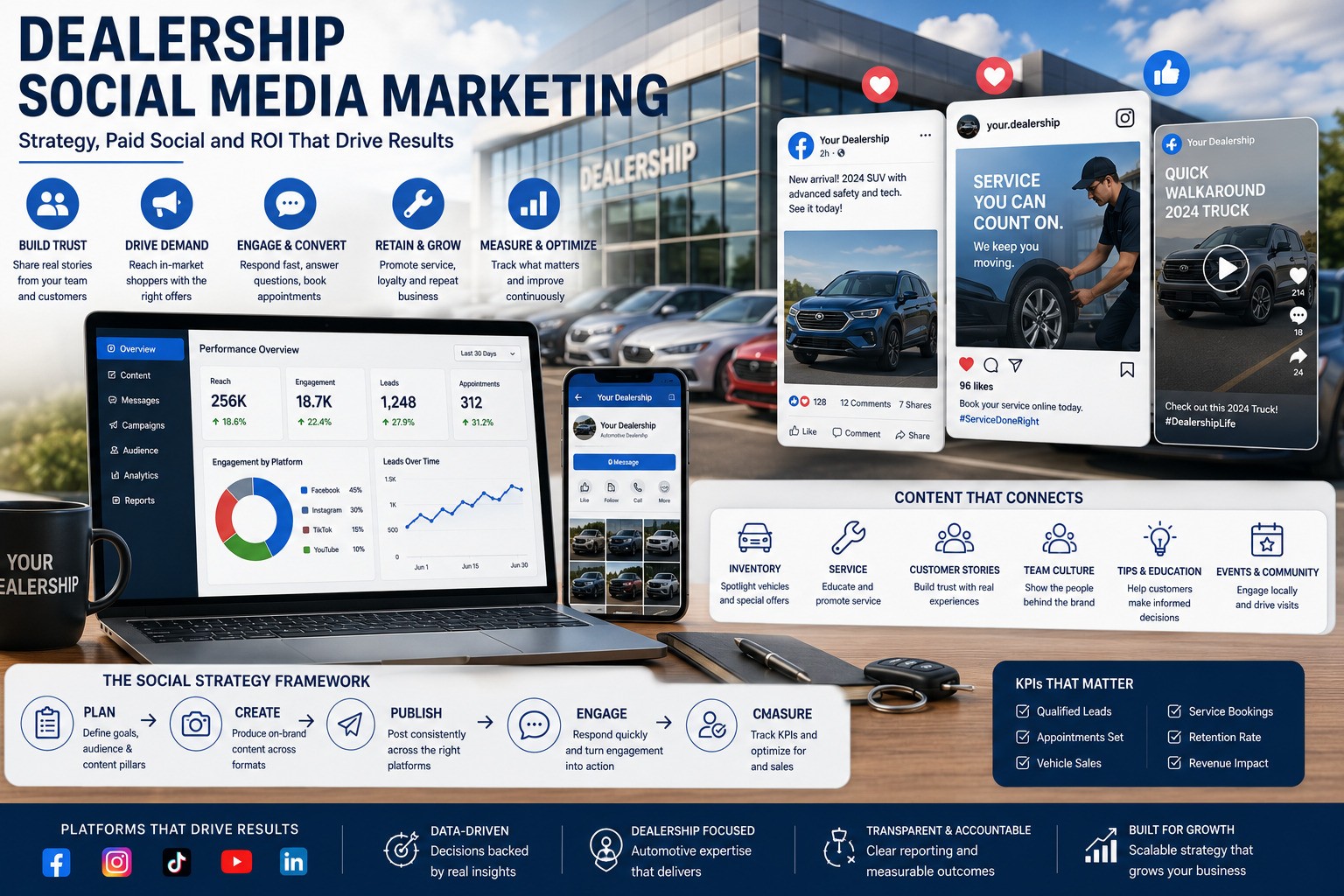
Dealership social media marketing is the coordinated use of organic content, paid social, video, inventory creative, direct-message lead handling and first-party audiences to create trust, qualified demand, service retention and measurable dealership outcomes.
A 2026 operating guide for Facebook, Instagram, TikTok, YouTube, inventory catalogs, short-form video, lead routing, CRM audiences, paid-social measurement, pricing and provider selection.
Quick answer: separate organic publishing from paid acquisition, choose platforms by job, publish real dealership proof consistently, treat comments and DMs as accountable customer conversations, keep inventory feeds and landing pages current, and return qualified CRM or service outcomes to campaign decisions. Likes and reach are diagnostic signals; appointments, delivered units and completed repair orders determine business value.
2026 dealership social media demand
Google Ads Keyword Planner data for the United States, English language and Google Search shows meaningful commercial demand for dealership-specific social media expertise.
| Keyword | Average monthly searches | High top-of-page bid |
|---|---|---|
| dealership social media marketing | 140 | $39.17 |
| car dealership social media marketing | 140 | $39.17 |
The combination of page-one search opportunity and high advertiser bids makes this a commercial operating topic. A useful guide has to show how social activity connects with inventory, leads, CRM feedback and sold/service outcomes.
Dealership social media decision routes
| Need | Best route | Decision supported |
|---|---|---|
| Coordinate wider strategy | Automotive marketing strategy | Budget, channel roles and business outcomes |
| Build repeatable editorial content | Automotive content marketing | Topics, production and reuse |
| Build video capability | Automotive video marketing | Walkarounds, explainers and video operations |
| Promote live inventory | Automotive inventory ads | Feed truth, VDPs and sold-unit controls |
| Connect leads and audiences | Automotive CRM | Routing, lifecycle segments and outcome feedback |
| Protect public trust | Dealership reputation management | Reviews, complaints and recovery |
| Compare agencies | Dealer agency selection | Proof, ownership and contract controls |
Organic social and paid social have different jobs
| Lane | Primary job | Useful evidence | Failure signal |
|---|---|---|---|
| Organic | Build local familiarity, trust, expertise and reusable creative | Saves, shares, useful comments, profile actions, branded demand and proven content themes | Posting volume with no identifiable audience or business role |
| Paid prospecting | Create qualified incremental demand | Qualified traffic, leads, appointments and downstream outcomes | Cheap reach or forms with weak CRM quality |
| Paid retargeting | Reconnect with known shoppers | Qualified return visits, leads and progression | High frequency with falling response |
| Lifecycle | Support service, equity, lease maturity and reactivation | Bookings, responses, retention and completed outcomes | Broad customer uploads with weak consent or segment logic |
Choose social platforms by dealership job
| Platform | Strong dealership jobs | Operating requirement |
|---|---|---|
| Facebook + Instagram | Local reach, inventory catalogs, lead forms, retargeting, service, video and messaging | Accurate feeds, audience controls, clear conversion paths and CRM feedback |
| TikTok | Discovery, authentic short-form video, staff expertise and model education | Consistent native creative and accountable comment/DM handling |
| YouTube | Vehicle education, comparisons, explainers and video remarketing | Useful topics, strong retention and clear next-step paths |
| Recruiting, dealer-group leadership, vendor/B2B visibility and fleet topics | Clear professional audience and business purpose |
Platform count is a capacity decision. A dealership should master the channels it can consistently staff, moderate, measure and feed with useful creative.
Build a dealership content operating system
| Content family | Examples | Business role |
|---|---|---|
| Inventory in motion | Walkarounds, fresh trades, trim comparisons, feature demos | Vehicle discovery and VDP demand |
| Education | Finance process, trade-ins, maintenance, ownership questions | Reduce buyer anxiety and create trust |
| Social proof | Customer deliveries, staff expertise, community involvement | Reduce perceived dealership risk |
| Service/fixed ops | Seasonal service, technician explanations, declined-work education | Service demand and retention |
| People/culture | Staff stories, behind-the-scenes, recruiting | Familiarity, employer brand and local identity |
Plan monthly around business priorities, capture content in repeatable weekly production windows, approve offers quickly, publish by purpose and reuse proven creative across organic posts, paid ads, email, landing pages and sales follow-up.
Comments, DMs and Story replies need a lead-response contract
Social platforms are customer-contact surfaces. A buyer who asks about availability, price, trade, service or an appointment needs accountable routing just like a web lead or phone call.
| Social event | Required owner | Required system action | Management metric |
|---|---|---|---|
| Vehicle availability question | Sales/BDC | Verify inventory, respond and create CRM record when lead intent is present | Median first-response time + qualified conversation rate |
| Direct-message lead | Sales/BDC | Preserve conversation, consent and accountable follow-up | DM-to-appointment rate |
| Service question | Service team | Answer or route to booking path | DM/comment-to-booking rate |
| Complaint | Customer-care manager | Public acknowledgement + private recovery workflow | Escalation and closure time |
| Pricing/finance dispute | Manager/compliance owner | Verify facts before publishing response | Resolved case with approved record |
2026 paid-social format map
| Format | Best use | Quality gate |
|---|---|---|
| Vehicle/catalog ads | Promote current inventory dynamically | Feed accuracy, sold-unit suppression, current VDP and local geography |
| Short-form video ads | Vehicle/model discovery and proof | Native creative, useful hook and matched landing path |
| Lead forms | Low-friction enquiry capture | Consent, routing, response SLA and CRM sync |
| Messaging ads | Start direct buyer conversations | Human ownership, transcript retention and escalation |
| Retargeting | Reconnect with recent site/video/social engagers | Suppression, frequency and next-step relevance |
| Service/lifecycle campaigns | Bookings, reactivation and owner communication | Permitted first-party audiences and completed-RO feedback |
Meta inventory, Advantage+ and conversion controls
Meta supports automation-first lead campaigns, catalog-based inventory advertising and server-side event feedback. Dealership governance should still define geography, exclusions, conversion quality, lead routing, feed freshness and human ownership.
- Advantage+ leads: optimize only toward lead events the dealership can actually work and evaluate.
- Vehicle catalogs: keep inventory, price and VDP destinations current; suppress sold or unavailable units.
- Conversions API: return approved qualified-lead, appointment, sold or service signals where the dealership has a compliant implementation.
- Audience controls: document geography, language, first-party audience eligibility and suppression.
Review current Meta documentation for Advantage+ leads, Advantage+ audience and Conversions API.
Video handoff: from view to dealership action
Video should answer a useful shopper question and preserve context when the viewer takes the next step. Unit-level video should link to a current VDP; model education should lead to relevant inventory; service explainers should reach a booking path; DMs generated by video need the same lead-response contract described above.
Measure video completion as a creative diagnostic, then inspect qualified traffic, conversations, appointments and assisted business outcomes before scaling the format.
CRM audiences and first-party data governance
Useful social segments can include recent website visitors, unsold shoppers, service customers, lease-maturity cohorts, equity opportunities and reactivation groups. Define how every segment is created, refreshed, suppressed and removed. Dealer-owned customer data should remain governed by consent, privacy, platform terms and documented access controls.
Social media measurement from delivery to sold outcome
| Layer | Metrics | Decision |
|---|---|---|
| Delivery | Reach, impressions, frequency, spend | Did the intended audience receive the campaign? |
| Creative | Watch time, completion, saves, shares, CTR | Which messages/formats deserve another test? |
| Conversation | DMs, comments with lead intent, response time | Is the store turning social interaction into accountable dialogue? |
| Opportunity | Qualified leads, calls, forms, service bookings | Is social creating useful dealership activity? |
| Business outcome | Appointments, shows, delivered units, completed ROs, cost per outcome | Should budget scale, hold or move? |
Use consistent UTM taxonomy and CRM source definitions. Google Analytics documents campaign URL parameters in its campaign URL guidance.
How to verify social-media claims without relying on a vendor case study
Published case studies can be useful context, but they rarely isolate one channel cleanly. A dealership can demand stronger proof by requiring every social-media test to be reproducible from its own systems.
| Proof field | Required definition | Reason |
|---|---|---|
| Baseline | Named pre-test period, inventory/service conditions and existing channel mix | Prevents normal demand changes from being credited to the test |
| Denominator | Spend, eligible audience, units, leads or service opportunities used in the rate | Makes percentages auditable |
| Primary outcome | Qualified conversation, appointment, delivered unit or completed RO under one written definition | Stops vanity metrics from becoming success criteria |
| Matchback | UTM/source plus CRM/DMS/service reconciliation and unmatched-record count | Shows how platform activity connects with dealership outcomes |
| Change log | Creative, audience, budget, feed and landing-page changes with dates | Shows what actually changed during the result period |
| Incrementality check | Holdout, geo split, time split or declared baseline comparison when feasible | Separates additional demand from demand likely captured anyway |
| Decision rule | Scale, hold, rebuild or stop threshold agreed before the test | Prevents retrospective success stories |
Vendor proof test: ask the provider to reproduce one claimed win from the dealership’s own ad account, CRM and sales or service records. If the numerator, denominator, match keys, attribution window and campaign changes cannot be reconstructed, treat the claim as marketing evidence rather than decision-grade evidence.
Paid-social economics and budget gate
Judge incremental paid-social spend with fully loaded cost and downstream quality. Media-only CPL can hide management, creative, feed, platform and labor costs.
| Input | Dealer check |
|---|---|
| Media spend | Actual auction/platform spend controlled by the dealer |
| Management + production | Agency/platform fees, filming, editing and creative |
| Qualified outcomes | CRM-qualified leads, appointments, delivered units or completed ROs |
| Incremental contribution | Incremental outcomes × contribution per outcome − fully loaded program cost |
In-house, agency, platform or hybrid?
| Model | Best fit | Buyer proof |
|---|---|---|
| In-house | Store has content access plus paid-media/analytics skill | Production capacity, response ownership and measurable campaign expertise |
| Automotive agency | Dealer needs strategy, production, paid social and reporting | Inventory, CRM, service and outcome examples |
| Platform | Internal team needs workflow, publishing or reporting infrastructure | Data ownership, integrations and real operating adoption |
| Hybrid | Group wants local voice plus specialist execution | Explicit roles, approvals, account ownership and handoff |
Social media provider scorecard
- Dealer-specific organic and paid-social expertise.
- Current Meta/catalog/feed capability.
- Video production process and dealer asset ownership.
- DM/comment routing and community-management standards.
- CRM/CAPI/offline outcome feedback.
- Offer/compliance approval workflow.
- Dealer-owned accounts, audiences, pixels and history.
- Transparent media, management, production and technology costs.
- Ability to reproduce claimed results from dealer-owned source systems.
- 90-day implementation with evidence gates.
Pricing, finance, testimonials and disclosure controls
Dealership social content can include prices, finance terms, lease offers, testimonials and time-limited claims. Every offer needs a source record, approval owner, visible material terms, publication/expiration dates and takedown process.
In March 2026, the FTC warned 97 dealership groups about advertised prices that may omit mandatory fees, rely on unavailable discounts, require dealer financing or add-ons, or promote unavailable vehicles. Review the FTC’s automotive pricing warning and Consumer Reviews and Testimonials Rule guidance.
First 90 days of a dealership social program
| Period | Work | Evidence gate |
|---|---|---|
| Days 1–15 | Audit profiles, account ownership, content, audiences, feeds, tracking, lead routing and baseline | Ownership map + bottleneck list |
| Days 16–30 | Define platform jobs, content families, paid formats, DM routing, approvals and source taxonomy | Operating plan + calendar |
| Days 31–60 | Launch organic cadence and controlled paid/inventory/video tests | Creative, audience and lead-quality evidence |
| Days 61–90 | Reconcile tests to CRM/DMS or service outcomes and evaluate production capacity | Scale, hold, rebuild or stop decision under the predeclared proof protocol |
Methodology and sources
This September 2026 revision combines live U.S. Keyword Planner demand, current dealership social-media SERP research, official Meta/Google measurement documentation and FTC automotive advertising guidance.
- Demand: Google Ads Keyword Planner, United States, English, Google Search, accessed September 6, 2026.
- Current-market review: current 2026 dealership social-media guides were compared for organic/paid separation, platform roles, inventory advertising, video, messaging, CRM feedback and measurement.
- Primary platform sources: Meta Advantage+ leads, Advantage+ audience and Conversions API; Google Analytics campaign URL guidance.
- Compliance: FTC March 2026 automotive pricing warning and current review/testimonial guidance.
Frequently asked questions about dealership social media marketing
What is dealership social media marketing?
It is the coordinated use of organic content, paid social, video, inventory creative, direct-message lead handling and first-party audiences to support dealership trust, demand, retention and measurable outcomes.
Should a dealership prioritize organic or paid social?
Use organic content for trust, local proof and creative learning. Use paid social for controlled reach, prospecting, retargeting, inventory, leads and lifecycle campaigns. The mix should follow the dealership’s constraint and ability to measure downstream quality.
Which social platforms matter most for dealerships?
Facebook and Instagram commonly support local paid and organic programs, TikTok supports short-form discovery, YouTube supports deeper video education and LinkedIn serves recruiting and B2B roles. Choose platforms by job and operating capacity.
Should dealership DMs be treated as leads?
When a message contains real vehicle, trade, finance, service or appointment intent, assign an owner, preserve the conversation and create accountable CRM or service follow-up.
What do vehicle catalog ads require?
They require accurate inventory, current VDP destinations, sold-unit suppression, geographic controls and rapid correction of feed or pricing mismatches.
What dealership social video works best?
Useful video answers a real shopper or owner question: vehicle walkarounds, comparisons, service explanations, trade/finance education, staff expertise and customer proof.
How should dealerships measure social media ROI?
Use reach and engagement for diagnosis, then evaluate qualified conversations, leads, appointments, delivered units, completed repair orders and fully loaded cost per outcome.
How much does dealership social media marketing cost?
Total cost can include media, management, production, feed/data services, software and internal labor. Compare complete operating cost with qualified downstream outcomes.
How should dealerships use Conversions API?
Use an approved implementation to return trustworthy qualified-lead, appointment, sold or service events when consent, identifiers, source mapping and governance are ready.
How should a dealership choose a social media provider?
Require dealer-specific organic and paid expertise, inventory/feed competence, video operations, lead routing, CRM feedback, compliance controls, transparent costs, dealer-owned accounts and a measurable 90-day plan.