
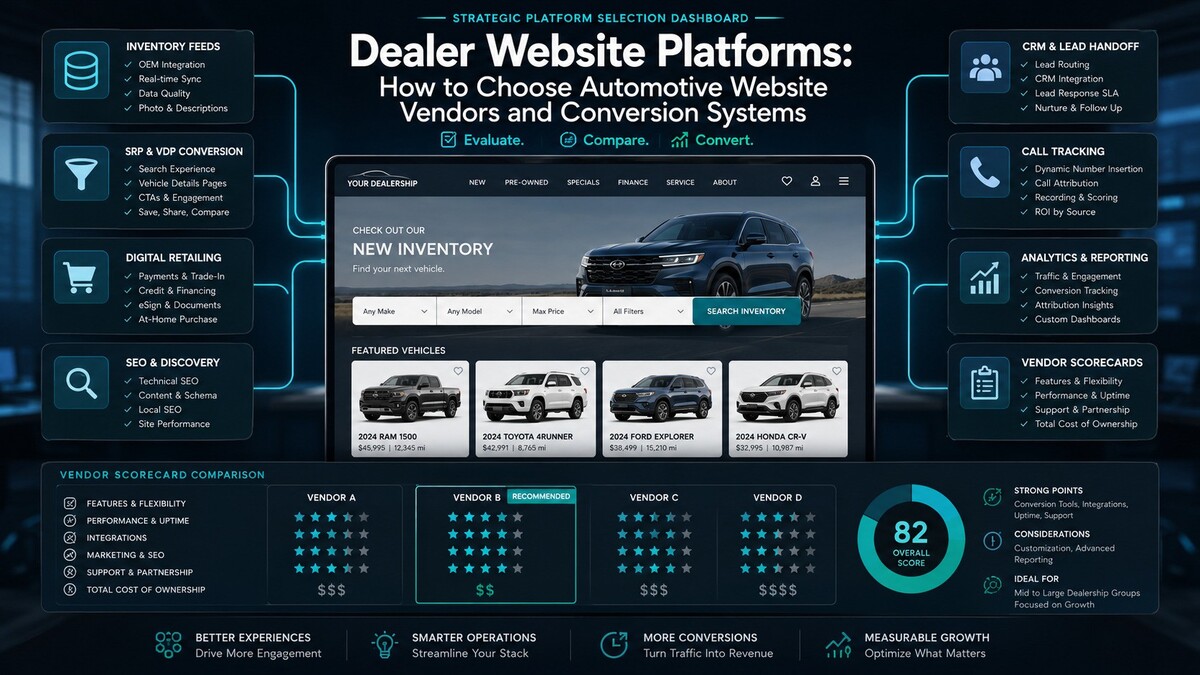
Dealer websites, conversion, inventory merchandising and vendor selection
Choose the website platform that controls inventory, conversion, CRM handoff and ownership risk
Dealer website systems are the foundation of dealership digital performance. Strong dealership website platforms support inventory visibility, SRP and VDP conversion, lead quality, CRM handoff, digital retailing, service demand, local SEO, analytics and vendor accountability.
Weak site control can break campaign attribution, hide lead context, delay inventory merchandising and leave the dealership dependent on vendor-owned analytics, scripts or content access. This guide helps dealership operators, dealer groups and marketing teams evaluate automotive website vendors with a practical scorecard, demo checklist, buyer questions and a first-90-day implementation lens.
Quick answer
The best dealer website platform is the one that proves inventory accuracy, fast SRP and VDP performance, clean CRM handoff, SEO control, owned analytics access and a documented launch plan before the contract is signed.
Reviewed by the Automotive Digital Marketing Editorial Team. Last updated June 10, 2026. Evaluation criteria include inventory reliability, SRP and VDP performance, CRM handoff, SEO control, analytics ownership, support model and launch risk. See how ADM evaluates dealer website platforms.
What is a dealer website platform?
A dealer website platform is the automotive website system a dealership uses to publish inventory, merchandise vehicles, build landing pages, capture leads, support calls and forms, connect digital retailing tools, pass shopper activity into CRM and measure performance.
For most dealerships, the website is the conversion layer between demand generation and sales or service follow-up. Vendor decisions should be evaluated by how well the system supports dealership operations: inventory feeds, SRP and VDP speed, mobile UX, lead routing, SEO control, compliance, OEM requirements, analytics, vendor access and account ownership.
Start Here: Dealer Website Platform Decision Routes
| Decision | Best starting point | What to inspect |
|---|---|---|
| Need to compare website vendors | Dealer vendor selection | Ownership, implementation, reporting, support model, first-90-day proof. |
| Need more organic visibility | Dealer website SEO | SRP and VDP indexation, model pages, service pages, technical SEO and local visibility. |
| Need better paid media conversion | Automotive PPC | Landing pages, call tracking, lead quality, campaign-to-page alignment and source reporting. |
| Need stronger inventory merchandising | Automotive inventory ads | Inventory feed quality, VIN-level pages, aged units, VDP content and merchandising speed. |
| Need better CRM handoff | Lead management | Form routing, call capture, lead source clarity, BDC response and sales feedback loops. |
| Need planning templates | Website vendor scorecard and RFP worksheets | RFP questions, vendor scorecards, budget planning and ownership checks. |
Core dealer website platform categories
- Full-service dealer website platforms: website hosting, templates, inventory pages, landing pages, OEM support, analytics and vendor support.
- Website plus digital retailing systems: systems that connect finance, trade-in, payments, shopper workflows and CRM handoff.
- Inventory merchandising systems: site tools focused on SRPs, VDPs, photos, descriptions, specials, aged inventory and VIN-level conversion.
- SEO-focused website systems: vendor systems that emphasize crawlability, content control, local pages, schema, site speed and technical SEO access.
- Enterprise dealer group platforms: multi-rooftop controls, shared design systems, regional reporting, brand governance and permission management.
- Conversion and personalization layers: chat, trade-in, finance, service scheduling, offers, popups, personalization and AI-assisted shopping paths.
Dealer website vendor categories dealers commonly compare
Dealerships often compare full-service site providers, OEM-approved website programs, digital retailing-connected systems, inventory merchandising tools and conversion layers. Evaluate each vendor by operating fit: inventory reliability, CRM handoff, SEO control, analytics ownership, support model and migration plan.
| Vendor category | Typical dealer reason to consider it | What to verify before signing |
|---|---|---|
| OEM-approved website provider | Brand compliance, co-op alignment, familiar templates. | SEO control, content flexibility, analytics ownership and migration terms. |
| Conversion-focused website system | Lead quality, VDP engagement, call/form performance. | Real CRM test leads, mobile VDP speed and source reporting. |
| Enterprise dealer group platform | Multi-rooftop control, governance, shared reporting. | Permissions, store-level SEO, regional dashboards and rollout support. |
| Inventory merchandising system | Better SRPs, VDPs, aged inventory and VIN-level performance. | Feed speed, pricing accuracy, photos, sold-unit handling and campaign alignment. |
100-point dealer website platform scorecard
Use this weighted scorecard to compare dealer website vendors beyond design. The highest-weighted criteria are the areas most likely to affect traffic quality, conversion, lead context, vendor accountability and ownership risk.
| Criteria | Weight | Why it matters | What good looks like |
|---|---|---|---|
| Inventory feed reliability | 15 | Inventory accuracy affects SEO, ads, merchandising and shopper trust. | Clean VIN data, fast updates, accurate pricing, photos, incentives and sold-unit handling. |
| SRP and VDP conversion | 15 | Most dealer website outcomes depend on shopper paths from search or ads into vehicle pages. | Fast pages, clear CTAs, useful vehicle content, strong mobile UX and minimal friction. |
| SEO control | 12 | Dealers need control over titles, copy, internal links, schema, indexation and local pages. | Editable page elements, crawlable inventory, clean canonicals, fast templates and content flexibility. |
| CRM and lead routing | 12 | Website leads lose value if they arrive with poor source detail or slow handoff. | Clear routing, source metadata, call tracking, form QA and CRM field consistency. |
| Analytics and attribution | 12 | Leadership needs to know which pages, campaigns and vendors create qualified opportunities. | GA4 support, call/form tracking, event clarity, clean UTM handling and source-to-sale alignment. |
| Digital retailing fit | 8 | Finance, trade-in and payment paths can increase conversion or create friction. | Integrated flows, transparent handoff, CRM notes and mobile-first UX. |
| Content flexibility | 8 | Dealers need pages for models, service, specials, local markets, fixed ops and campaigns. | Reusable page modules, landing page control, service content, specials management and approvals. |
| Vendor and data ownership | 8 | Dealers should avoid lock-in around domains, accounts, analytics and content. | Dealer-owned accounts, export paths, clear offboarding, documentation and admin access. |
| Support model | 5 | Website vendors affect launch, daily marketing execution, reporting and optimization. | Named support, ticket accountability, SLA clarity and QA process. |
| First-90-day implementation | 5 | Launch quality determines whether the site stack creates momentum or chaos. | Discovery, migration plan, SEO QA, inventory QA, tracking setup, CRM testing and launch checklist. |
Dealer website platform selection checklist
- Confirm who owns the domain, analytics, tag manager, call tracking, content and lead data.
- Test inventory feed speed, pricing accuracy, photo handling, incentives and sold-unit removal.
- Review SRP and VDP mobile performance on real inventory pages.
- Send CRM test leads from forms, calls, chat and digital retailing paths.
- Check SEO control for titles, headings, copy, schema, canonicals, redirects and indexation.
- Require a written migration plan with redirects, tracking, CRM QA and launch monitoring.
- Score the first-90-day plan before signing the contract.
Which dealer website platform type fits which dealership?
| Dealership situation | Best-fit vendor system | Selection priority |
|---|---|---|
| Single rooftop with weak lead quality | Conversion-focused website system | VDP UX, forms, calls, CRM context and source reporting. |
| Dealer group with inconsistent websites | Enterprise dealer group platform | Governance, permissions, templates, reporting and multi-rooftop controls. |
| Store losing organic visibility | SEO-focused website system | Crawlability, content control, indexation, page speed and local/service pages. |
| High inventory spend with weak VDP engagement | Inventory merchandising system | Feed quality, VIN pages, aged units, photos, pricing and campaign landing pages. |
| Digital retailing rollout | Website plus digital retailing system | Payment flow, trade-in, finance, CRM handoff and shopper progress data. |
When should a dealership switch website platforms?
A dealership should consider switching site providers when inventory pages are slow, CRM handoff is unclear, SEO control is limited, reporting is vendor-owned, digital retailing creates friction, support is slow or migration risk is lower than the cost of staying on the current system.
- SRPs and VDPs are slow on mobile.
- Lead source detail is weak inside CRM.
- The dealer cannot control titles, copy, schema, redirects or landing pages.
- Inventory updates are delayed or inaccurate.
- Analytics, tag manager or call tracking access is controlled by the vendor.
- Dealer group reporting requires manual work across rooftops.
How to select and validate a dealer website platform
- Define the business problem. Decide whether the store needs better SEO, conversion, inventory merchandising, CRM handoff, digital retailing, reporting or multi-rooftop control.
- Map website requirements. List inventory feed needs, SRP and VDP requirements, landing pages, SEO controls, CRM routing, analytics events and support expectations.
- Score the vendor shortlist. Compare vendors by inventory reliability, conversion quality, SEO control, CRM handoff, analytics, ownership, support and launch plan.
- Review migration risk. Require a migration plan covering redirects, content, page speed, inventory QA, CRM testing and launch monitoring.
- Validate the first 90 days. Confirm discovery, staging review, implementation QA, launch reporting and post-launch optimization.
What to require in a dealer website platform demo
- Live inventory update example, including pricing, photos, incentives and sold-unit handling.
- SRP and VDP mobile speed review using live inventory pages, mobile screenshots and performance data.
- CRM test lead with source fields, shopper context and routing proof.
- GA4 event and call tracking proof for forms, calls, chat and digital retailing and high-value page actions.
- SEO control screen for titles, copy, internal links, schema, canonicals, indexation and redirects.
- Redirect and migration sample plan with launch QA steps and rollback process.
- Admin access, ownership documentation, export options and offboarding terms.
Dealer group website platform requirements
Dealer groups should evaluate website systems differently from single rooftops because governance, reporting and operational consistency matter across stores.
- Multi-rooftop permissions: location-level access, corporate controls and role-based publishing rights.
- Brand and OEM templates: shared components that still allow store-level specials, inventory and service content.
- Location SEO: market pages, store pages, service pages, schema and local content controls by rooftop.
- Regional reporting: roll-up views for traffic, calls, forms, appointments, source quality and vendor performance.
- CRM standardization: consistent source fields, routing logic and lead quality reporting across locations.
- Inventory rules: shared merchandising standards with store-level flexibility for aged units and local campaigns.
Questions to ask dealer website vendors
- Who owns the domain, analytics, tag manager, call tracking, content, media and lead data?
- How often does inventory update, and how are pricing, incentives, sold vehicles and photos handled?
- Can the dealership control title tags, meta descriptions, headings, copy, internal links, schema and landing pages?
- How are SRPs, VDPs, model pages, service pages and specials pages structured for SEO?
- What happens to URL structure, redirects, page speed, schema and indexation during migration?
- How are website forms, phone calls, chats and digital retailing events passed into CRM?
- Which conversion events are tracked by default, and which require extra configuration?
- Can dealer groups manage multiple rooftops, locations, brands, permissions and regional reporting?
- What is included in support, what is billable, and how quickly are urgent issues resolved?
- What proof can the vendor show for inventory visibility, lead quality or conversion lift?
Common mistakes when choosing dealer website platforms
- Choosing a vendor by design mockups before testing inventory, CRM, SEO and analytics controls.
- Reviewing demo pages instead of real SRPs, VDPs, forms, calls and mobile shopping paths.
- Accepting vendor-owned analytics, tag manager, call tracking or content access.
- Ignoring migration risk until launch week.
- Comparing form volume without checking appointment quality, show rate or sold/service outcomes.
- Letting digital retailing, chat, trade-in and website forms create separate shopper records inside CRM.
Website migration risks dealers should control
A dealer website migration can improve conversion and visibility, but it can also damage traffic, lead routing and reporting when the launch is rushed. The dealership should require a written migration plan before switching systems.
- SEO loss: missing redirects, changed URLs, blocked inventory pages, broken canonicals or lost local/service content.
- Tracking gaps: missing GA4 events, broken call tracking, inconsistent UTM handling or incomplete conversion mapping.
- CRM disruption: forms, chats and digital retailing leads arriving without useful source or shopper context.
- Inventory problems: delayed feeds, incorrect prices, missing photos, sold units remaining live or new units not publishing.
- Vendor lock-in: unclear ownership of content, analytics, scripts, lead data, landing pages or domain access.
- Slow launch QA: mobile issues, broken CTAs and page speed problems.
First 90 days after choosing a dealer website platform
| Phase | Dealer priority | Evidence to request |
|---|---|---|
| Days 1-15 | Discovery, access, inventory feed review, analytics audit and CRM requirements. | Access checklist, migration plan, tracking map and implementation owner. |
| Days 16-45 | Build templates, migrate content, test inventory, configure forms and map redirects. | Staging review, redirect file, inventory QA, CRM test leads and page speed checks. |
| Days 46-60 | Launch with SEO, analytics, conversion and CRM QA. | Launch checklist, conversion event proof, call/form testing and error monitoring. |
| Days 61-90 | Optimize SRPs, VDPs, specials, landing pages, content, reporting and vendor workflow. | First performance report, issues log, next-quarter plan and source-quality review. |
Dealer website platform red flags
- The vendor focuses on design but cannot explain inventory feed, SEO, CRM or analytics details.
- The system does not provide clear ownership of content, tracking, lead data and offboarding terms.
- Reporting emphasizes sessions and form counts but not calls, appointments, show rate or sold/service outcomes.
- Migration planning does not include redirects, staging QA, inventory QA, CRM testing and conversion tracking.
- The vendor cannot describe how digital retailing, chat, trade-in, finance and website forms are connected.
- Dealer groups cannot manage rooftops, brands, permissions and reporting without manual workarounds.
How dealer website platforms fit the dealership marketing system
The website is the conversion layer for nearly every channel. SEO brings shoppers into model, service, local and inventory pages. PPC and inventory ads send shoppers to SRPs, VDPs and campaign landing pages. Reputation and Google Business Profile send local shoppers into location and service paths. CRM, AI and lead management determine whether those interactions turn into appointments and revenue.
Website vendor selection is a marketing operations, data ownership, vendor accountability and sales-process decision.
How ADM evaluates dealer website platforms
ADM’s editorial team evaluates dealer website platforms by dealership operating fit: inventory feed reliability, SRP and VDP conversion, SEO control, CRM handoff, analytics, digital retailing integration, ownership terms, support model and first-90-day implementation proof.
Next decisions after choosing a dealer website platform
After the website platform decision, the next operational choices usually involve content, customer data, reputation, AI workflows and generative search visibility.
Dealer Website Platform FAQ
What should a dealership look for in a website platform?
A dealership should evaluate inventory feed quality, SRP and VDP conversion, mobile speed, SEO control, CRM handoff, analytics, digital retailing fit, vendor support, account ownership and the first-90-day implementation plan.
Are dealer website platforms only about design?
Design is one part of the system. The website also controls conversion, inventory, lead capture, analytics and vendor integrations.
How should dealers compare website vendors?
Dealers should compare vendors with a scorecard that includes dealership fit, site control, inventory reliability, SEO flexibility, lead routing, reporting quality, support model, contract terms and migration risk.
What is the biggest risk when switching dealer website platforms?
The primary risks are SEO loss, broken tracking, CRM disruption, inventory errors and unclear ownership of content or analytics.
Should dealer groups evaluate website platforms differently from single rooftops?
Dealer groups should evaluate multi-rooftop governance, brand controls, permissions, regional reporting, shared templates and the ability to standardize tracking and CRM workflows across stores.
How does a dealer website platform affect paid media?
The website affects paid media by controlling landing page speed, form friction, call tracking, inventory page quality, offer clarity, conversion events and the accuracy of source reporting.