
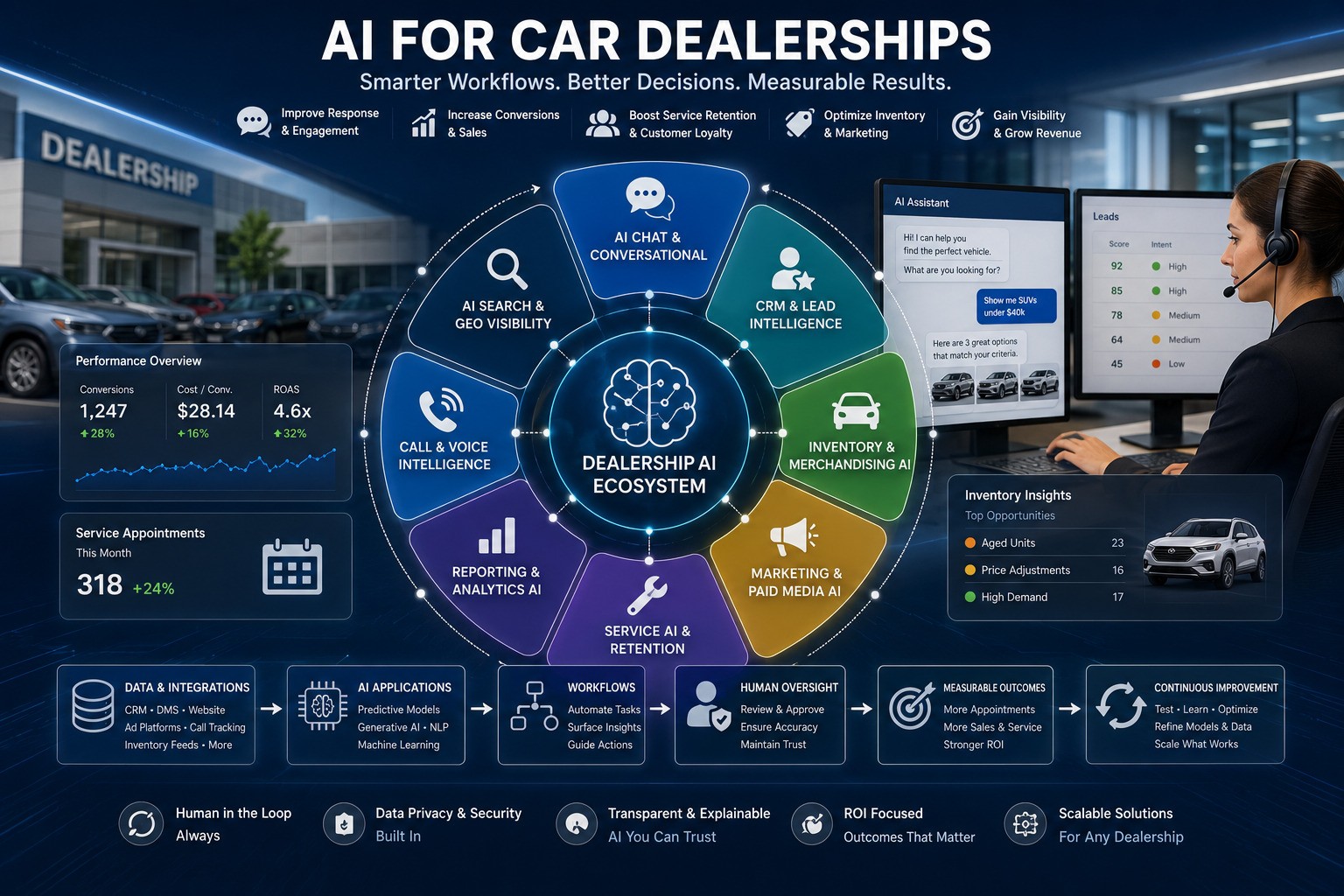
AI for car dealerships can improve lead response, CRM follow-up, inventory merchandising, service retention, marketing production and reporting—but only when the technology is tied to a defined workflow, reliable data, human oversight and a measurable business outcome.
This guide covers artificial intelligence in automotive retail: dealerships, dealer groups, BDC teams, marketing departments and vendor-selection teams. It does not focus on autonomous vehicles, manufacturing systems or vehicle engineering. The goal is to help dealer operators decide where dealership AI fits, which category of tool to evaluate, what integrations matter and how to prove value before expanding a pilot.
Quick answer: the best dealership AI program starts with one bottleneck, one accountable owner and one baseline KPI. A store should not buy “AI” as a vague capability. It should buy a clearly governed improvement to a specific process such as after-hours response, lead prioritization, VDP content quality, service reactivation or reporting accuracy.
Evaluating dealership AI? Use the route table below to identify the use case first. Then compare products by workflow fit, integrations, data rights, human controls, implementation requirements and 90-day evidence.
Choose the Right Dealership AI Route
| Need | Best starting point | What the solution should improve |
|---|---|---|
| Faster shopper response | AI chat for car dealers | Response speed, qualification, appointment routing and handoff context. |
| Better lead prioritization | CRM AI for dealerships | Next-best action, stale-lead recovery, lifecycle outreach and sales adoption. |
| Stronger vehicle merchandising | Inventory AI | VDP descriptions, feature accuracy, aged-unit promotion and content QA. |
| Visibility in AI-assisted search | Automotive GEO | Clear entities, useful answers, citation-ready content and technical discoverability. |
| Vendor and software evaluation | Automotive AI vendors | Product fit, pricing model, integrations, governance and support. |
| Formal procurement | AI marketing RFP template | Comparable proposals, data terms, pilot scope, KPIs and exit rights. |
What Is AI for Car Dealerships?
AI for car dealerships is the use of machine learning, generative AI, conversational systems, predictive analytics and workflow automation to support dealership marketing, sales, BDC, service and management processes. The software may draft, classify, summarize, score, recommend, personalize or automate—but dealership staff remain responsible for customer experience, compliance, pricing accuracy and final business decisions.
Dealership AI is not one product category. A dealer may encounter AI inside a CRM, website platform, chat product, call-tracking system, CDP, inventory tool, advertising platform, reputation platform, service scheduler or reporting suite. The useful question is not “Do we need AI?” It is “Which workflow needs improvement, and what evidence would prove that this system improved it?”
AI, Predictive Models and Automation: What Dealers Are Actually Buying
Dealership technology often uses the word “AI” for several different capabilities. Buyers should separate rule-based automation from predictive, generative, conversational and analytical systems because each category requires different data, controls and evidence.
| Capability | What it does | Dealership example | Main control |
|---|---|---|---|
| Rule-based automation | Executes predefined logic when a trigger or condition occurs | Send follow-up after a CRM stage change | Trigger, suppression and exception QA |
| Predictive AI | Scores likelihood, priority or expected outcome | Prioritize leads for BDC follow-up | Data quality, drift and bias review |
| Generative AI | Creates or transforms text, images, summaries or recommendations | Draft an email, campaign brief or VDP description | Source grounding, factual review and approval |
| Conversational AI | Maintains a dialogue and routes the customer or task | Qualify a shopper through chat or voice | Escalation, transcript access and approved answers |
| Analytical AI | Detects patterns, anomalies and relationships in data | Summarize reporting or flag unusual lead-source performance | Metric validation and analyst review |
Dealership AI Tools by Category
| Category | Typical use case | Required connections | Primary KPI | Main risk |
|---|---|---|---|---|
| Conversational AI | Website chat, SMS, inbound calls, qualification and appointment routing | Website, CRM, inventory, scheduler and phone systems | Response time, appointment rate and show rate | Incorrect answers or poor human handoff |
| CRM intelligence | Lead scoring, next-best action, task prioritization and lifecycle campaigns | CRM, DMS, email/SMS and customer history | Follow-up completion, appointment conversion and reactivation | Recommendations based on incomplete data |
| Inventory AI | VDP descriptions, missing-field detection, merchandising and aged-unit promotion | Inventory feed, website CMS and merchandising rules | VDP engagement, leads and days to turn | False vehicle claims or stale availability |
| Marketing AI | Content briefs, ad variants, email drafts, campaign QA and audience insights | Ad accounts, analytics, content workflow and brand rules | Qualified traffic, conversion rate and production efficiency | Generic output, duplication or unsupported claims |
| Call intelligence | Transcription, summaries, intent tagging, coaching and missed-opportunity detection | Call tracking, CRM and QA workflow | Connected calls, appointments and coaching adoption | Privacy, consent or inaccurate classification |
| Service AI | Recall, maintenance, declined-service and retention campaigns | DMS, scheduler, customer history and communication tools | Service appointments, reactivation and retention | Irrelevant outreach or bad timing |
| Reporting AI | Anomaly detection, summaries, budget recommendations and source-quality analysis | Analytics, CRM, call tracking and advertising data | Decision speed and reporting accuracy | Confident summaries built on broken tracking |
| AI search and GEO | Improving content clarity and discoverability in AI-assisted search | Content, internal links, schema and measurement | Qualified organic visibility and assisted conversions | Publishing thin pages for query variants |
High-Value AI Use Cases for Dealerships
Lead response and BDC handoff
Conversational AI can answer routine questions, collect intent, identify a vehicle or service need, summarize the interaction and route the customer to the right team. The value comes from reducing delay without blocking access to a person. Dealers should test pricing guardrails, inventory freshness, escalation rules, transcript visibility and whether the summary reaches the CRM in a usable format.
CRM follow-up and lifecycle marketing
CRM AI can prioritize leads, detect stalled opportunities, recommend outreach and identify customer groups such as lease maturities, equity positions, declined-service customers and likely upgrade candidates. These systems perform best when lead sources, stages, tasks and customer records are consistently maintained. A dealership with weak CRM discipline should repair the operating process before trusting automated recommendations.
Inventory merchandising and VDP content
Inventory AI can identify missing features, generate draft vehicle descriptions, surface differentiators and create campaign angles for aged units. Every output should remain connected to the live inventory feed and approved merchandising rules. Human review is required for condition, equipment, pricing, incentives, warranty language and any claim that could affect a shopper’s decision.
Paid media and creative operations
Advertising platforms already use machine learning for bidding, audience modeling and budget allocation. Dealer-side AI can add campaign QA, creative variants, search-term analysis, anomaly alerts and landing-page recommendations. It cannot repair an unclear offer, missing conversion tracking or a CRM that does not report lead quality back to marketing. The broader paid-media operating framework belongs in the automotive PPC hub.
Service retention and customer reactivation
AI can support maintenance reminders, declined-service follow-up, recall outreach, ownership-cycle messaging and customer reactivation. The workflow should use verified service and customer data, respect communication preferences and avoid sending messages that imply facts not present in the record.
Reporting, attribution and decision support
AI can summarize complex reports, flag unusual changes and explain performance in plain language. The output is only as trustworthy as the underlying tracking. Before adding an AI reporting layer, confirm website events, CRM source mapping, call tracking, ad-account access and outcome definitions. Dealers building a unified data layer should align the work with their automotive CDP strategy.
How Dealership AI Is Sold
Dealership AI may be purchased as a standalone tool, a feature inside an existing platform, an agency-managed workflow or a custom integration. The commercial model affects data access, implementation effort, reporting and switching cost.
| Buying model | Best fit | Advantages | Questions to resolve |
|---|---|---|---|
| Standalone AI vendor | A defined use case requiring specialized capability | Focused product and faster innovation | Does it integrate deeply enough with the current stack? |
| CRM- or website-native AI | Dealers prioritizing simpler deployment | Existing data and workflow access | Can data and outputs be exported if the platform changes? |
| Agency-managed AI | Teams needing strategy, production and oversight | Human execution and cross-channel support | Which technology, prompts, data and work product belong to the dealer? |
| OEM-approved program | Stores requiring program compliance and approved integrations | Standardized procurement and support | Does the program limit testing, ownership or local flexibility? |
| Custom AI workflow | Dealer groups with internal data and technical resources | Greater control and workflow specificity | Who owns security, maintenance, evaluation and model changes? |
Dealership AI Pricing and Cost Questions
There is no single dealership AI price because products solve different problems and use different billing models. Common structures include per-rooftop subscriptions, per-user fees, usage-based pricing, per-conversation charges, implementation fees, integration fees and managed-service retainers.
A useful quote should separate recurring software, setup, integration, training, data work, custom reporting, support and optional services. It should also define contract length, usage limits, overage charges, renewal terms and the cost of exporting data or transitioning away from the vendor.
- Which features are included at the quoted price?
- Is pricing based on rooftops, users, conversations, leads, records or model usage?
- Which integrations require additional fees?
- Is implementation fixed-fee, hourly or included?
- What usage produces an overage?
- What support and training are included?
- What data, prompts, transcripts and configurations can the dealership export?
Integrations Required for Dealership AI
Integration depth determines whether an AI tool can improve a real workflow or merely generate disconnected output. Most dealer use cases require some combination of CRM, DMS, website platform, inventory feed, call tracking, CDP, advertising accounts, email/SMS tools, service scheduler and analytics.
| System | Why the AI may need it | Key verification |
|---|---|---|
| CRM | Lead history, source, stage, activities and follow-up actions | Read/write scope, field mapping, task creation and audit logs |
| DMS | Customer, transaction and service history | Permitted data, refresh frequency and safeguards |
| Website and chat | Behavior, forms, conversations and content delivery | Consent, session context and human escalation |
| Inventory feed | Availability, pricing, equipment and merchandising | Freshness, source fields and publication controls |
| Call tracking | Transcripts, outcomes, attribution and coaching | Consent, retention, redaction and CRM matching |
| Advertising platforms | Campaign data, conversion signals and creative performance | Account ownership, permissions and change controls |
| Service scheduler | Availability, appointment booking and retention workflows | Real-time slots, confirmation logic and escalation |
How to Compare Dealership AI Vendors
Compare vendors against the workflow, not against a generic AI feature list. A strong vendor can explain the first use case, required data, implementation owner, human controls, failure modes and measurable result. It should also explain which situations are a poor fit.
| Decision criterion | Evidence to request | Weak signal |
|---|---|---|
| Workflow fit | A dealership-specific process map and named owner | “AI transforms everything” without a first use case |
| Integration depth | Native connections, field mapping and data-flow documentation | Manual exports presented as real-time integration |
| Accuracy controls | Source restrictions, confidence handling, escalation and logs | No clear answer for invented or uncertain output |
| Human oversight | Approval queues, overrides, transcript access and staff roles | Claims that staff can be fully removed from the workflow |
| Measurement | Baseline, control period, KPI definition and reporting sample | Activity metrics without business outcomes |
| Data rights | Written ownership, export and deletion terms | Dealer cannot retrieve history or configuration |
| Security and governance | Access controls, retention policy, incident process and vendor oversight | Security documentation is unavailable before purchase |
| Automotive experience | Relevant workflows, references and implementation examples | Generic use cases relabeled for dealers |
AI Governance, Accuracy and Customer Data
Dealership AI governance should define who approves a use case, which data the system can access, which outputs require review, how incidents are handled and how performance is measured. The NIST Generative AI Profile provides a useful framework for governing, mapping, measuring and managing generative-AI risks.
Dealers should also treat customer-data access as a security and vendor-management issue. The FTC’s auto-dealer Safeguards Rule guidance explains why covered dealers need safeguards for customer information and must consider relationships with service providers.
| Risk | What can go wrong | Required control |
|---|---|---|
| Pricing and incentives | The system invents a payment, offer, rate or eligibility statement | Approved sources, restricted responses and human escalation |
| Inventory accuracy | Vehicle equipment, condition or availability is wrong | Live feed connection and publication review |
| Customer communication | Messages are misleading, repetitive or insensitive to context | Frequency rules, preference checks and staff oversight |
| Data exposure | Customer information is shared beyond approved scope | Least-privilege access, retention limits and vendor controls |
| Bias or inconsistent treatment | Recommendations create unexplained differences in customer handling | Testing, documentation, review and escalation |
| Measurement error | The system claims success using weak or incomplete data | Baseline metrics, outcome validation and source-quality checks |
How to Measure Dealership AI ROI
AI ROI should connect operating improvement to customer and business outcomes. “Messages generated,” “conversations handled” and “recommendations produced” are activity metrics, not proof of value.
| Use case | Baseline | Primary outcome | Quality check |
|---|---|---|---|
| AI chat | Response time and current appointment rate | Appointments and shows | Transcript accuracy and human-handoff rate |
| CRM AI | Task completion and stale-lead volume | Reactivated opportunities and appointment conversion | Recommendation acceptance and false-positive rate |
| Inventory AI | VDP completeness and engagement | Qualified vehicle inquiries and days-to-turn movement | Claim accuracy and editing rate |
| Service AI | Current reactivation and booking rate | Incremental service appointments | Opt-outs, complaints and irrelevant-message rate |
| Reporting AI | Time to produce and interpret reporting | Faster, better-supported decisions | Factual accuracy and analyst correction rate |
A 90-Day Dealership AI Pilot
- Choose one bottleneck. Select a workflow with enough volume to measure and a clear operational owner.
- Define the baseline. Record current speed, conversion, quality, cost and staff effort before deployment.
- Map the data. Confirm required systems, fields, permissions, refresh timing and data-quality limitations.
- Set guardrails. Define approved sources, prohibited claims, review rules, escalation and audit logging.
- Configure a controlled pilot. Limit the first rollout by store, team, campaign, use case or customer segment.
- Review outputs weekly. Inspect accuracy, customer experience, adoption, exceptions and data problems.
- Compare outcomes. Measure against the baseline and separate business outcomes from activity volume.
- Decide whether to scale. Expand only after the workflow, controls and evidence are repeatable.
AI Search Visibility and GEO
Dealerships and automotive vendors increasingly need content that works in traditional search and AI-assisted discovery. The fundamentals remain the same: publish helpful original information, make important pages easy to find through internal links, keep structured data aligned with visible content and provide clear text, images and evidence. Google states that no special AI-only markup is required for eligibility in its AI search features; its official AI features guidance emphasizes established SEO fundamentals.
For this page, GEO means using precise dealership terminology, answering buyer questions, separating product categories, documenting tradeoffs and linking to deeper canonical resources. It does not mean generating dozens of thin pages for every phrase variation.
Questions to Ask Before Buying Dealership AI
- Which dealership workflow improves first?
- Who owns that workflow internally?
- Which systems and data fields are required?
- Which answers or actions require human approval?
- How are uncertain or incorrect outputs handled?
- What will be measured before and after launch?
- Which integrations are native, custom or manual?
- How are customer data, prompts, transcripts and configurations retained?
- What can the dealership export if the agreement ends?
- What implementation work is required from sales, BDC, service, IT and marketing?
- How does pricing change with rooftops, users or usage?
- What would make this dealership a poor fit?
Procurement next step: after defining the first use case, score the product against workflow fit, data requirements, integrations, controls, evidence and exit rights. For a broader stack review, use the dealership software stack scorecard, then contact ADM when the evaluation requires a structured decision framework.
Methodology and Update Policy
This guide organizes dealership AI by visible workflow, required system connections, measurable outcome and operating risk. The vendor scorecard is based on procurement factors that can be verified during discovery, implementation and a controlled pilot: workflow fit, integration depth, accuracy controls, human oversight, measurement, data rights, security and automotive experience.
Official guidance is reviewed for AI risk management, customer-data safeguards and search visibility. Product capabilities, commercial models and regulatory obligations can change, so the page is reviewed when material platform, legal or market developments affect dealership buyers. ADM does not rank a vendor because of a commercial relationship, and legal, privacy, employment or compliance decisions should be reviewed by qualified counsel.
Frequently Asked Questions About AI for Car Dealerships
What is the best AI for a car dealership?
The best AI is the product that improves a clearly defined dealership workflow, integrates with the required systems, provides human controls and produces measurable outcomes. A store with slow response may need conversational AI, while a dealer group with inconsistent follow-up may benefit more from CRM intelligence.
How much does dealership AI software cost?
Pricing varies by product category and may be based on rooftops, users, conversations, leads, usage or managed-service scope. Compare recurring software, implementation, integrations, training, support, overages and data-export costs rather than comparing the headline subscription alone.
Which dealership systems should AI integrate with?
Depending on the use case, dealership AI may need the CRM, DMS, website, inventory feed, call tracking, CDP, email/SMS platform, ad accounts, analytics or service scheduler. The vendor should document what data is read, what can be written back and how often information is refreshed.
Can AI replace a dealership BDC?
AI can reduce repetitive work, support after-hours response, summarize conversations and prioritize follow-up. It should not be assumed to replace the judgment, empathy, escalation and accountability of a well-managed BDC. The strongest model combines automation with clear human ownership.
What are the main risks of dealership AI?
Important risks include inaccurate pricing or inventory claims, weak customer handoffs, poor data quality, excessive access to customer information, unsupported performance claims, bias, vendor lock-in and automation that produces activity without better outcomes.
How should a dealership measure an AI pilot?
Start with a pre-launch baseline, then measure one primary business outcome and several quality controls. Depending on the use case, that may include response time, appointment rate, show rate, reactivation, VDP engagement, service bookings, staff time, output accuracy and human intervention.
Is dealership AI the same as AI in the automotive industry?
No. AI in the automotive industry also includes manufacturing, engineering, autonomous systems, connected vehicles and supply chains. Dealership AI focuses on automotive retail workflows such as marketing, lead management, customer communication, inventory merchandising, sales, service and reporting.
Final Verdict
AI for car dealerships creates value when it improves a real operating constraint and remains connected to accurate data, accountable staff and measurable outcomes. Start with one workflow, test it under controlled conditions and require evidence before expanding. The objective is not more automation. It is a better dealership process with faster response, clearer decisions, stronger customer experience and less operational waste.