
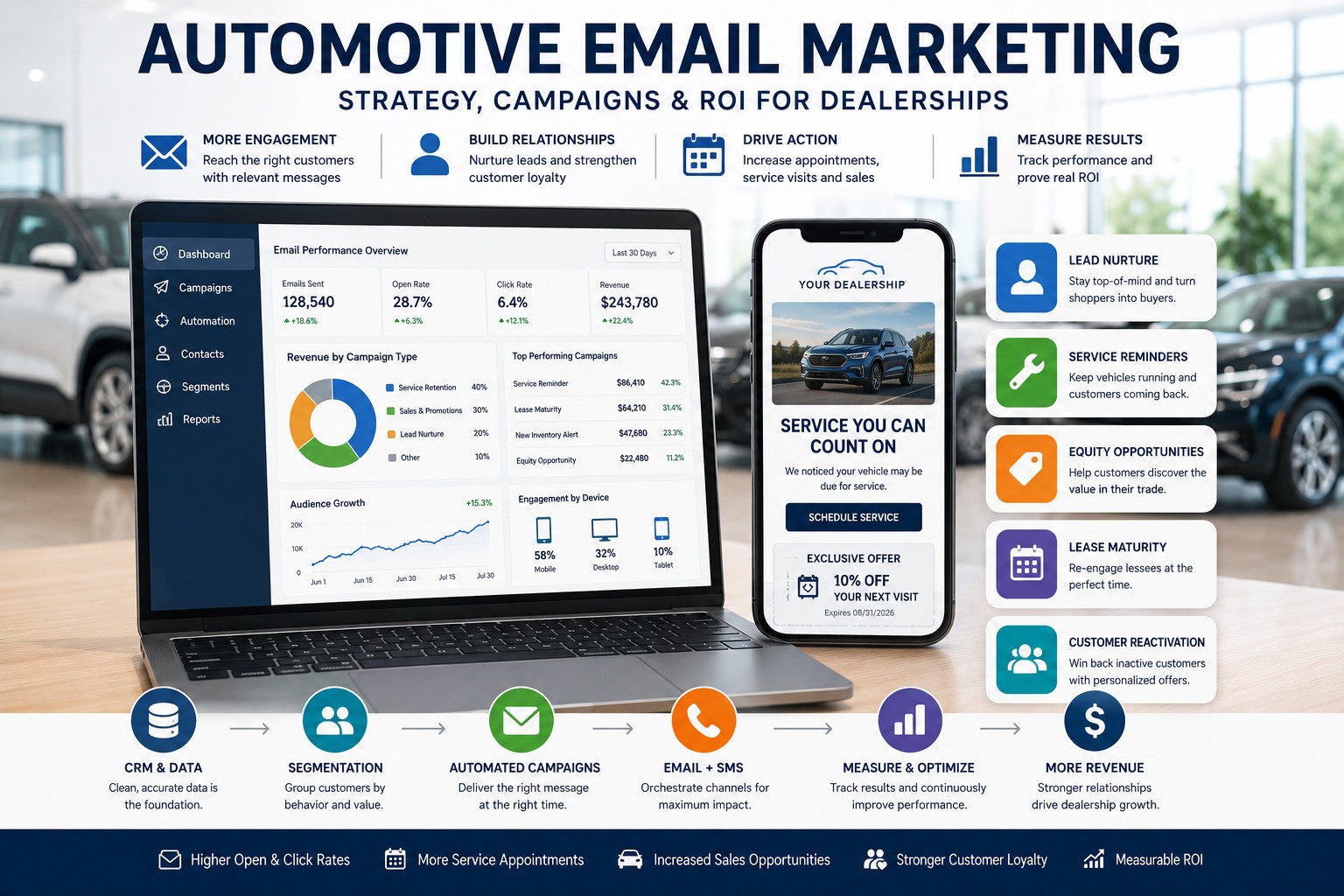
Automotive email marketing helps car dealerships convert leads, retain service customers, reactivate CRM records and generate repeat sales through targeted lifecycle campaigns. A strong program combines dealership data, segmentation, automation, consent, deliverability, email and SMS coordination, and reporting tied to appointments and revenue.
This guide explains the strategy, campaign types, software requirements, vendor criteria and measurement framework dealership owners, dealer groups, BDC leaders, CRM managers and marketing teams should use.
Start with the operating problem: identify the lifecycle gap, choose the right campaign and data requirements, then evaluate platforms and vendors against measurable dealership outcomes.
Automotive Email Marketing: Choose Your Route
| Business need | Best starting point | Expected outcome |
|---|---|---|
| Convert more leads | Lead nurture and unsold follow-up | More appointments, shows and sold opportunities |
| Increase fixed-ops retention | Service retention campaigns | More service bookings, repair orders and repeat visits |
| Activate CRM data | Data, segmentation and personalization | More relevant campaigns and fewer wasted sends |
| Choose technology | Email software and platform options | A platform matched to dealership data and workflows |
| Protect inbox placement | Email deliverability | Better sender reputation and fewer blocked messages |
| Evaluate a provider | Vendor selection and pricing | A defensible shortlist, RFP and implementation plan |
| Prove business value | Measurement and ROI | Reporting tied to appointments, ROs, sales and retention |
What Is Automotive Email Marketing?
Automotive email marketing is the use of customer, lead, vehicle, service and behavioral data to send relevant dealership messages throughout the ownership lifecycle. It includes lead nurture, unsold prospect follow-up, sold-owner onboarding, service reminders, declined-service recovery, recall outreach, lease maturity, equity opportunities, review requests and inactive-customer reactivation.
Unlike generic newsletter marketing, dealership email programs must work with CRM and DMS records, inventory, BDC workflows, service history, consent, suppression rules, OEM requirements and sales or service outcomes. The goal is not more email. The goal is better-timed communication that helps a customer take a useful next step.
Automotive Email Marketing Strategy Framework
A dealership email strategy should answer six questions before campaigns are built:
- Audience: Which customer or prospect segment is being served?
- Lifecycle stage: What has happened, and what should happen next?
- Data: Which CRM, DMS, inventory, website or service signals are reliable?
- Message: What information, offer or assistance is genuinely useful?
- Action: Is the desired outcome a reply, appointment, service booking, appraisal, test drive or purchase?
- Measurement: Which dealership outcome will prove that the campaign worked?
Email should support the broader automotive marketing strategy, not operate as an isolated monthly calendar.
Dealership Email Campaign Types
| Campaign | Audience and trigger | Primary objective | Core KPI |
|---|---|---|---|
| New-lead nurture | Fresh internet, phone, trade or finance lead | Secure a qualified appointment | Appointment and show rate |
| Unsold follow-up | Showroom or phone prospect who did not buy | Restart the buying conversation | Return appointment and sold rate |
| Sold-owner onboarding | Recent vehicle buyer | Set expectations and build the service relationship | Engagement and first service visit |
| Service due | Time, mileage or maintenance trigger | Generate a service appointment | Bookings and completed repair orders |
| Declined service | Customer declined recommended work | Recover needed service | Recovered RO revenue |
| Lease maturity | Customer entering a renewal window | Generate an upgrade or retention appointment | Appointments and retained customers |
| Equity opportunity | Owner with a relevant upgrade signal | Start a trade or appraisal conversation | Appraisals, appointments and sales |
| Reactivation | Inactive lead, owner or service customer | Bring the customer back | Reactivation and incremental revenue |
Lead Nurture and Unsold Prospect Follow-Up
Lead nurture should reflect the shopper’s source, vehicle interest, purchase stage and prior interaction. Useful messages may confirm availability, suggest comparable inventory, explain payment or trade options, answer common objections and make appointment scheduling easy.
Automation should support—not replace—the dealership lead-management process. Every sequence needs clear BDC ownership, stop rules after customer activity and feedback from appointment and sales outcomes.
Service Retention Email Campaigns
Fixed operations is one of the highest-value email use cases because service demand recurs throughout ownership. Campaigns can support maintenance reminders, declined work, recalls, tires, brakes, seasonal inspections and inactive-customer recovery.
Service campaigns should use actual ownership and service signals, provide a direct booking path and measure completed appointments and repair orders. Detailed fixed-ops planning belongs in the dealership service-retention guide.
Equity, Lease Maturity and Owner Reactivation
Ownership-stage campaigns work when the underlying signal is credible. Equity messages should reflect market value and customer context; lease campaigns should align with the real maturity window; reactivation should acknowledge the customer’s previous relationship rather than treating the record as a cold prospect.
Use dedicated workflows for dealership equity mining and lease maturity marketing when those programs require deeper operational guidance.
CRM Data, Segmentation and Personalization
Segmentation is the difference between lifecycle marketing and a database blast. Useful groups include active leads, unsold showroom visitors, sold owners, service-only customers, declined-service customers, lease-maturity customers, high-mileage owners, model owners and inactive records.
The data model should define a source of truth, record-matching rules, synchronization frequency, ownership of suppressions and how campaign outcomes return to the CRM. The dealer CRM guide covers the system and vendor layer; the automotive CDP guide explains identity resolution and cross-system activation.
Automotive Email Marketing Software and Platform Options
| Solution type | Best fit | Main advantage | Common limitation |
|---|---|---|---|
| CRM-native email | Stores prioritizing lead and sales workflow | Direct access to CRM tasks and outcomes | Limited creative, deliverability or lifecycle depth |
| Dedicated email platform | Teams with strong marketing operations | Campaign, testing and deliverability capabilities | Integration and identity work may be substantial |
| Dealership marketing automation | Stores needing managed automotive workflows | Dealer-specific triggers and campaign libraries | Variable transparency and data portability |
| CDP-orchestrated messaging | Dealer groups with multiple data sources | Unified segmentation and cross-channel activation | Higher implementation and governance burden |
| Managed vendor or agency service | Teams lacking campaign resources | Strategy, execution and creative support | Risk of weak ownership or generic programs |
| OEM program platform | Dealers requiring approved tools or co-op support | Brand alignment and program convenience | May limit flexibility, integrations or measurement |
Compare options using the dealership marketing software scorecard, with special attention to data access, automation, deliverability, permissions, reporting and transition rights.
Email Automation and Lifecycle Triggers
Automotive email automation should react to meaningful events: a new lead, an appointment, a missed appointment, a sale, a service milestone, declined work, lease maturity, equity position or a period of inactivity. Each trigger needs eligibility rules, exclusions, cadence limits and an owner.
A practical data flow is:
Lead sources and website behavior → CRM and DMS records → segmentation or CDP → email/SMS platform → BDC or service workflow → appointment, repair-order and sales outcomes → reporting.
Before launch, test duplicate records, stale inventory references, recent-purchase suppressions, employee records, opt-outs and conflicts with active human follow-up.
Email Creative, Testing and Customer Experience
Infrastructure alone does not make a campaign useful. Dealership teams should review the subject line, preheader, mobile layout, dynamic fields, landing page, accessibility and contact frequency as one customer experience. Tests should optimize for appointments, replies, service bookings and qualified conversions—not vanity metrics alone.
| Element | Dealership risk | Required control |
|---|---|---|
| Subject and preheader | Misleading urgency or unclear value | State the offer, context and next step accurately |
| Dynamic fields | Wrong customer, vehicle or store data | Use preview, fallback and suppression rules |
| Mobile layout | Weak booking or reply path | Test responsive design, readable type and the primary CTA |
| Experiment design | Optimizing opens instead of outcomes | Define one hypothesis and a dealership-level success metric |
| Frequency | Email and SMS fatigue | Use a shared contact policy and preference controls |
Email and SMS Orchestration
| Dimension | SMS | Combined workflow | |
|---|---|---|---|
| Best use | Detail, nurture, explanations and inventory options | Urgent reminders and concise follow-up | Lifecycle communication with channel-specific roles |
| Cadence | Longer sequences and broader context | Limited, timely messages | Shared frequency and suppression rules |
| Primary action | Click, reply, research or booking | Reply, confirm or book | A coordinated next step without duplicate pressure |
| Governance | Unsubscribe and sender controls | Consent and text-specific requirements | One preference and customer-contact policy |
The dealership SMS marketing guide covers text-first use cases and governance in more depth.
Email Deliverability for Dealerships
A campaign cannot generate appointments if it does not reach the inbox. Dealerships should require vendors and internal teams to document sender authentication, reputation monitoring, list hygiene and remediation responsibilities.
- Authentication: configure SPF, DKIM and DMARC for the sending domains used by the dealership or vendor.
- List quality: remove invalid addresses, control imports and suppress chronically inactive or risky records.
- Reputation: monitor bounces, spam complaints, block-list events and sudden volume changes.
- Engagement: send relevant messages to defined segments instead of treating every CRM record as equally marketable.
- Ownership: document who controls domains, DNS records, sending accounts, templates and historical performance if the vendor changes.
| Control | Owner | Launch evidence | Ongoing metric |
|---|---|---|---|
| Domain and DNS ownership | Dealership IT or authorized administrator | Documented access and recovery process | Ownership reviewed after vendor or staff changes |
| SPF, DKIM and DMARC alignment | Sending platform and dealership IT | Authentication test passes for production domains | Authentication failures and policy reports |
| Unsubscribe and suppression synchronization | Marketing operations | End-to-end test across CRM and sending systems | Suppression failures and processing time |
| Volume ramp and inactive-record policy | Email program owner | Approved launch segments and cadence | Bounces, complaints and engagement by cohort |
| Provider escalation | Named dealership and vendor contacts | Written remediation and incident process | Time to identify and resolve deliverability issues |
| Inbox-placement review | Vendor or deliverability specialist | Baseline monitoring established | Placement trends by mailbox provider |
Use Google’s current email sender guidelines as a technical reference alongside vendor-specific deliverability reporting.
Consent, Compliance and Customer Data Protection
Dealership email and SMS programs require operational review, not a one-time legal disclaimer. Teams should maintain accurate sender information, a physical postal address, clear unsubscribe handling, documented text-message consent, suppression controls and safeguards for customer information.
- FTC CAN-SPAM compliance guide
- FCC guidance on calls and texts
- FTC Safeguards Rule FAQ for automobile dealers
Compliance requirements can change and depend on campaign design and jurisdiction. Dealerships should obtain qualified legal guidance for their specific program.
Automotive Email Marketing Metrics and ROI
Reporting should separate technical health, engagement and dealership outcomes.
| Measurement layer | Useful metrics | Decision supported |
|---|---|---|
| Deliverability | Delivery, bounce, complaint, unsubscribe and inbox-placement indicators | Can the program reliably reach customers? |
| Engagement | Clicks, replies, click-to-open rate and landing-page conversion | Is the message useful to the segment? |
| Sales outcomes | Appointments, show rate, appraisals, sold opportunities and units | Does lead and owner communication produce demand? |
| Service outcomes | Bookings, completed repair orders, recovered declined work and repeat visits | Does lifecycle communication improve fixed-ops retention? |
| Governance | Duplicate sends, suppression failures, stale-record rate and rooftop compliance | Can the program scale safely? |
Open rates should not be treated as a definitive business outcome. Use campaign tagging, CRM status, call tracking, appointment records and sales or repair-order feedback to evaluate incremental value. The dealer CRM reporting template provides a practical reporting structure.
Automotive Email Marketing Costs and Pricing Models
Dealership email marketing pricing varies because the service may include software, data integration, campaign management, creative, deliverability support, SMS usage and reporting. Common commercial models include:
- monthly software subscription;
- pricing by rooftop, database size or send volume;
- managed-service or agency retainer;
- implementation and integration fees;
- creative or campaign-production fees;
- SMS and data-enrichment usage charges;
- OEM program or co-op arrangements.
Require a written scope that separates recurring fees from onboarding, integrations, message overages, creative, custom reporting and migration. Confirm who owns templates, domains, customer data and campaign history.
How to Choose an Automotive Email Marketing Vendor
A strong provider should demonstrate dealership data fluency, deliverability competence, lifecycle strategy, measurable outcomes and a realistic implementation plan. Avoid selecting a vendor on template design or open rates alone.
| Evaluation area | Evidence to request | Warning sign |
|---|---|---|
| Dealership specialization | Sales and fixed-ops lifecycle examples | Only generic newsletters or retail examples |
| Data integration | CRM/DMS integration map and sync frequency | Unclear source of truth or manual exports |
| Segmentation | Dealer-specific audience and suppression plan | One list for every campaign |
| Deliverability | Authentication, reputation and remediation process | No visibility into domains or complaint handling |
| Automation | Trigger, eligibility, stop-rule and ownership examples | Automation without workflow governance |
| Reporting | Appointments, ROs, sold outcomes and segment results | Reports stop at opens and clicks |
| Data ownership | Written export, transition and deletion policy | Dealer cannot retrieve campaign history or assets |
| Dealer-group controls | Rooftop permissions, approvals and shared definitions | Duplicate campaigns and inconsistent reporting |
Procurement next step: use the automotive email marketing RFP template to document requirements, integrations, evidence, pricing and implementation responsibilities before demos.
Dealership Email Marketing Checklist
- Define the primary audience, trigger, action and business KPI for every campaign.
- Audit CRM and DMS data quality before increasing send volume.
- Separate lead, sold-owner, service, lease, equity and inactive-customer segments.
- Configure sender authentication and document domain ownership.
- Create consent, unsubscribe, suppression and contact-frequency rules.
- Map email and SMS roles to BDC, sales and service workflows.
- Connect campaigns to appointments, repair orders and sold outcomes.
- Document vendor access, data portability and transition requirements.
First 90 Days of an Email Marketing Program
| Period | Priority work | Required output |
|---|---|---|
| Days 1–15 | Audit data, consent, authentication, campaigns, integrations and reporting | Baseline, risk register and ownership map |
| Days 16–30 | Fix segments, suppressions, tracking and high-risk workflow problems | Approved campaign and measurement plan |
| Days 31–60 | Launch priority lead, service and reactivation programs | Campaign results by segment and lifecycle stage |
| Days 61–90 | Match outcomes, refine cadence and prioritize the next quarter | 90-day business review and roadmap |
Questions to Ask an Email Marketing Vendor
- Which CRM, DMS, CDP and website data can you use, and how often does it synchronize?
- How do you authenticate sending domains and monitor deliverability?
- How do you segment sales leads, owners, service customers and inactive records?
- Which trigger, suppression and stop rules are available?
- How do you coordinate campaigns with BDC, sales and service teams?
- How do you measure appointments, repair orders, sold units and retention?
- Which fees are separate from the software or managed-service price?
- Who owns domains, customer data, templates and campaign history?
- How do multi-rooftop permissions, approvals and reporting work?
- What would prevent the dealership from achieving results in the first 90 days?
Recommended Decision Framework
| Situation | Priority action | Condition before launch |
|---|---|---|
| CRM data is unreliable | Fix data quality, matching and suppression rules | A source of truth and accountable owner are confirmed |
| Lead follow-up is weak | Launch nurture with clear BDC ownership | Stop rules and outcome feedback are active |
| Service retention is weak | Build ownership-based service journeys | DMS history and a direct booking path are available |
| Deliverability is weak | Repair authentication, list quality and monitoring | Domain ownership and escalation responsibilities are assigned |
| The platform limits control | Run a structured vendor evaluation | Requirements, data ownership and exit terms are documented |
| ROI is unclear | Build outcome matching and reporting | Appointment, RO and sold feedback can return to the reporting layer |
How This Guide Fits the Automotive Email Marketing Cluster
Keep email strategy, campaign design, deliverability, measurement and vendor-evaluation guidance on this page. Use supporting pages for deeper CRM, CDP, SMS, service-retention, equity, lease-maturity and procurement topics. That structure gives the automotive email marketing cluster one clear canonical home while preserving focused paths for buyers with a narrower job to complete.
Need a structured review? Contact ADM to evaluate lifecycle gaps, data ownership, software requirements, vendor evidence and reporting before a renewal or platform change.
Methodology and Sources
This guide is organized around dealership lifecycle jobs, the data and controls required to execute them, and the evidence a buyer should request from software providers or managed-service vendors. The campaign framework connects audience, trigger, action and dealership outcome; the vendor scorecard evaluates integration, deliverability, governance, reporting, ownership and implementation risk.
- Technical sender guidance is checked against Google’s published email sender requirements.
- Email compliance references use FTC CAN-SPAM guidance; calling and text-message references use current FCC consumer guidance.
- Customer-data safeguards are checked against the FTC’s automobile-dealer Safeguards Rule materials.
- Recommendations that depend on campaign design, state law or jurisdiction require qualified legal review.
- ADM evaluates platforms by documented capabilities and buyer evidence. Commercial relationships, when present, do not change the inclusion criteria or editorial conclusions.
The editorial team reviews this guide when material platform, deliverability, compliance or dealership-workflow changes warrant an update.
Frequently Asked Questions About Automotive Email Marketing
What is automotive email marketing?
Automotive email marketing uses dealership lead, customer, vehicle and service data to send relevant lifecycle campaigns that support appointments, service retention, repeat sales and measurable revenue.
What email marketing software is best for a car dealership?
The best choice depends on the dealership’s CRM and DMS integrations, automation needs, deliverability requirements, internal resources, reporting expectations and data-ownership rules. CRM-native tools, dedicated platforms, automotive automation systems and managed vendors serve different operating models.
How should a dealership segment its email database?
Dealerships should separate active leads, unsold prospects, sold owners, service-only customers, declined-service customers, lease-maturity customers, equity opportunities and inactive records. Segments should use reliable lifecycle and behavioral signals rather than broad list labels alone.
How can a dealership improve email deliverability?
Use SPF, DKIM and DMARC, maintain clean lists, suppress invalid or chronically inactive addresses, monitor bounces and complaints, control sending volume and send relevant messages to defined customer segments.
Should a dealership use email, SMS or both?
Most dealerships benefit from both. Email is useful for detail, nurture and context; SMS is useful for concise, time-sensitive communication where consent permits. Shared cadence and suppression rules prevent duplicate or excessive contact.
How much does dealership email marketing cost?
Pricing can include software subscriptions, per-rooftop or database fees, send volume, managed services, integrations, creative, SMS usage and implementation. Dealers should compare the full scope and ownership terms rather than the base monthly fee alone.
How should a dealership measure email marketing ROI?
Measure deliverability and engagement, then connect campaigns to replies, appointments, show rates, service bookings, repair orders, sold opportunities, retention and revenue. Opens and clicks are supporting indicators, not the final business result.
What should an automotive email marketing RFP include?
An RFP should define data sources, integrations, segmentation, automation, deliverability, consent, reporting, pricing, implementation, support, data ownership and transition requirements, together with the evidence vendors must provide.