
Quick answer
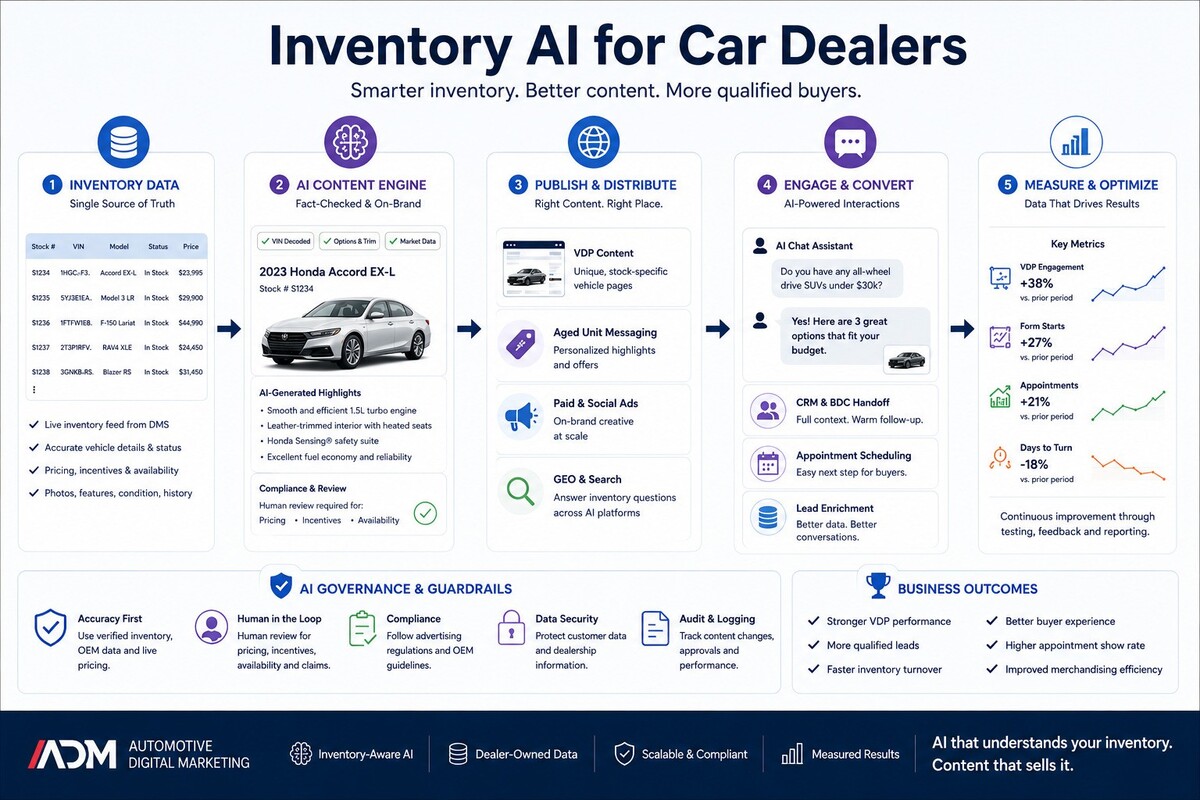
Inventory AI for car dealers helps dealerships turn approved vehicle data into reviewed VDP content, aged-unit messaging, buyer answers, CRM context and measurable merchandising actions.
Use it to improve shopper understanding and inventory execution without publishing unsupported claims about price, incentives, availability, mileage, condition, certification or equipment. A reliable workflow uses current source data, controlled publishing rules, human review for sensitive claims and reporting tied to VDP engagement, calls, form starts, appointments and days to turn.
Reviewed by the Automotive Digital Marketing Editorial Team. Evaluation criteria include source-data reliability, VDP usefulness, approval rules, pricing and availability controls, CRM handoff, change tracking, vendor ownership and outcome reporting.
Evaluating inventory AI? Start with the merchandising bottleneck, then inspect inventory-feed access, VDP rules, human review, compliance guardrails, CRM handoff and first-90-day measurement.
Start Here: Inventory AI Routes
| Inventory task | Best starting point | Use it when |
|---|---|---|
| Improve VDP content | VDP descriptions and feature coverage | Vehicle pages are thin, inconsistent or missing shopper-relevant details. |
| Move aged units | Aged inventory messaging | Vehicles need stronger positioning across the website, email, paid social and sales follow-up. |
| Support chat and CRM | Inventory-aware chat and CRM context | BDC or AI chat needs cleaner vehicle context before handoff. |
| Build content for AI search | GEO and inventory explanations | You need clearer model, trim, comparison and FAQ content for AI-assisted discovery. |
| Choose a vendor | Inventory AI vendor selection | You are comparing AI merchandising tools, website platform features, CDP layers or agency workflows. |
What Inventory AI Should Do
Inventory AI should turn real vehicle data into useful merchandising assets. It can draft VDP descriptions, highlight differentiators, identify missing features, suggest alternative vehicles, create approved ad variants, summarize aged-unit opportunities and help sales or BDC teams understand what matters about a specific vehicle.
Dealer inventory is sensitive because availability, pricing, incentives, mileage, certification status and vehicle condition can change quickly. The system should not publish unchecked claims or let stale data become customer-facing copy.
VDP Descriptions and Feature Coverage
Strong inventory AI improves VDP usefulness by translating vehicle attributes into shopper-friendly language. It should cover equipment, packages, condition context, fuel economy, drivetrain, trim, technology, safety, warranty and certification status only where those facts are accurate and approved.
A reliable workflow pulls approved inventory data, flags missing fields and routes sensitive claims for review before publication.
Required Data Before AI Creates VDP Content
| Data field | Source of truth | Publication rule |
|---|---|---|
| VIN, stock number and vehicle status | DMS or live inventory feed | Match the live vehicle record before publication. |
| Trim, drivetrain, packages and equipment | OEM data, window sticker or approved vehicle record | Use VIN-specific data for vehicle-level claims. |
| Mileage, condition and certification | Inspection record and approved merchandising data | Route condition-sensitive claims through human review. |
| Price, payment, incentives and availability | Live dealership systems | Use controlled language and staff escalation rules. |
Aged Inventory Messaging
Aged-unit messaging should clarify vehicle fit, equipment, condition context and buyer-use value while preserving live pricing accuracy. Inventory AI can help identify practical differentiators, create approved email snippets, develop paid-social angles, prepare BDC talk tracks and refresh VDP content without turning every aged unit into a generic discount message.
Managers should review aged-unit prompts against current inventory age, price position, merchandising history and campaign plans so the output supports a specific decision rather than merely producing more copy.
Inventory-Aware Chat and CRM Context
AI chat and CRM workflows become more useful when they understand the vehicle path. When a shopper asks about a specific VDP, the handoff should include the vehicle, trim, key questions, trade-in context, appointment intent and any uncertainty around availability or pricing.
Inventory AI should support the dealership’s AI chat and CRM workflow as part of one inventory process. The objective is a cleaner handoff, usable lead context and staff escalation where live data or approval is required.
GEO and Inventory Explanations
Dealers can organize recurring questions by model, trim, drivetrain, ownership use case, charging, towing, cargo, certification and trade-in fit. This creates clearer explanations, comparisons and FAQs for shopper research and AI-assisted discovery.
Use anonymized question themes rather than private customer transcripts, and keep model or vehicle claims grounded in approved source data.
Inventory AI Vendor Scorecard
| Category | What a strong vendor shows | What to ask |
|---|---|---|
| Inventory-feed access | Uses current vehicle data and explains refresh timing. | How often is inventory data updated and how are sold units handled? |
| Accuracy guardrails | Prevents unsupported claims about price, incentives, features or availability. | Which claims require human review or staff escalation? |
| VDP workflow | Creates useful descriptions and flags missing merchandising details. | Can the team approve, edit and log changes? |
| Channel reuse | Adapts approved inventory language for website, email, paid media and CRM. | How are assets reused without creating contradictions? |
| CRM and chat support | Provides vehicle context for BDC, AI chat and sales follow-up. | What appears in CRM notes or chat handoff? |
| Reporting | Connects merchandising changes to VDP engagement, calls, forms and movement. | Which KPIs should improve in 90 days, and how are they attributed? |
Inventory AI Readiness Audit
Review your inventory data, VDP workflow, approval rules, aged-unit messaging, chat context, CRM handoff and reporting model before selecting or scaling an AI merchandising workflow.
Request an Inventory AI Readiness Audit
For dealership groups, rooftops and automotive teams evaluating AI merchandising workflows.
Inventory AI Guardrails
- Use approved inventory sources for vehicle facts.
- Escalate pricing, incentive, payment and availability questions to staff when needed.
- Keep human review for VDP copy, offers and condition-sensitive claims.
- Track generated or revised content so managers can inspect changes and sources.
- Measure VDP engagement, calls, forms, appointments, aged-unit activity and days-to-turn movement.
Final Verdict
Inventory AI requires current vehicle data, approval rules, merchandising standards and measurement tied to dealership outcomes. The strongest use cases improve VDP usefulness, aged-unit positioning, chat context, CRM follow-up and inventory-aware campaigns while protecting price, incentive and availability accuracy.
Frequently Asked Questions About Inventory AI
What is inventory AI for car dealers?
Inventory AI for car dealers uses artificial intelligence to improve vehicle descriptions, merchandising consistency, VDP content, aged-unit messaging, chat context, CRM follow-up and inventory-aware marketing.
Can AI write VDP descriptions?
AI can draft VDP descriptions from approved vehicle data, but dealerships should review claims about features, condition, pricing, incentives, certification and availability before publication.
How does inventory AI help AI chat?
Inventory AI can provide vehicle context, differentiators, shopper questions and availability guardrails so AI chat and BDC teams can create cleaner handoffs.
How should dealers measure inventory AI?
Dealers should measure VDP engagement, calls, form starts, appointment requests, aged-unit activity, lead quality and days-to-turn movement rather than content volume alone.