
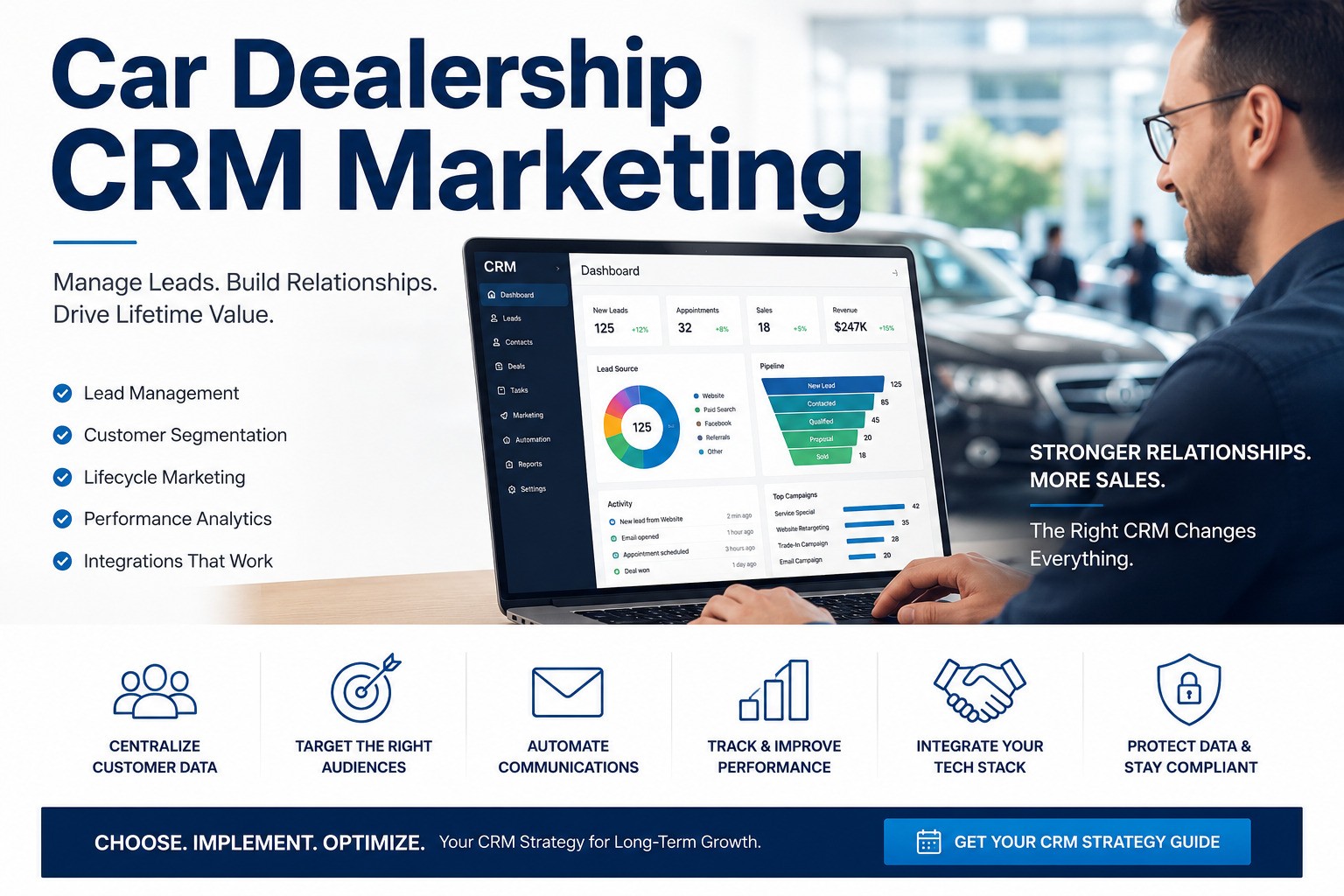
Automotive CRM software is the operating layer dealerships use to capture leads, organize customer records, route follow-up, manage calls, email and SMS, schedule appointments, support sales and service workflows, and connect activity with dealership outcomes. The right car dealer CRM should help staff respond faster, use customer and inventory context, keep managers accountable and preserve dealer control of data and integrations.
A 2026 dealership CRM buyer and operating guide for vendor comparison, DMS integration, speed-to-lead, adoption, lifecycle marketing, reporting, migration and first-90-day execution.
Quick answer: the best CRM for a dealership is the one that fits the store’s sales and service workflow, integrates reliably with the DMS and website, makes fast and relevant response easy, earns consistent staff adoption, exposes manager-level accountability and lets the dealer export its own customer and activity history. Feature count matters less than operating fit and measurable use.
2026 automotive CRM demand snapshot
Google Ads Keyword Planner data for the United States, English language and Google Search shows strong commercial demand around this category.
| Keyword | Average monthly searches | High top-of-page bid |
|---|---|---|
| automotive CRM | 1,300 | $34.59 |
| car dealer CRM | 1,600 | $38.38 |
That level of demand means a useful CRM page has to do more than define software. Dealer buyers need to understand category boundaries, workflow fit, current vendor differences, migration risk, total cost, adoption and how to verify business outcomes.
Car dealership CRM decision routes
| Decision | Best route | Use it when |
|---|---|---|
| Understand the category | What a dealership CRM is | You need the software boundary before comparing products. |
| Improve lead handling | Dealership lead management | Routing, response or appointment quality is weak. |
| Improve BDC execution | Automotive BDC workflow | Technology exists but process or staffing is inconsistent. |
| Connect lifecycle channels | Automotive email marketing | Nurture, retention or ownership-cycle communication needs structure. |
| Coordinate texting | Dealership SMS marketing | Consent, cadence or texting ownership is fragmented. |
| Evaluate first-party data | Automotive CRM vs CDP | You need identity resolution, activation or group-level data governance. |
| Compare software | CRM vendor comparison | You are preparing demos, renewal or replacement decisions. |
| Use a scorecard | Dealership software scorecard | You need a repeatable evaluation framework. |
What is a car dealership CRM?
A car dealership CRM is customer relationship management software designed around automotive retail workflows: internet leads, calls, showroom visits, appointments, trade-ins, finance starts, vehicle-of-interest changes, sold customers, service history, lease maturity and multi-rooftop reporting.
A CRM should answer four daily questions: who needs attention, why now, what should happen next and did the action produce a dealership outcome? A system that only stores contacts can still be technically functional while contributing very little to the sales floor.
CRM vs DMS vs CDP vs communications layer
| System | Primary role | Typical data/workflow | What it should not be expected to solve alone |
|---|---|---|---|
| CRM | Leads, customers, tasks, communication and follow-up | Source, contact history, appointments, calls, email, SMS, pipeline, sales/service activity | Accounting, complete transaction processing or every communication/intelligence use case |
| DMS | Core dealership transaction and operating system | Deals, repair orders, inventory, accounting, customer and vehicle records | Complete lead nurture and customer engagement workflow |
| CDP | Identity resolution and first-party audience activation | Cross-system profiles, segments and activation | Daily sales-floor or BDC task execution |
| Communications / engagement layer | Speed, conversation handling and intelligence around calls, text, chat or video | Real-time conversations, routing, call intelligence, AI response or specialized follow-up | Core CRM opportunity and customer governance |
Stack rule: adding another layer is justified only when it solves a clearly defined gap that the CRM and DMS do not solve adequately. The dealership should know which system owns each field, task, communication and outcome.
Speed-to-lead: test the operating system, not a stopwatch
Fast response matters, but a dealership should not optimize to one arbitrary response-time number without checking lead quality and staffing reality. The operational goal is fast, relevant and accountable response.
| Lead event | CRM should support | Management evidence |
|---|---|---|
| New internet lead | Immediate capture, source recognition, owner assignment and alerting | Median first-response time by source and shift |
| After-hours lead | Defined automation, escalation or AI-assisted response with next-day ownership | After-hours response and appointment quality |
| No first response | Escalation to manager or backup owner | Unanswered-lead rate and age |
| Customer replies | Conversation should return to an accountable human or governed workflow | Reply-to-next-action time |
| Lead changes vehicle | Vehicle-of-interest context should update without destroying prior history | Record continuity and correct inventory context |
A platform can send fast automated messages and still perform poorly if staff ignore replies, leads route to the wrong owner or appointment quality remains weak. Measure response alongside contact, appointment, show and sold rates.
CRM adoption: the feature that determines whether the rest matter
Dealership CRMs fail operationally when salespeople, BDC agents and managers work around the system. Adoption should be tested by role before signing and measured after launch.
| Role | Critical adoption test | Failure signal |
|---|---|---|
| Salesperson | Can find assigned opportunities, see conversation history and complete next actions quickly | Notes are kept outside the CRM or tasks are batch-completed without real follow-up |
| BDC agent | Can prioritize leads, communicate across channels and schedule appointments without tool switching | Manual copy/paste and inconsistent source handling |
| Manager | Can see pipeline, overdue activity, response quality, appointments and outcomes in real time | Management depends on exported spreadsheets to understand the floor |
| Service team | Can access relevant customer and vehicle context with correct permissions | Sales/service history remains fragmented |
| CRM administrator | Can manage workflows, permissions, integrations and reports without vendor dependence for routine changes | Every small change requires a ticket or paid services |
Essential automotive CRM features
| Capability | Why it matters | What to verify |
|---|---|---|
| Lead capture and routing | Gets each enquiry to the right team quickly | Sources, assignment, escalation, duplicates and after-hours logic |
| Task/workflow automation | Creates consistent follow-up | Conditional logic, role ownership, overdue alerts and customization |
| Calls, email and SMS | Preserves communication history | Consent, recording, templates, suppressions and shared visibility |
| Appointment management | Connects activity to showroom/service outcomes | Scheduling, confirmation, show status and no-show recovery |
| Customer and vehicle context | Makes follow-up relevant | Vehicle owned, vehicle of interest, trade, service history and lifecycle stage |
| DMS/website integrations | Reduces disconnected records and manual entry | Data direction, timing, field mapping, failure alerts and ownership |
| Segmentation/campaigns | Supports lifecycle marketing and reactivation | Dynamic audiences, exclusions and attribution |
| Reporting and exports | Enables leadership control | Appointments, shows, sold/service outcomes, source quality, raw exports and API access |
| Multi-rooftop controls | Balances group governance with local relevance | Permissions, shared records, deduplication and rooftop attribution |
| AI/automation governance | Can improve response and prioritization | Human handoff, permissions, audit trail, source data and message control |
2026 automotive CRM vendor comparison: what to verify
This is a buyer-oriented comparison of public product positioning, not a paid ranking. Product capabilities and packaging change; dealerships should validate current demos, integrations, contracts and references.
| CRM | Public strengths to investigate | Best-fit questions | What the dealer should verify live |
|---|---|---|---|
| VinSolutions | CRM-native AI, automation, Cox Automotive data, single-customer record, reporting and performance-management support | Do Cox ecosystem data and AI workflows materially improve prioritization for this store? | DMS/service match-and-merge, workflow flexibility, data export, AI controls and actual reporting depth |
| DealerSocket | Broad sales, marketing, service, desking, communication and integration footprint | Does a broad suite simplify the store’s stack or create features staff will not use? | Lead workflow, mobile use, call/text history, desking handoff, integrations and manager reporting |
| DriveCentric | Live pipeline, unified conversations, video, live inventory visibility, manager oversight and expanding fixed-ops engagement | Will the engagement model improve staff adoption and conversation quality? | Pipeline usability, inventory freshness, manager visibility, service workflow, exports and DMS integration |
Do not choose from the matrix alone. Use your own dealership scenarios in each demo: a fresh internet lead, duplicate household, vehicle change, aged lead, after-hours response, service customer, cross-rooftop record and sold-unit handoff.
CRM integrations that matter
Map data flow between the CRM and DMS, website, inventory feeds, call tracking, chat, digital retailing, desking, scheduler, email, SMS, CDP, ad platforms and BI tools.
- Direction: identify which system creates and owns each field.
- Frequency: real-time and scheduled batch integration can produce different operating outcomes.
- Failure handling: require alerts, retry logic and an accountable support owner.
- Portability: dealer should be able to export records, notes, activities, templates and reporting history.
- Consent: email/SMS preferences must survive integrations and vendor changes.
Lifecycle marketing across sales and service
| Lifecycle segment | Need | Useful CRM action |
|---|---|---|
| New lead | Fast relevant response | Route by source/intent and measure appointment quality |
| Unsold prospect | Continued assistance | Use inventory, timing and prior-interaction context |
| Recent buyer | Ownership onboarding | Introduce service, delivery support and preferences |
| Service customer | Maintenance and retention | Use service history and appointment behavior |
| Declined-work customer | Relevant recovery | Follow up on specific declined work |
| Lease/equity opportunity | Replacement evaluation | Use term, mileage, payment position and vehicle interest |
| Inactive customer | Reason to re-engage | Use ownership stage and prior relationship |
CRM data quality and governance
A durable CRM data policy should define record ownership, duplicate rules, required fields, lead-source naming, consent status, retention periods, permissions, DMS synchronization, cross-rooftop sharing, export rights and correction/deletion processes. Increasing marketing automation before fixing dirty data increases irrelevant communication and unreliable reporting.
Dealership CRM reporting and ROI
| Metric | Question it answers |
|---|---|
| Median response time | How quickly does the store act on new demand? |
| Contact rate | Which sources and workflows create actual two-way contact? |
| Appointment rate | Which cohorts create valid appointments? |
| Show rate | Are confirmation and follow-up working? |
| Sold rate | Which sources and segments create deliveries? |
| Service booking / RO match | Which lifecycle programs create fixed-ops activity? |
| Database reactivation rate | How much value is recovered from existing records? |
| Opt-out / complaint rate | Is communication relevant and governed? |
| Data completeness / duplicate rate | Can the CRM support reliable workflow? |
| User adoption | Are the workflows actually being used as designed? |
The dealer CRM reporting template provides a recurring management-review structure.
Automotive CRM pricing and total cost
Most automotive CRM vendors do not publish one universal dealership price. Total cost can include per-user or per-rooftop licenses, implementation, migration, integrations, training, messaging usage, managed services, premium support, data exports and contract-exit work.
| Cost category | Buyer question |
|---|---|
| Recurring platform | What is charged per rooftop, user, module or volume band? |
| Implementation | Which configuration, migration and training tasks are included? |
| Integrations | Which connections require separate vendor or third-party fees? |
| Messaging | Are email, SMS, MMS, calls or AI conversations usage-based? |
| Support | Which support level and response times are included? |
| Exit | What data-export, migration-assistance or termination costs apply? |
CRM vendor selection scorecard
| Category | What a strong vendor shows | Evidence to request |
|---|---|---|
| Dealership specialization | Understands sales, service, BDC, DMS, inventory and OEM realities | Dealer-specific workflows and references |
| Adoption | Fast daily workflows for each role | Scenario-based live demo with salesperson, BDC and manager tasks |
| Lead workflow | Flexible routing, tasks, escalation and appointment control | Live workflow using dealer scenarios |
| Integrations | Documented connections with monitoring | Field map, timing and failure process |
| Data quality | Duplicate and normalization controls | Sample audit and migration plan |
| Lifecycle | Sales/service/equity/reactivation capability | Segment map and campaign logic |
| Reporting | Appointments, shows, sold/service outcomes and exports | Management report and raw-data access |
| Group scale | Shared governance with rooftop relevance | Permissions and group-reporting demo |
| Implementation | Named owners, milestones, training and risks | 90-day plan and escalation path |
| Data ownership | Dealer retains records, activities and exports | Contract and transition policy |
| Commercial terms | Transparent pricing, renewal, SLA and termination | Complete order form and exit-cost schedule |
CRM demo script: make every vendor solve the same dealership cases
- Route a new lead arriving after hours and show escalation.
- Merge a duplicate household without losing activity history.
- Change vehicle of interest and preserve prior context.
- Show a manager which leads are aging and why.
- Send and receive a text, email and call while preserving one timeline.
- Show a sold customer reappearing in service.
- Demonstrate a cross-rooftop customer with permissions.
- Export records, notes, activities and report data.
- Show an integration failure and the alert/support process.
- Show how adoption, response, appointments and sales are reported by user/team.
CRM migration and implementation
- Define requirements: users, rooftops, workflows, integrations, reports and ownership.
- Inventory data: records, notes, activities, templates, consent and reports.
- Clean and map: duplicates, sources and field mapping.
- Test integrations: website, DMS, calls, messaging, service and analytics.
- Configure workflows: routing, tasks, escalation, appointments and permissions.
- Train by role: sales, BDC, service, managers and administrators.
- Run parallel validation: compare lead and report counts before cutover.
- Measure adoption: workflow use, data completeness and manager usage.
First 90 days of CRM implementation
| Period | Primary work | Evidence gate |
|---|---|---|
| Days 1–15 | Audit data, systems, lead sources, workflows, integrations and user roles | Baseline, requirements and risk register |
| Days 16–30 | Fix routing, fields, permissions, suppression and reporting gaps | Validated configuration and migration plan |
| Days 31–60 | Launch priority workflows and management dashboards | Adoption, response and data-quality signals |
| Days 61–90 | Measure appointments, shows, service activity, sold outcomes and user adoption | 90-day review and next-quarter roadmap |
Final verdict
The best automotive CRM is the platform that staff will actually use, managers can govern, integrations can support and the dealer can leave without losing its own data. Speed-to-lead, AI, video, marketing automation and dashboards are valuable when they improve the dealership’s real workflow. They do not compensate for weak adoption, dirty data, poor DMS integration or unclear ownership.
Buyer workflow: define the operating gaps, shortlist vendors, run the same live demo script, validate integrations and exports, score adoption by role, price the full contract and approve a 90-day implementation with measurable adoption and outcome gates.
Methodology and sources
This September 2026 revision compares the current automotive CRM SERP with official vendor documentation and dealership operating requirements. Vendor descriptions summarize public product positioning and should be revalidated during demos.
- Demand: Google Ads Keyword Planner, United States, English, Google Search, accessed September 6, 2026.
- Vendor sources: official VinSolutions, DealerSocket and DriveCentric product pages reviewed September 6, 2026.
- Evaluation standard: operating fit, adoption, lead response, DMS/integration reliability, data ownership, reporting, migration and contract terms.
- Neutrality: no CRM is ranked first without store-specific evidence. Public vendor claims remain vendor claims until verified against the dealership’s own workflow and data.
Frequently asked questions about automotive CRM software
What is an automotive CRM?
An automotive CRM is dealership-focused customer relationship software for leads, communication, tasks, appointments, sales and service follow-up, with integrations to dealership systems and vehicle/customer data.
What is the best CRM for a car dealership?
The best CRM is the platform that fits the dealership’s workflow, integrations, staff roles, reporting and data-ownership requirements. A single rooftop, dealer group, high-volume BDC and service-heavy operation may need different strengths.
Which automotive CRM vendors should a dealership compare?
Current dealer buyers commonly evaluate platforms such as VinSolutions, DealerSocket and DriveCentric along with other products that fit their DMS, OEM, geography and workflow. Compare current capabilities in live demos rather than relying on static rankings.
How fast should dealership leads be answered?
The dealership should aim for fast, relevant and accountable response, then track response time with contact, appointment, show and sold rates. A fast automated acknowledgement is not the same as useful two-way engagement.
What is the difference between a CRM and a DMS?
A CRM manages customer engagement, lead workflow and follow-up. A DMS manages core dealership transactions such as deals, repair orders, inventory and accounting. Reliable integration matters because each system owns different parts of the customer and transaction record.
What is the difference between CRM and CDP?
A CRM supports daily customer workflow. A CDP unifies identities and data across systems for segmentation and activation. Some dealer groups need both.
How much does automotive CRM software cost?
There is no universal public price because dealership contracts vary by rooftops, users, modules, integrations, messaging, migration, training and support. Compare total recurring, one-time, usage and exit costs.
How should a dealership measure CRM adoption?
Measure task completion quality, response behavior, data completeness, manager usage, conversation history, appointment handling and whether users perform work inside the CRM rather than in side systems or spreadsheets.
How long does CRM implementation take?
A structured 30- to 90-day implementation is common for a controlled rollout, with longer timelines for complex groups, migrations or integrations. Use evidence gates for data quality, integrations, training and adoption.
Who owns dealership data after the CRM contract ends?
The dealership should retain customer records, notes, activities, templates, consent history and reporting exports. Export format, timing, assistance and fees should be written into the contract before purchase.