
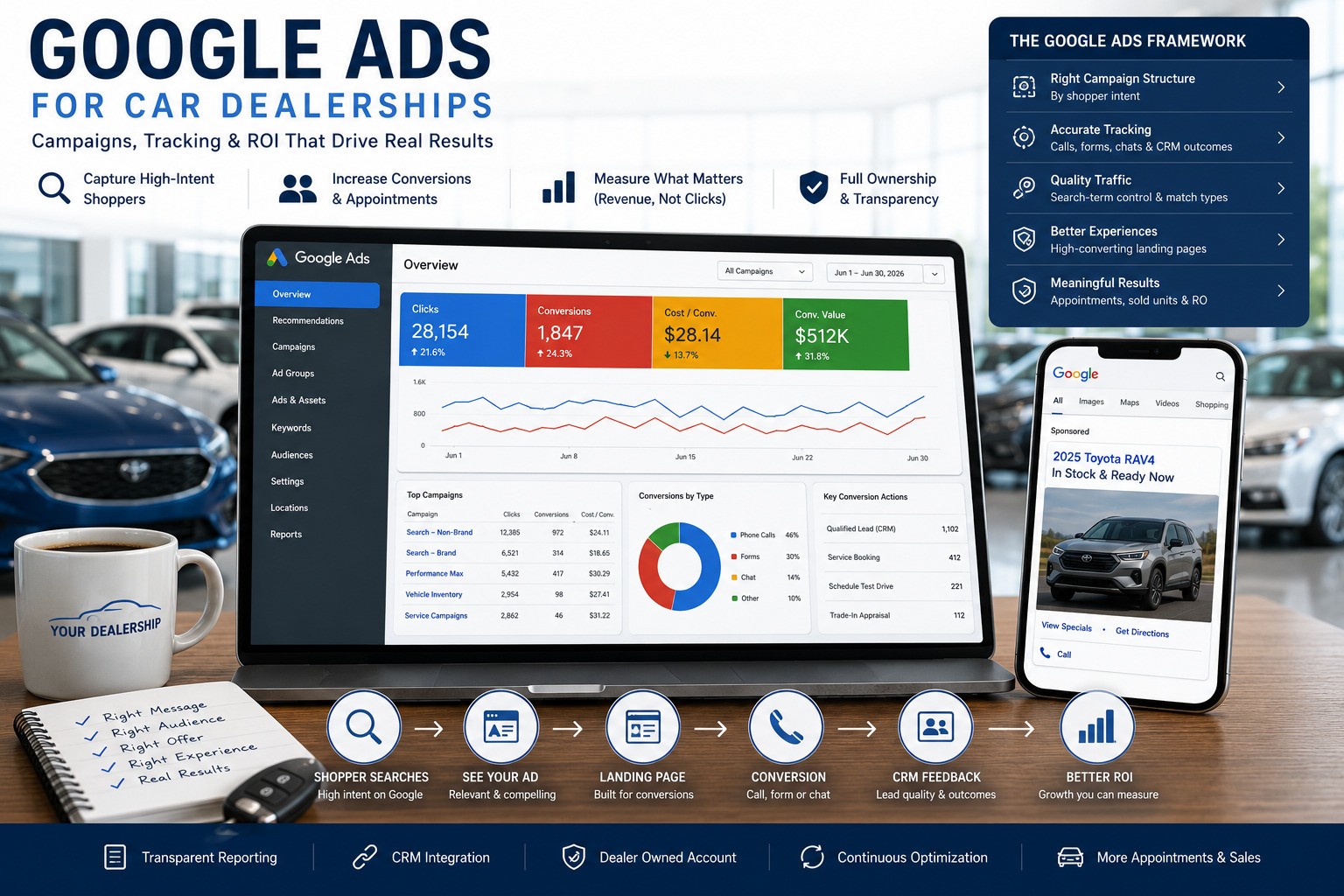
Google Ads for car dealerships should operate as a controlled demand system across vehicle sales, fixed ops, finance/trade and local dealership intent. The account should separate shopper jobs, route clicks to the right dealership page, keep vehicle data current, measure meaningful calls/forms/appointments and return qualified CRM or DMS outcomes into the decision process.
A 2026 dealership Google Ads operating guide for Search, Vehicle Ads, Performance Max, AI Max, budgets, search-term control, landing pages, conversion tracking, CRM/DMS feedback and account ownership.
Quick answer: a strong dealer account separates brand demand from acquisition, uses Search for explicit intent, uses Vehicle Ads for live inventory, uses Performance Max only with trustworthy feeds/conversions, isolates service economics, controls search-term waste and measures the path from ad interaction to qualified lead, appointment, delivered unit or completed repair order.
2026 Google Ads demand for dealerships
Google Ads Keyword Planner data for the United States, English language and Google Search shows modest search volume with unusually strong commercial bidding around this specialist intent.
| Keyword | Average monthly searches | High top-of-page bid |
|---|---|---|
| Google Ads for car dealerships | 50 | $56.31 |
| car dealership Google Ads | 0 | Not reported |
The bid signal makes this a high-intent operating and provider-selection topic. Dealers need account architecture, feed controls, measurement and ownership standards they can verify.
Choose the right Google Ads route
| Dealer need | Best starting point | Use it when |
|---|---|---|
| Set wider paid-media strategy | Automotive PPC | You need bidding, experimentation, budget and provider governance across paid channels. |
| Promote live inventory | Automotive inventory ads | You need Merchant Center, Vehicle Ads, PMax vs Shopping, VDP policy or sold-unit controls. |
| Grow service demand | Fixed-ops PPC | You need service, maintenance or repair campaigns with separate economics. |
| Standardize reporting | Dealer PPC report template | You need shared definitions for spend, leads, appointments and sold/service outcomes. |
| Prepare provider review | Automotive PPC RFP template | You need account ownership, scope and comparable proposals. |
| Connect outcomes | Automotive CRM | You need source mapping, appointments, shows and delivered-unit feedback. |
| Fix landing constraints | Dealer website platforms | SRPs, VDPs, forms, speed or mobile conversion paths limit campaign performance. |
2026 dealership Google Ads campaign map
| Campaign family | Primary job | Landing path | Primary quality check |
|---|---|---|---|
| Brand Search | Protect dealership-name and department demand | Homepage/location/department | Incrementality, impression share and qualified outcomes |
| Non-brand/model Search | Capture local vehicle-shopping intent | Model SRP, category SRP or relevant offer | Qualified calls/forms, appointments and inventory progression |
| Vehicle Ads | Expose actual eligible inventory | Matching current VDP | Feed eligibility, VDP truth and delivered-unit feedback |
| Performance Max | Automated cross-channel acquisition using feeds/assets/signals | Eligible inventory and intent-matched pages | Conversion quality, incremental reach and CRM feedback |
| Fixed-ops Search | Capture maintenance/repair/service demand | Specific service page or scheduler | Qualified calls, bookings and completed repair orders |
| Conquest | Reach alternative-model/dealer shoppers | Useful comparison or inventory path | Incremental qualified demand at acceptable cost |
| Demand Gen / YouTube | Create or recapture consideration | Model, inventory, service or lead path | Qualified assisted demand and downstream progression |
How each campaign family fails at a dealership
| Campaign family | Typical failure | Evidence to require |
|---|---|---|
| Brand Search | Overfunded because cheap conversions flatter the blended average | Brand spend, impression share and downstream outcomes reported separately |
| Non-brand/model Search | Cut because it is compared with easier brand traffic | Own qualified-lead, appointment and sold economics plus landing-page path |
| Vehicle Ads | Feed or VDP defects get misdiagnosed as bidding problems | Eligibility/disapproval report, feed fields, VDP parity and owner for corrections |
| Performance Max | Brand demand and easy conversion actions inflate reported efficiency | Brand controls, conversion composition, feed segments and CRM-quality feedback |
| Fixed-ops Search | Sales economics or sales keywords contaminate service decisions | Independent budget, service query set, booking and completed-RO metrics |
| Conquest | Expensive traffic with weak incremental intent | Query themes, landing relevance and qualified downstream cost |
| Demand Gen / YouTube | View-through or assisted credit is treated like direct acquisition | Predeclared role, reach/frequency, qualified assisted outcomes and incrementality test |
Brand and acquisition economics must stay separate
Dealer-brand campaigns frequently look efficient because the shopper already typed the dealership name. Report brand and non-brand separately so leadership can distinguish demand protection from incremental acquisition. This separation should survive account dashboards, budget reviews and agency presentations.
| Question | Brand campaign | Non-brand acquisition |
|---|---|---|
| Shopper already knows dealer? | Usually yes | Often no |
| Primary management job | Coverage and incrementality | Qualified demand creation |
| Useful cost metric | Cost of protected/assisted demand | Cost per qualified lead/appointment/outcome |
| Budget decision | Protect necessary demand efficiently | Scale only when downstream economics hold |
Search campaign structure by dealer intent
- Dealer brand: dealership name, location and department navigation.
- Model/local: make/model + market, “for sale” and high-intent inventory queries.
- Used inventory: body style, price, condition and local-intent groups where inventory depth supports them.
- Service: maintenance, repair, recall, tires, oil and brand service with separate budgets.
- Finance/trade: clear compliant claims and dedicated process paths.
- Conquest: controlled competitive/model alternatives with explicit quality thresholds.
Search terms, match types and negative keywords
Actual search terms should be reviewed as an operating input. The account needs an explainable process for exclusions, match-type changes, geography and lead-quality feedback.
| Waste pattern | Control | Evidence |
|---|---|---|
| Jobs / careers | Shared negative lists | Search-term exclusions |
| DIY / parts-only research | Department-specific negatives | Query-quality log |
| Wrong geography | Location settings and geo exclusions | Spend/lead quality by market |
| Brand hiding acquisition weakness | Separate campaign/reporting | Brand vs non-brand outcome economics |
| Broad-match drift | Reliable primary conversions + active query review | CRM-qualified outcomes by campaign/query theme |
AI Max for dealership Search campaigns
AI Max is an optimization layer inside Search campaigns. Google documents expanded search-term matching, text customization, Final URL expansion, brand controls, geographic controls and additional reporting. Dealerships should deploy it only when conversion definitions, eligible landing pages, geography and CRM feedback are dependable.
| AI Max control | Dealer requirement |
|---|---|
| Search-term matching | Reliable primary conversions and frequent query-quality review |
| Text customization | Approved offer language and accurate inventory claims |
| Final URL expansion | Clean site architecture with explicit inclusions/exclusions |
| Brand controls | Separated dealer-brand and conquest logic |
| Geography | Rooftop market rules and store-overlap governance |
| Reporting | Search terms, selected landing pages, assets and CRM-qualified outcomes |
Bidding strategy follows conversion maturity
| Approach | Useful condition | Risk to control |
|---|---|---|
| Maximize Clicks / controlled discovery | Low-data or diagnostic phase | Traffic quality and query waste |
| Maximize Conversions | Clean primary conversion actions with adequate volume | Easy low-value actions dominating optimization |
| Target CPA | Stable qualified conversion history | Target disconnected from dealer economics |
| Maximize Conversion Value | Different outcomes have defensible relative values | Arbitrary values automating weak decisions |
| Target ROAS | Reliable revenue/value imports and mature attribution | Inconsistent CRM/DMS matching |
Performance Max for car dealerships
Performance Max can support cross-channel demand and inventory programs when conversion actions, locations, assets, feeds and business feedback are reliable. Dealer governance should include feed freshness, brand interpretation, URL controls, search themes/audience signals, asset review, lead-spam monitoring and documented budget-change rules.
For inventory-led campaigns, Google’s current Vehicle Ads documentation supports Performance Max and Standard Shopping with vehicle data. Use the dedicated inventory route above for Merchant Center eligibility, feed/VDP parity and sold-unit controls.
Demand Gen, YouTube and first-party audiences
Demand Gen and YouTube can create or recapture consideration before a shopper performs a lower-funnel Search query. Customer/site audiences should follow appropriate consent, privacy and governance. Report upper/mid-funnel campaigns separately from lower-funnel Search so assisted demand does not distort direct acquisition economics.
Fixed-ops Google Ads
Service campaigns need their own budgets, queries, landing pages and conversion definitions. Maintenance, repair, recalls, tires and brand service have different economics from vehicle-sales acquisition. Measure qualified calls, booked appointments and completed repair orders under service-specific definitions.
2026 call-ad migration for phone-heavy dealerships
Google has deprecated call-only ads. New call ads can no longer be created from February 2026, and existing call ads are scheduled to stop receiving impressions in February 2027. Phone-focused dealerships should migrate to responsive search ads with call assets, then verify call reporting, call-conversion definitions, business-hour coverage and CRM disposition quality.
| Migration check | Dealer requirement |
|---|---|
| Legacy inventory | Identify every remaining call-only ad and its campaign/ad group |
| Replacement | Approved responsive search ad with verified call asset |
| Measurement | Call reporting and primary call-conversion definition match the business goal |
| Operating hours | Calls route when trained staff can answer or follow up under a documented process |
| Outcome quality | Qualified calls are reconciled with appointments, shows, sold units or completed ROs |
Landing paths by shopper job
| Intent | Recommended path | Check before scaling |
|---|---|---|
| Dealer brand | Homepage/location/department | Phone visibility, location accuracy and routes |
| Model/category | Relevant SRP/model inventory | Stock depth, filters, price and mobile speed |
| Exact vehicle | Current VDP | Availability, price, imagery and next step |
| Service | Specific service page/scheduler | Booking friction, phone routing and terms |
| Finance | Finance explanation/application | Disclosure clarity and form friction |
| Trade | Appraisal/trade flow | Trust, fields and mobile completion |
Conversion tracking and offline-outcome contract
Separate primary business actions from diagnostic engagement. A VDP view, form, qualified call, appointment, show and delivered unit represent different commercial stages.
| Stage | Definition | Source |
|---|---|---|
| Qualified lead | Unique real sales/service need the dealership can act on | CRM plus call/form/chat |
| Appointment | Qualified lead with scheduled appointment | CRM/scheduler |
| Show | Appointment recorded as attended under one reschedule rule | CRM/scheduler |
| Delivered unit | Matched completed vehicle sale | DMS/CRM |
| Completed repair order | Matched completed service work | DMS/service system |
Document match keys, attribution window, duplicates, unmatched records and upload ownership. Google recommends enhanced conversions for leads for lead-to-offline measurement. For 2026 implementations, verify the unified enhanced-conversions setting and Data Manager API workflow; Google states that from June 15, 2026 most new offline-conversion and enhanced-conversions-for-leads uploads move to the Data Manager API.
Google Ads budget allocation for dealerships
A useful budget starts from department capacity, inventory priorities and acceptable qualified-outcome cost. Published agency budget bands can provide context, while dealership-specific allocation should still follow local demand, gross opportunity, capacity and marginal outcome economics.
| Condition | Budget action | Evidence gate |
|---|---|---|
| Brand coverage weak | Protect necessary navigation demand | Impression share and incrementality |
| Non-brand economics strong | Add acquisition budget incrementally | Qualified lead/appointment cost remains acceptable |
| Aged inventory priority | Allocate inventory-specific support | Feed/VDP ready and unit economics support it |
| Service capacity available | Fund fixed ops independently | Booking and completed-RO economics |
| Lead quality weak | Hold expansion and repair intent/landing/conversion quality | CRM dispositions improve |
| Tracking unreliable | Fund measurement repair first | Primary conversions reconcile with source systems |
Dealer Google Ads reporting
- spend, clicks, CPC and impression share;
- brand vs non-brand separated;
- search terms and negative-keyword actions;
- Vehicle Ads/feed eligibility where applicable;
- qualified calls/forms and appointment quality;
- shows, delivered units or completed repair orders where reliable;
- performance by department and rooftop;
- budget changes, experiments and next actions.
Account ownership and provider-interest test
The dealership should retain administrative ownership of Google Ads, conversion history, audiences, creative assets and reporting data. Provider access should be removable and documented.
Provider-interest test: ask what evidence would make the provider recommend reducing its own managed spend. A credible answer should reference marginal qualified-outcome cost, inventory/service capacity, organic demand, conversion quality and another workstream with higher expected value.
| Control | Dealer requirement |
|---|---|
| Admin ownership | Dealer/group retains administrative access |
| Conversion actions | Definitions and owners documented |
| Change history | Material changes visible and explainable |
| Audiences/assets | Portable within policy/privacy limits |
| Exit | Provider removal leaves account/history intact |
OEM/co-op constraints and inventory-feed advertising rights
Tier-three media can be constrained by OEM/co-op rules, approved creative, reimbursement requirements and program-vendor requirements. Treat those constraints as inputs before campaign architecture and budget are finalized.
| Control | Dealer question | Evidence to require |
|---|---|---|
| OEM/co-op eligibility | Which campaigns, creative, media and vendors qualify under the current brand program? | Current program rules and named approval owner |
| Creative/disclosure approval | Who owns pre-approval and reimbursement documentation? | Workflow, SLA and rejection escalation |
| Feed syndication | Which third parties receive the dealership inventory feed and which can advertise those vehicles? | Destination list, contract rights and opt-out path |
| Competing Vehicle Ads | Can marketplaces or vendors advertise the same VINs against the dealership’s own campaigns? | Feed-rights review plus live SERP/account evidence |
| Account ownership | Does co-op reimbursement require agency/platform control of the Google Ads asset? | Written ownership and transition language |
Include feed-distribution rights in vendor due diligence. A dealer can own its Google Ads account and still have inventory promoted by another party that receives syndicated vehicle data under a separate agreement.
Google Ads audit checklist
- Confirm ownership, billing and access.
- Separate brand, non-brand, inventory, fixed ops and remarketing.
- Review campaign-family failure modes before changing bids.
- Review queries, negatives, geography and match types.
- Check bidding against conversion maturity.
- Inspect Merchant Center/Vehicle Ads where used.
- Audit remaining call-only ads and call-asset migration.
- Validate calls, forms and duplicate conversion controls.
- Review CRM/DMS source mapping and offline feedback.
- Inspect landing-page intent and inventory truth.
- Compare budgets with inventory/service capacity.
- Review OEM/co-op constraints and inventory-feed advertising rights.
- Document tests, risks and next decisions.
First 90 days of a strong dealer Google Ads program
| Period | Priority | Evidence gate |
|---|---|---|
| Days 1–15 | Audit ownership, account structure, campaign failure modes, queries, bidding, calls, feeds, landing pages and CRM quality | Baseline, waste map and risk register |
| Days 16–30 | Repair tracking, call-asset migration, intent segmentation, negatives, geography and departmental goals | Approved restructuring/measurement plan |
| Days 31–60 | Refine Search, AI Max, PMax, inventory, service, bidding and landing paths | Controlled tests and qualified-quality signals |
| Days 61–90 | Compare qualified opportunities, appointments, sold/service feedback and budget mix | Strengthen, retarget, consolidate or stop decision by campaign family |
Dealer Google Ads red flags
- Brand and non-brand demand blended in one performance story.
- Every conversion action carries equal optimization weight.
- Search terms have no visible review process.
- Vehicle campaigns run with stale feed or VDP data.
- Provider scales automation before CRM outcome quality is reliable.
- Service and sales share one undifferentiated budget.
- Generic homepage receives high-intent model/vehicle/service traffic.
- Legacy call-only ads remain with no migration owner.
- Agency controls the underlying account asset.
- Feed syndication and third-party vehicle-ad rights are unknown.
- Reports omit qualified lead, appointment or business-outcome feedback.
Methodology and official sources
The September 2026 revision compares current dealership Google Ads guides with official Google documentation and dealership buyer controls. Competitive review focused on campaign separation, failure modes, Vehicle Ads, bidding, AI Max, call-asset migration, landing paths, offline outcomes, budget logic, OEM/co-op constraints, feed rights and provider incentives.
- Demand: Google Ads Keyword Planner, United States, English, Google Search, accessed September 6, 2026.
- Google sources: match types, AI Max, Performance Max, Vehicle Ads, call-ad transition guidance, enhanced conversions for leads and 2026 Data Manager API migration guidance.
- Current-market review: DealerSmart, INSIDEA and Carbide Digital pages reviewed September 7, 2026.
- Evidence standard: platform metrics diagnose delivery; CRM/DMS outcomes verify business quality.
Frequently asked questions about Google Ads for car dealerships
Do Google Ads work for car dealerships?
Yes, when campaign intent, landing pages, conversion actions, feed quality and CRM/service feedback are governed together.
Which Google Ads campaigns should a dealership run?
Most stores need a controlled mix of brand Search, non-brand/model Search, Vehicle Ads, selected Performance Max, fixed-ops Search and carefully measured remarketing or video.
Why separate brand and non-brand campaigns?
Brand searches come from shoppers who already know the dealership. Separating them keeps acquisition performance and incremental budget decisions visible.
What is AI Max for dealership Search?
AI Max is an optimization layer inside Search that can expand matching, customize assets and select eligible landing pages while using brand, URL and geographic controls.
Should dealers use Performance Max?
Performance Max can be useful when conversion actions, feeds, assets, geography and lead-quality feedback are reliable enough to guide automation.
How much should a dealership spend on Google Ads?
Set budget from qualified opportunity requirements, inventory/service capacity and acceptable cost per outcome, then reallocate using actual downstream economics.
What should dealerships do with legacy call-only ads in 2026?
Move phone-focused campaigns to responsive search ads with call assets, verify call reporting and conversion definitions, and complete the migration before existing call-only ads stop receiving impressions in February 2027.
Should CRM/DMS outcomes be sent back to Google Ads?
Qualified lead, appointment, sold and service-stage feedback can improve measurement and bidding when consent, identifiers, source mapping and stage definitions are dependable.
What changed for offline conversion uploads in 2026?
Google states that from June 15, 2026 most new offline-conversion and enhanced-conversions-for-leads uploads move to the Data Manager API, so dealerships should verify current implementation requirements.
How should OEM co-op affect a dealership Google Ads plan?
Verify current brand rules, eligible media, creative approval, reimbursement workflow and vendor requirements before finalizing account architecture or budget.
Can another company advertise a dealership’s inventory on Google?
Potentially, when that company receives syndicated vehicle data and has contractual rights to advertise the inventory. Dealers should review feed destinations, advertising rights and opt-out controls.
Who should own the Google Ads account?
The dealership or dealer group should retain administrative ownership of the account, conversion history, audiences, assets and reporting data.
How should a dealer evaluate a Google Ads provider?
Require transparent account ownership, search-term control, feed competence, conversion definitions, CRM feedback, budget logic, change history and an explanation of when the provider would reduce managed spend.