
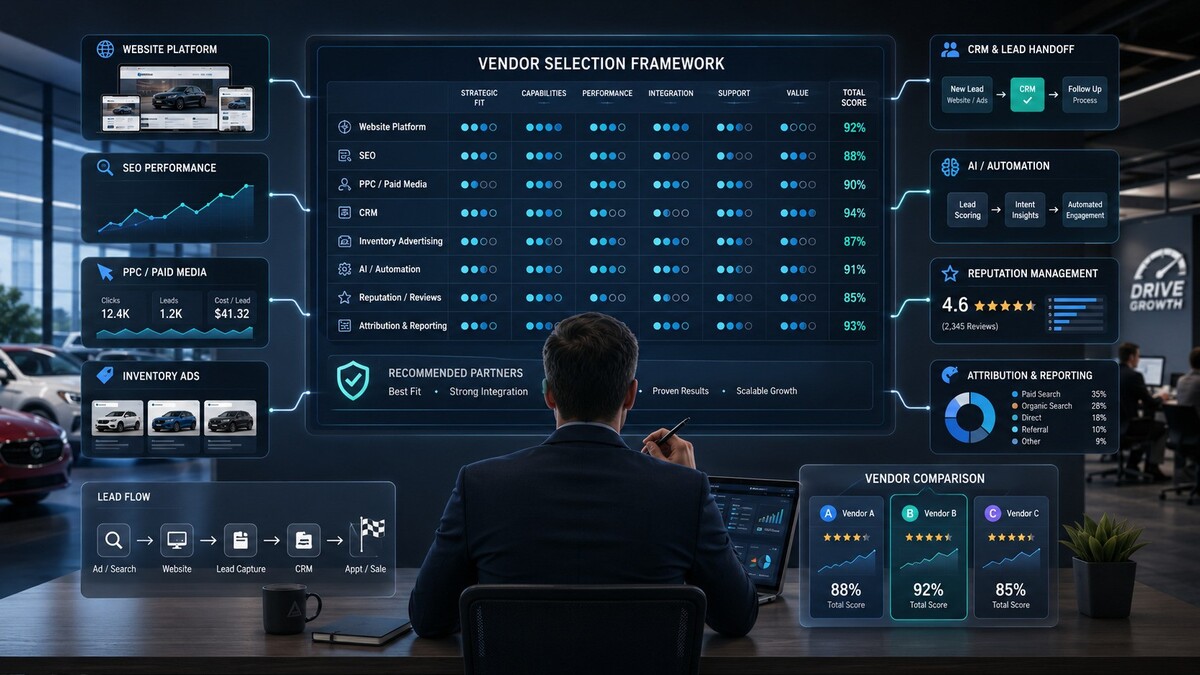
Dealer vendor selection is the process dealerships use to compare marketing, website, CRM, SEO, PPC, CDP, AI, reputation, analytics and reporting vendors before signing or renewing contracts.
Quick answer: choose vendors by business bottleneck, category fit, data ownership, integration requirements, reporting quality, first-90-day execution and proof that the vendor can improve calls, forms, appointments, service demand, sold units, retention or workflow quality.
Reviewed by the Automotive Digital Marketing Editorial Team. Evaluation criteria include dealership fit, account ownership, data access, integration requirements, reporting quality, compliance awareness and first-90-day execution.
Dealer owners, GMs, group marketing leaders, OEM program teams, SaaS buyers, procurement teams and agencies can use the same evaluation logic: define the operating problem, choose the right vendor category, verify ownership, test integrations and require measurable first-90-day execution.
Need a practical worksheet? Use the route table below to open the Vendor Scorecard and RFP Templates before vendor calls.
Dealer Vendor Selection Routes
| Vendor decision | Best starting point | Use it when |
|---|---|---|
| Compare marketing providers | Best Automotive Digital Marketing Companies | You need a shortlist of agencies, platforms, website providers, data partners or managed marketing vendors. |
| Choose an agency | Car Dealer Advertising Agency Guide | You are choosing an agency for paid media, SEO, creative, reporting or full-service dealership marketing. |
| Evaluate SEO fit | Car Dealership SEO | You need local SEO, inventory SEO, fixed-ops SEO, technical SEO or organic reporting support. |
| Evaluate social/video vendors | Automotive Social Media Marketing | You need organic social, paid social, video, inventory creative, reputation proof or lifecycle audiences. |
| Evaluate CRM and BDC workflow | Automotive Lead Management | You need better lead routing, response process, BDC accountability, CRM reporting or attribution feedback. |
| Use an RFP and scorecard | Vendor Scorecard and RFP Templates | You want a structured evaluation process before vendor calls, demos or contract renewal. |
Vendor Categories Dealerships Commonly Evaluate
Most dealership vendor decisions fall into a few repeatable categories. Each category has different evaluation criteria, data requirements and risk points. Compare each vendor by the operational job it must perform: website conversion, SEO visibility, paid media efficiency, CRM workflow, reputation, attribution, AI automation or reporting clarity. For agencies and platforms responsible for editorial production, governance and channel reuse, also review the automotive content marketing operating model.
| Vendor category | What it should improve | Primary risk to check |
|---|---|---|
| Dealer website platforms | SRPs, VDPs, speed, conversion paths, merchandising, forms, calls and compliance | Template limits, migration risk, ownership, page speed and conversion control |
| SEO vendors | Local visibility, inventory discovery, service demand, technical health and organic leads | Generic content, weak reporting, migration gaps and no dealership-specific SEO depth |
| PPC and paid media vendors | Qualified traffic, calls, forms, appointments, inventory demand and budget efficiency | Budget waste, weak negative keywords, unclear ownership and vanity reporting |
| Inventory advertising vendors | Demand for available units, aged inventory, VDP traffic and offer relevance | Feed quality, landing-page mismatch, poor creative and weak source-to-sale reporting |
| Social, video and creative agencies | Local trust, paid social demand, video output, inventory creative and retargeting | Generic posting, no paid structure, no content workflow and weak measurement |
| Reputation platforms | Reviews, local trust, response process, review velocity and store-level visibility | Review gating risk, poor escalation, weak department reporting and no local SEO tie-in |
| CRM and lead management systems | Speed-to-lead, routing, BDC process, follow-up, appointment quality and source feedback | Workflow complexity, adoption gaps, dirty data and poor integration with marketing reports |
| CDP, attribution and analytics vendors | First-party audiences, measurement, journey visibility, vendor accountability and budget decisions | Overstated attribution claims, integration burden and reports that leadership cannot use |
| AI chat and automation vendors | Lead capture, after-hours coverage, shopper answers, follow-up support and staff efficiency | Bad data, compliance gaps, weak handoff, poor training and no clear escalation path |
Dealer Bottleneck to Vendor Type Map
| If the dealership problem is | Prioritize this vendor type | What to verify first | Success signal |
|---|---|---|---|
| Low local visibility | SEO, local search and reputation vendors | Google Business Profile, local pages, reviews, service pages and technical crawlability | More qualified non-brand organic traffic, calls and service requests |
| High ad spend with weak outcomes | PPC, paid media and attribution vendors | Campaign structure, calls, forms, budget waste, source-to-sale visibility and landing pages | Lower cost per qualified opportunity and better appointment quality |
| Traffic but poor conversion | Website platform, CRO and lead path vendors | SRPs, VDPs, forms, calls, chat, mobile speed and offer clarity | Higher conversion rate and cleaner CRM handoff |
| Leads but weak follow-up | CRM, BDC, lead management and automation vendors | Routing, response time, templates, task completion, appointment process and manager visibility | Better response speed, appointment rate and show rate |
| Retention or fixed-ops leakage | CRM, email/SMS, service marketing and reputation vendors | Customer database, service intervals, reminders, coupons, review flow and reactivation process | More service bookings, repeat visits and customer reactivation |
| Leadership cannot see what works | Analytics, CDP, attribution and reporting vendors | Data access, integrations, identity resolution, dashboard logic and decision usefulness | Cleaner budget decisions and vendor accountability |
Dealer Vendor Selection Scorecard
Use this scorecard before demos and again after final proposals. Score each category from 1 to 5, then reject vendors that fail on account ownership, reporting quality, integration reality or first-90-day clarity.
| Criterion | What strong looks like | What to ask for |
|---|---|---|
| Dealership fit | Understands rooftops, inventory, service, CRM, OEM rules and dealership economics | Dealer-specific examples and constraints the vendor commonly handles |
| Problem fit | Clearly maps its solution to your actual bottleneck | What problem the vendor is not designed to solve |
| Proof and evidence | Shows relevant examples, use cases, sample reports and implementation logic | Comparable dealer scenarios, not generic claims |
| Data and account ownership | Dealer keeps ad accounts, analytics, audiences, content assets and reporting history | Written ownership and offboarding terms |
| Integration requirements | Explains DMS, CRM, website, inventory feed, call tracking and analytics dependencies | Implementation checklist and responsible parties |
| Reporting quality | Connects activity to calls, forms, appointments, service, sold feedback or workflow outcomes | Sample report with business metrics |
| First-90-day plan | Defines audit, setup, launch, optimization and review milestones | 30/60/90-day roadmap |
| Communication model | Names who does the work, who owns strategy and who attends performance calls | Account team roles and escalation path |
| Contract flexibility | Clear scope, cancellation terms, renewal logic and transition process | Contract, SLA and offboarding language |
| Compliance awareness | Understands pricing claims, offer approvals, privacy, consent, OEM rules and platform limits | Review process and compliance examples |
RFP Questions for Automotive Marketing Vendors
- Which dealership problem are you best suited to solve, and which problems are outside your scope?
- How do you define success in the first 30, 60 and 90 days?
- What data, account access, feeds, CRM fields or website access do you need?
- Who owns ad accounts, pixels, audiences, analytics, content, creative files and reporting history?
- How do you report calls, forms, appointments, lead quality, service requests or sold outcomes?
- How do you handle implementation with the website provider, CRM, DMS, call tracking and inventory feed?
- What does your reporting show that a GM, marketing director or dealer principal can act on?
- What are the top three reasons your dealership implementations fail?
- How do you handle compliance, offer approvals, pricing claims and OEM/co-op constraints?
- What happens if we cancel, switch vendors or need to export data and assets?
Data, Account and Asset Ownership Checklist
- Ad accounts should be owned by the dealership or dealer group whenever possible.
- Google Analytics, Search Console, call tracking and tag manager access should remain under dealership control.
- Creative files, content, landing pages, audiences and historical reports should have clear export rules.
- CRM fields and lead-source mapping should be documented before launch.
- Inventory feeds, website forms and call tracking should be tested before campaigns scale.
- Offboarding should define what the dealer keeps, what the vendor removes and how transition support works.
How to Choose a Dealer Vendor
- Identify the dealership bottleneck. Decide whether the main issue is local visibility, paid media waste, website conversion, follow-up, retention or reporting clarity.
- Choose the correct vendor category. Match the bottleneck to the vendor type most likely to solve it, such as SEO, PPC, website, CRM, CDP, attribution, reputation, social or AI.
- Score the shortlist. Use the dealer vendor selection scorecard to compare dealership fit, proof, ownership, integrations, reporting, first-90-day plan and contract terms.
- Ask RFP and ownership questions. Confirm account ownership, data access, implementation requirements, reporting expectations, compliance process and offboarding terms.
- Review the first 90 days. Require a practical launch plan with audit, setup, QA, optimization, reporting and next-quarter recommendations.
First 90 Days After Selecting a Dealer Vendor
| Period | Vendor work | Dealer input | Output |
|---|---|---|---|
| Days 1–15 | Access, audit, implementation checklist, tracking review and baseline documentation | Accounts, CRM contacts, website vendor contacts, business goals and prior reports | Baseline and launch plan |
| Days 16–30 | Setup, integration, tracking validation, campaign or workflow launch and first quick fixes | Approvals, compliance review, inventory priorities and store feedback | Live implementation and first QA report |
| Days 31–60 | Optimization, reporting cleanup, issue resolution and early performance review | Lead quality, appointment feedback, service or sales manager input | Improvement plan and priority fixes |
| Days 61–90 | Performance review, budget or workflow recommendations and next-quarter roadmap | Decision-maker review and renewal/scale criteria | 90-day vendor score and next-step decision |
When should a dealership replace a vendor?
A dealership should replace a vendor when ownership terms are unclear, reporting does not support decisions, integrations create operational drag, first-90-day execution stalls, or the vendor no longer matches the store’s main growth bottleneck.
- Reporting does not connect to calls, forms, appointments, service demand or sold outcomes.
- The vendor controls accounts, audiences, tracking or historical data.
- The team cannot explain implementation responsibilities.
- Support calls produce activity summaries without operating decisions.
- The contract creates renewal pressure before performance is clear.
Dealer Vendor Red Flags
- The vendor cannot explain which dealership problem it solves best.
- The pitch emphasizes dashboards without showing how a manager should make better decisions.
- Account ownership, audience ownership or data export terms are unclear.
- Reports do not connect to calls, forms, appointments, service demand, sold units or workflow outcomes.
- The vendor needs many integrations but cannot provide an implementation checklist.
- The first 90 days are vague.
- Pricing is easy to understand, but the scope is not.
- The vendor blames the dealer, CRM, website or market before auditing the process.
- Contract renewal or cancellation terms are hard to understand.
Where to Start in the Vendor Buying Process
Start with the bottleneck map, choose the right vendor category, score the shortlist, then use the RFP questions and ownership checklist before reviewing contracts. Channel-specific decisions should move into the next vendor decision pages below.
Next Vendor Decisions
Vendor Selection Decision Rule
Dealer vendor selection should start with the dealership’s operating bottleneck, then move through category fit, ownership terms, integration requirements, reporting quality, contract flexibility and first-90-day proof. Vendors that cannot protect dealer-owned data, explain implementation responsibilities or connect their work to measurable outcomes should not survive the shortlist.
Next step: score current vendors, identify the weakest operating link, then use the RFP questions and ownership checklist before renewal, replacement or new vendor selection.
Frequently Asked Questions About Dealer Vendor Selection
What is dealer vendor selection?
Dealer vendor selection is the process of evaluating and choosing automotive marketing, website, CRM, reputation, AI, analytics, paid media and software vendors based on dealership goals, integrations, ownership, reporting, cost and expected business outcomes.
How should a dealership compare marketing vendors?
A dealership should compare vendors by category fit, dealership experience, data ownership, integration requirements, reporting quality, first-90-day plan, contract terms and proof that the vendor can improve calls, leads, appointments, service demand, retention or sold outcomes.
What vendor categories matter most for dealership marketing?
The main categories include dealer website platforms, SEO, PPC, inventory ads, social and video, reputation management, CRM and lead management, CDP, attribution, AI chat, automation and reporting tools.
What should be included in a dealership vendor RFP?
A dealership vendor RFP should include business goals, rooftop count, current technology stack, data access requirements, reporting expectations, ownership terms, implementation timeline, compliance needs, budget range and questions about first-90-day execution.
What are the biggest red flags when choosing a dealer vendor?
Major red flags include unclear account ownership, vague reporting, no implementation plan, weak dealership experience, poor integration detail, hard-to-understand contracts, generic dashboards and no connection to business outcomes.
How often should a dealership review vendors?
Most dealerships should review core vendors at least quarterly for performance and annually for contract fit, ownership terms, reporting quality, integration health and whether the vendor still matches the dealership’s growth priorities.