
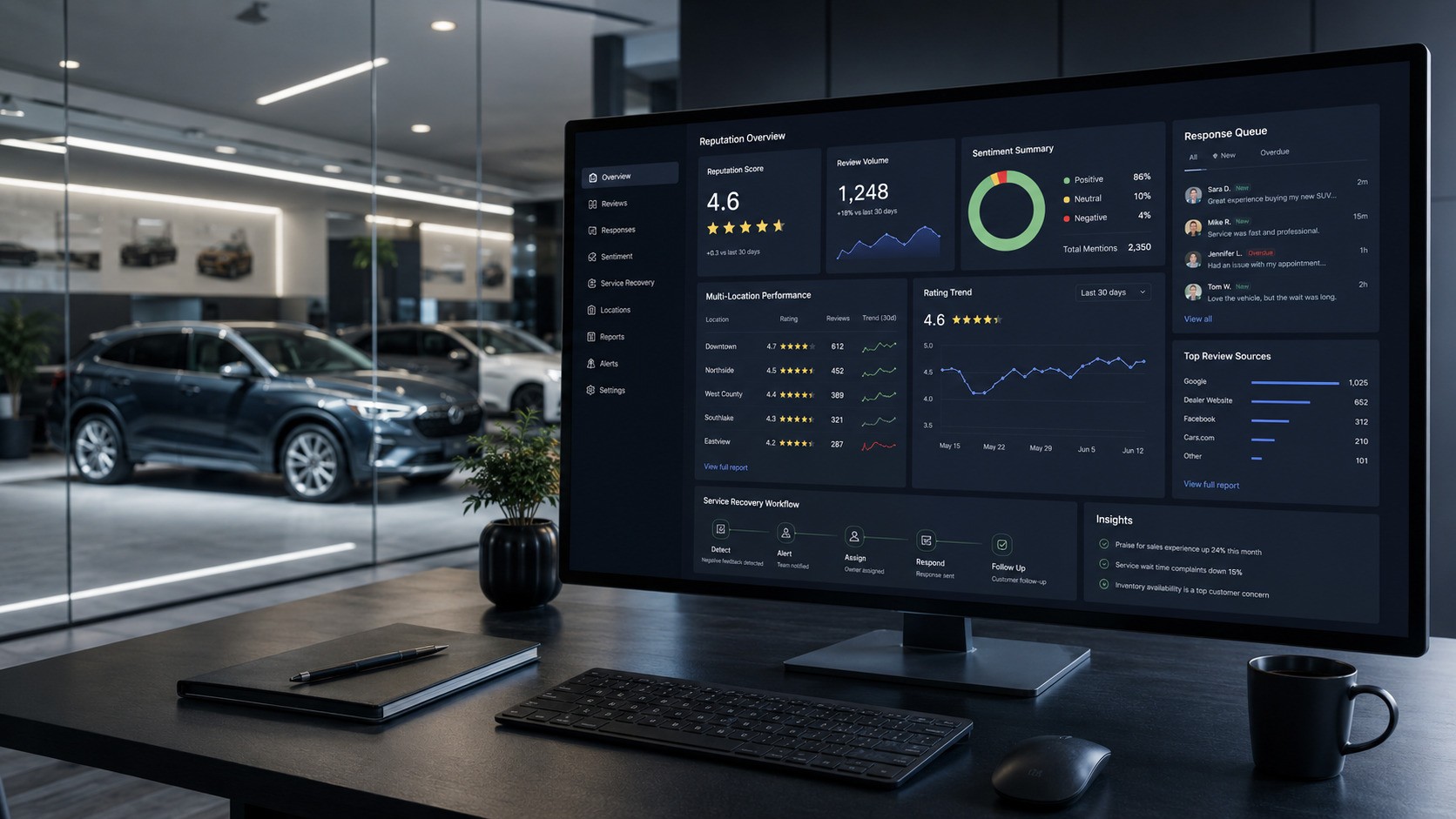
Dealership reputation management is the operating system a store or dealer group uses to earn legitimate reviews, monitor public feedback, respond consistently, recover unhappy customers and turn review themes into operational fixes. In 2026, the category extends beyond star ratings: reviews, listings, social commentary and customer feedback increasingly function as a shared trust and customer-experience data layer.
A 2026 dealer guide for Google reviews, response benchmarks, complaint recovery, reputation software, vendor comparison, multi-location governance, pricing and measurable customer-experience outcomes.
Quick answer: the strongest reputation program does four jobs well: creates a steady stream of legitimate recent reviews, responds to feedback quickly and personally, routes serious complaints to managers who can resolve them, and measures recurring themes by department and location so the dealership can fix the customer experience that produces the reviews.
2026 dealership reputation demand
Google Ads Keyword Planner data for the United States, English language and Google Search shows modest volume with strong commercial buyer intent.
| Keyword | Average monthly searches | High top-of-page bid |
|---|---|---|
| dealership reputation management | 40 | $20.31 |
| car dealership reputation management | 50 | $31.82 |
The search volume is smaller than broad automotive marketing categories, but the bid signal is substantial. That makes this page primarily a vendor-selection and operating-governance resource.
2026 automotive reputation evidence snapshot
Fresh automotive research gives dealers a useful benchmark context. Widewail’s Q1 2026 Voice of the Customer report analyzed approximately 1.2 million Google reviews from nearly 18,000 U.S. dealerships and reported review volume down roughly 15% year over year. A separate 2026 automotive review study in the Netherlands analyzed 204,976 review texts across 853 locations, illustrating how response gaps and response time can be measured as operating metrics rather than anecdotes.
| Evidence | Observed data | Dealer use |
|---|---|---|
| Widewail Q1 2026 U.S. automotive study | ~1.2M Google reviews, nearly 18,000 dealerships | Use large-scale U.S. context for review-volume and complaint-theme trends. |
| Widewail Q1 2026 volume trend | ~15% YoY decline in review volume | A single rooftop’s lower velocity may reflect both store process and wider market normalization. |
| Repmanager 2026 Netherlands study | 204,976 review texts, 853 locations | Useful cross-market evidence for measuring response rate, response time and unresolved complaint share. |
Evidence rule: use industry datasets for context, then manage the dealership against its own baseline, nearby competitors, transaction volume and department mix. A national average cannot replace rooftop-specific operating data.
Dealership reputation management decision routes
| Primary need | Best starting point | Use it when |
|---|---|---|
| Improve Google reviews | Google review workflow | Volume, recency, response rate or complaint handling is weak. |
| Improve local visibility | Local SEO for dealerships | Reviews are part of a wider local-search problem. |
| Fix profile operations | Google Business Profile workflow | Departments, listings, photos, services or profile ownership need work. |
| Compare software | Reputation platform comparison | You are shortlisting software or managed services. |
| Recover unhappy customers | Service recovery workflow | Negative feedback is public but operational follow-through is inconsistent. |
| Standardize multi-rooftop governance | Dealer-group governance | Locations differ sharply in response quality or customer experience. |
| Evaluate vendors | Dealer vendor selection | You need contract, implementation, ownership and transition standards. |
What automotive reputation management includes
| Operating layer | Dealer requirement | Proof |
|---|---|---|
| Review generation | Event-based legitimate requests after real customer interactions | Trigger logic, timing, consent and suppressions |
| Monitoring | Centralized alerts across relevant review and social sources | Supported-source list and alert workflow |
| Response | Personal, timely replies with role and escalation controls | Queue, response-time report and audit trail |
| Service recovery | Negative feedback reaches the manager who can resolve it | Case owner, due date and resolution record |
| Customer intelligence | Review themes become department/location trends | Topic taxonomy and recurring-issue report |
| Local presence | Listings and profile data remain accurate | Exception report and location ownership |
| Group governance | Central standards with local accountability | Permissions, rooftop dashboard and escalation policy |
| Data ownership | Dealer can export history and transition vendors | Export format and contract language |
Google review workflow for dealerships
Review request workflow
- Trigger requests after verified sales, service or support events.
- Use timing that fits the interaction rather than one generic blast.
- Respect consent, opt-outs, OEM rules and messaging requirements.
- Avoid review gating or selectively routing only satisfied customers to public review sites.
- Track request delivery, completion and new-review velocity by rooftop and department.
Response workflow
- Assign response ownership for sales, service, parts and finance.
- Set a response-time target plus escalation threshold for serious complaints.
- Use templates as quality controls while preserving specific customer context.
- Move account-specific, legal, safety or privacy-sensitive matters into an appropriate private recovery channel.
- Tag themes so leadership can distinguish isolated complaints from recurring operating problems.
Dealers should follow Google’s current Maps user-contributed content policy and Business Profile review-response guidance. Incentives and review solicitation should also be checked against current FTC review guidance.
Response rate, response time and complaint gap
Average star rating is too blunt to manage reputation operations. Three metrics expose the process more clearly:
| Metric | Definition | Management question |
|---|---|---|
| Response rate | Share of reviews receiving an appropriate public response | Is the store consistently acknowledging customer feedback? |
| Median response time | Median elapsed time from review publication to dealership response | Are unhappy customers waiting longer than satisfied customers? |
| Complaint gap | Share of negative reviews left without a public response under the dealership’s defined negative-rating threshold | How much visible unresolved criticism remains in market? |
| Recovery closure rate | Share of escalated cases with a documented resolution outcome | Does public response lead to actual operational follow-through? |
| Recurring-theme rate | Frequency of repeated complaint topics by department/location | Which customer-experience problems need process correction? |
Measure these by sales, service, parts and finance where volume supports it. A group-level average can hide one rooftop or department with a persistent operational failure.
Competitive reputation-gap scorecard
A shopper sees the dealership beside nearby alternatives. Reputation management should therefore compare the rooftop with a defined local peer set instead of judging a star rating in isolation.
| Field | Dealer | Competitor set | Decision use |
|---|---|---|---|
| Overall rating | Current Google rating | Median and range across named nearby dealers | Shows visible trust position |
| Review count | Total current reviews | Median and nearest stronger competitor | Shows proof-volume gap |
| 90-day review velocity | New reviews in the last 90 days | Same window for competitors | Shows current momentum |
| Response rate | Dealer response coverage | Observed competitor response coverage | Shows whether public feedback is actively managed |
| Median response time | Dealer median | Observed competitor median where measurable | Shows service responsiveness |
| Complaint themes | Top recurring negative topics | Top recurring competitor topics | Shows where operational differentiation is possible |
Gap rule: name the competitor set and measurement window before comparing. Use the scorecard to choose one operational improvement, one review-generation improvement and one response-process improvement for the next cycle.
Service recovery and negative-review escalation
| Stage | Required action | Evidence |
|---|---|---|
| Detect | Capture review promptly | Alert timestamp |
| Classify | Tag location, department, severity and issue | Case record |
| Assign | Send to manager with authority to resolve the problem | Owner + due date |
| Respond | Acknowledge publicly without exposing sensitive information | Published response |
| Recover | Contact customer and address underlying issue | Resolution note |
| Learn | Aggregate recurring root causes | Monthly trend + corrective action |
For fixed ops, repeated complaints about scheduling, communication, repair status, pricing clarity or handoffs should feed the dealership’s service retention program.
From reputation management to customer intelligence
Current automotive platforms increasingly position reputation as a source of operational intelligence. The useful dealer-side interpretation is simple: public and private feedback should produce a ranked problem list that managers can act on.
| Review theme | Potential operating owner | Evidence to inspect |
|---|---|---|
| Slow communication | BDC / sales / service advisor management | Response times, unanswered calls/messages, handoff process |
| Pricing confusion | Sales/F&I/service leadership | Offer language, disclosures, RO estimates and customer explanations |
| Long waits | Service or sales operations | Appointment load, check-in, repair status and staffing |
| Handoff failures | Department managers | Ownership between BDC, salesperson, advisor and manager |
| Great employee mentions | Store leadership | Repeat positive staff themes and coaching examples |
A platform that labels sentiment without showing the underlying review, location, department, time period and trend is less useful than one that makes the evidence auditable.
Reputation management software: buyer requirements
| Capability | Why it matters | Proof to request |
|---|---|---|
| Event-based requests | Creates steady review flow tied to real customer events | Trigger map, timing and suppression logic |
| Multi-source monitoring | Centralizes reviews and social feedback | Supported-source list and alert coverage |
| Response workflow | Supports ownership, approvals and escalation | Live queue and audit history |
| Topic intelligence | Finds recurring CX issues | Department taxonomy and trend report |
| Multi-location reporting | Shows rooftop variance | Portfolio dashboard and permissions |
| CRM/DMS/service integration | Connects requests and recovery to actual customers | Architecture, direction, frequency and failure handling |
| Listings/profile support | Protects local trust and discovery data | Publisher coverage and exception workflow |
| AI controls | Can speed drafting/classification | Human approval, privacy, audit and escalation rules |
| Export/ownership | Protects dealer history during a switch | Export format, retention and transition SLA |
2026 automotive reputation platform comparison
This matrix summarizes current public product positioning from official vendor pages. It is a buyer starting point. Verify current integrations, pricing, service scope and references during the buying process.
| Platform | Public strengths to investigate | Best-fit question | What to verify live |
|---|---|---|---|
| Widewail | Automotive specialization, review generation, human-powered response service, customer-intelligence analysis and large automotive benchmark datasets | Does the dealer want automotive-specific managed response plus benchmarking and feedback intelligence? | Review sources, response SLA, DMS/CRM triggers, topic taxonomy, rooftop benchmark logic and export rights |
| Reputation | Enterprise reputation intelligence across reviews, listings, social and customer feedback with large automotive/OEM orientation | Does a dealer group or OEM need a broad multi-location intelligence and governance layer? | Location hierarchy, role permissions, listings coverage, feedback unification, reporting definitions and integration depth |
| Birdeye | Broad review/reputation platform with automotive customers, multi-location review generation and customer-experience tooling | Does the dealership want a broad reputation/customer-experience suite across several channels? | Automotive workflow depth, DMS/CRM triggers, managed-service scope, location reporting and data portability |
Named vendors should still be run through the same dealership scorecard. Product breadth, automotive specialization and managed-service depth solve different operating problems.
Software, managed service, agency or hybrid?
| Model | Best fit | Main advantage | Main risk |
|---|---|---|---|
| Software only | Dealer has strong internal owner | Control and lower service dependency | Low adoption or slow response execution |
| Managed reputation service | Dealer needs consistent response/review operations | Execution capacity | Generic responses or weak store context |
| Marketing agency | Reputation is integrated with local SEO and broader marketing | Cross-channel coordination | Reputation becomes a small add-on |
| Hybrid | Dealer group with central standards and local managers | Scale plus local accountability | Unclear ownership between vendor and store |
Reputation software pricing and total cost
Most vendors price by location, modules, service scope or a negotiated enterprise package. Compare total operating cost rather than a headline platform fee.
| Cost category | Buyer question |
|---|---|
| Platform | Per rooftop, brand, account or module? |
| Implementation | Are configuration, migration and training separate? |
| Managed responses | Included, capped or priced by volume/location? |
| Integrations | Which CRM/DMS/service connections have separate fees? |
| Listings | Which publishers and locations are included? |
| Reporting/intelligence | Are portfolio benchmarks, exports or custom reports extra? |
| Exit | What export, transition and cancellation fees apply? |
Dealer-group and multi-location governance
- Use central response/privacy standards with named local owners.
- Report sales, service, parts and finance separately where data supports it.
- Compare review velocity, response rate, response time and complaint gap by rooftop.
- Use role-based permissions and auditable approvals.
- Track unresolved cases and repeated issue themes.
- Benchmark rooftops against nearby competitors and comparable stores.
- Require each low-performing rooftop to own a corrective-action plan.
Reputation metrics and ROI
| Layer | Metrics | Decision |
|---|---|---|
| Review health | Volume, velocity, recency, rating trend | Is current social proof healthy? |
| Response operations | Response rate, median response time, complaint gap | Is feedback being managed consistently? |
| Customer experience | Theme frequency, severity, recovery closure | Which problems need an operational fix? |
| Local visibility | GBP/profile engagement and local conversion | Does public trust support discovery and action? |
| Group governance | Rooftop variance, overdue cases, manager adoption | Where is process discipline weak? |
| Economics | Program cost, internal labor, recovered-customer value | Is the reputation operating model worth its full cost? |
Dealership reputation vendor proof scorecard
| Category | High-quality evidence |
|---|---|
| Automotive specialization | Current dealer workflows and references |
| Review generation | Event triggers, timing, consent and suppression logic |
| Response operations | Queue, SLA, escalation and audit trail |
| Customer intelligence | Auditable topic trends tied to locations/departments |
| Service recovery | Case ownership and closure reporting |
| Multi-location governance | Role model, rooftop dashboards and portfolio benchmarks |
| Integrations | Documented architecture and failure monitoring |
| AI controls | Approval, context, privacy and escalation policy |
| Commercial terms | Line-item scope, renewal and exit terms |
| Data ownership | Usable exports and transition support |
Daily, weekly and monthly reputation operating cadence
| Cadence | Required work | Evidence |
|---|---|---|
| Daily | Review new feedback, respond or assign, escalate serious complaints, verify queue ownership | Open queue, response timestamps, overdue cases |
| Weekly | Review unresolved recovery cases, recurring themes, request delivery and department exceptions | Theme report, closure list, trigger/suppression exceptions |
| Monthly | Compare rating, volume, velocity, response rate/time, complaint gap and local competitors | Rooftop scorecard + competitor-gap report |
| Quarterly | Review vendor value, workflow adoption, policy risk, integration health and corrective-action progress | Executive review + next-quarter actions |
First 90 days of a reputation program
| Period | Priority | Evidence gate |
|---|---|---|
| Days 1–15 | Audit reviews, profiles, response time, complaint gap, issue themes, locations, competitors and current vendor | Baseline + ownership map + peer set |
| Days 16–30 | Define request logic, response SLA, permissions, escalation and operating cadence | Documented workflow |
| Days 31–60 | Launch/repair requests, response queue and recovery routing | Velocity, response and case-quality signals |
| Days 61–90 | Review themes, competitor gap, rooftop variance, unresolved cases, adoption and cost | Corrective-action plan by issue/location |
Reputation management red flags
- Promises to remove legitimate negative reviews.
- Review gating, fake-review tactics or undisclosed incentives.
- Auto-published sensitive responses without human controls.
- Reporting limited to average star rating.
- No response-rate or response-time measurement.
- No service-recovery owner or closure record.
- No defined competitor peer set or comparison window.
- No separation of sales, service, parts and finance themes.
- Opaque integration or data-export terms.
- Vendor case studies without baseline, dates, sample size or source system.
Methodology and sources
This September 2026 revision combines live Google Ads demand data, current U.S. automotive review research, cross-market review-response research, current top-ranking dealership reputation guides, official vendor product pages and Google/FTC review-policy guidance.
- Demand: Google Ads Keyword Planner, United States, English, Google Search, accessed September 6, 2026.
- U.S. automotive benchmark: Widewail Q1 2026 Voice of the Customer research.
- Cross-market benchmark: Repmanager Automotive Google Review Study 2026, Netherlands.
- Current-market review: Maxx Media, Savvy Dealer and Omni Advertising pages reviewed September 7, 2026.
- Vendor sources: official Widewail, Reputation and Birdeye automotive/reputation pages reviewed September 6, 2026.
- Policy sources: current Google review/content guidance and FTC review-solicitation guidance.
Frequently asked questions about dealership reputation management
What is dealership reputation management?
It is the process for generating legitimate reviews, monitoring public feedback, responding consistently, recovering unhappy customers and using recurring feedback themes to improve dealership operations.
Which reputation metrics should a dealership track?
Track review volume, velocity, recency, rating trend, response rate, median response time, complaint gap, recovery closure and recurring issue themes by department and location.
How should dealerships manage Google reviews?
Use verified customer-event requests, avoid gating, assign response ownership, protect private information, escalate serious complaints and track response and recovery quality.
How fast should a dealership respond to reviews?
Set and monitor a documented response-time target by severity and department. The most useful benchmark is the dealership’s own median response time and whether negative reviews wait longer than positive reviews.
Which dealership reputation software should a dealer compare?
Current buyers can evaluate automotive-focused and broader platforms such as Widewail, Reputation and Birdeye, then test each against the dealership’s own review sources, integrations, locations, response model and data-ownership requirements.
Should AI respond to dealership reviews?
AI can assist drafting, classification and routing, while sensitive responses should remain under human approval, privacy and escalation controls.
How much does dealership reputation management cost?
Total cost depends on locations, modules, integrations, managed responses, listings, implementation, reporting and contract terms. Compare complete operating cost and exit obligations.
How should dealer groups manage reputation across rooftops?
Use central standards, role-based permissions, rooftop-level metrics, local managers, issue escalation and corrective-action plans for underperforming locations.
How should a dealer handle a serious negative review?
Classify the issue, assign a manager, respond publicly without exposing private details, contact the customer through an appropriate private channel, document the resolution and track whether the same problem repeats.
How should a dealership compare reputation vendors?
Require proof of review triggers, response workflow, integrations, customer-intelligence reporting, multi-location governance, AI controls, pricing, data ownership and transition support.