
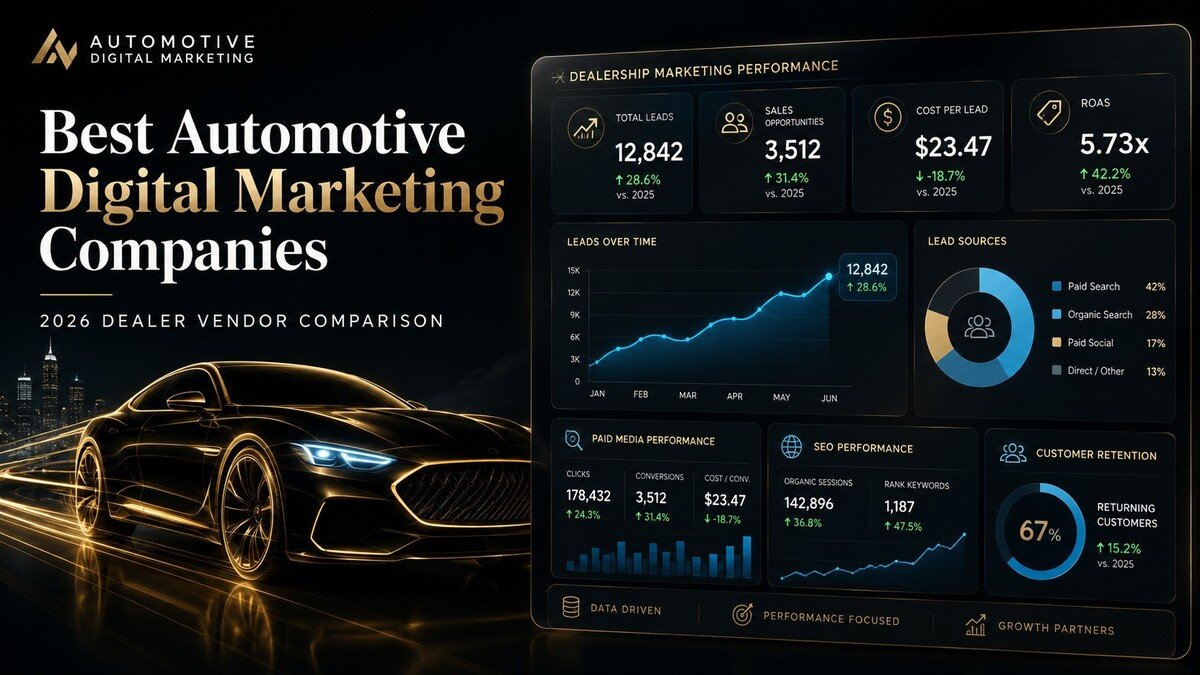
The 2026 Automotive Digital Marketing Buyer’s Guide is a practical PDF resource for dealerships, dealer groups, OEM program teams and automotive marketing vendors comparing the modern dealer marketing stack: websites, SEO, paid search, inventory advertising, AI chat, CRM, CDP, reputation, attribution, reporting and vendor selection.
Quick answer: the guide helps dealership decision-makers evaluate marketing vendors by channel fit, data ownership, integration depth, inventory awareness, CRM alignment, reporting quality, compliance risk, contract terms and first-90-day execution.
Why the 2026 guide matters
Dealership marketing decisions in 2026 are no longer just channel decisions. A dealer group comparing vendors has to evaluate account ownership, CRM source accuracy, inventory feed quality, AI chat handoff, call tracking, GA4 events, appointment reporting, OEM compliance, co-op documentation and the vendor’s ability to produce useful decisions in the first 90 days.
The buyer’s guide is designed for teams that need a structured way to compare website providers, SEO agencies, PPC agencies, inventory advertising partners, CRM/CDP tools, AI chat vendors, reputation platforms and attribution providers before renewal, migration or replacement. It gives dealership leaders a common language for vendor calls: what must be owned by the dealer, what must be measurable, what must integrate with operations and what must be proven before the contract is signed.
What changed in dealership marketing vendor selection
Vendor selection is more complex because the marketing stack is now connected to nearly every dealership operating function. Website performance affects SEO, paid media conversion and inventory merchandising. CRM source mapping affects reporting, appointment accountability and follow-up quality. Inventory feeds affect VIN-level advertising, SRP/VDP alignment and sold-unit suppression. AI tools affect lead routing, transcript quality, compliance review and customer experience.
The strongest vendor review process now checks more than price and promised lead volume. It asks whether the dealer controls ad accounts, analytics properties, call tracking numbers, landing pages, historical campaign data and reporting definitions. It also checks whether the vendor can explain how calls, forms, chats, appointments, show rate, sold units and service revenue are connected in reporting.
How dealer groups should compare vendors before renewal
Before a renewal or vendor switch, dealer groups should create a baseline of current providers, account ownership, integration status, reporting quality and implementation risk. The goal is not to replace every vendor; the goal is to identify the bottleneck that is limiting growth or accountability. Common bottlenecks include low-quality traffic, weak VDP conversion, inaccurate CRM source reporting, slow lead follow-up, poor inventory feed hygiene, unclear fixed-ops contribution or dashboards that do not help leadership make decisions.
The guide helps teams turn that review into a repeatable process. Each vendor should be evaluated against dealer specialization, integration depth, data ownership, inventory awareness, compliance workflow, first-90-day execution and exit terms. That structure is especially useful when a dealer group is comparing a website migration, agency review, CDP implementation, AI chat rollout or paid media reset across multiple rooftops.
Download the PDF: 2026 Automotive Digital Marketing Buyer’s Guide. Use it before vendor calls, RFPs, renewal conversations, website migrations, AI evaluations, CDP reviews or dealer group marketing planning.
Need the editable worksheet pack? Request the worksheet pack for the vendor scorecard, RFP checklist, budget worksheet, first-90-day rollout planner and monthly reporting template.
What is inside the buyer’s guide?
| Section | What it covers | Why it matters |
|---|---|---|
| Dealer marketing stack map | Websites, SEO, PPC, social/video, CTV, inventory ads, reputation, CRM, CDP, AI chat, attribution and reporting. | Helps leadership see how channels and vendors fit together. |
| Vendor selection criteria | Dealer specialization, integrations, account ownership, reporting, compliance, implementation and exit terms. | Reduces the risk of buying a tool or agency that does not fit dealership operations. |
| Channel-by-channel questions | What to ask SEO, PPC, website, AI, CRM, CDP, reputation and attribution vendors. | Improves vendor calls and RFP quality. |
| Budget planning framework | How to think about spend by rooftop count, channel maturity, service mix and business bottleneck. | Connects marketing budget to qualified opportunities, appointments, sold units and service revenue. |
| 90-day rollout plan | Access, audits, tracking cleanup, vendor onboarding, reporting cadence and performance review. | Turns vendor selection into an execution plan. |
| Worksheets and templates | Vendor scorecard, RFP checklist, monthly report outline and budget worksheet. | Creates practical assets for dealership teams before contract renewal or vendor change. |
Who should use it?
- Dealership owners and GMs comparing agencies, website providers, AI tools or marketing platforms.
- Dealer group marketing leaders standardizing vendor evaluation across rooftops and markets.
- OEM program teams evaluating dealer enablement, co-op, compliance and brand-to-local execution.
- Automotive SaaS vendors mapping how dealerships evaluate websites, CRM, CDP, AI, inventory ads and attribution.
- Agencies and platform buyers studying dealer marketing demand, vendor categories and buyer criteria.
Dealer marketing stack map
The guide organizes dealership marketing into a practical operating stack: website platform, local SEO, paid search, paid social, video, inventory advertising, reputation, CRM, lifecycle marketing, CDP, AI chat, reporting and attribution. Each layer should connect to a dealership outcome: traffic, lead quality, appointment rate, show rate, sold units, service revenue, retention or better marketing accountability.
Dealer marketing stack checklist
| Layer | What to verify |
|---|---|
| Website | Ownership, page speed, inventory pages, lead routing, analytics and conversion tracking. |
| SEO | Local visibility, model pages, service content, technical cleanup and reporting tied to business outcomes. |
| Paid media | Budget control, campaign structure, keyword intent, inventory alignment and lead quality. |
| CRM / CDP | Lead source accuracy, lifecycle segments, equity mining, service retention and clean handoff to sales teams. |
| Reporting | Calls, forms, chats, appointments, sold units, service revenue, attribution limits and monthly decision rules. |
Vendor selection scorecard
A weighted scorecard gives dealership teams a shared way to compare vendor fit, account ownership, integration depth, reporting quality and first-90-day execution. The strongest vendor matches the dealership’s bottleneck, protects the dealer’s accounts and data, and provides reporting that connects marketing activity to appointments, sold units and service revenue.
| Criteria | Why it matters | Example question |
|---|---|---|
| Dealer specialization | Automotive retail has inventory, CRM, fixed ops, trade-in, finance and OEM constraints. | What dealership-specific problems do you solve better than a general marketing provider? |
| Data ownership | Dealers need control of accounts, analytics, reports, customer data and campaign history. | What can we export if the relationship ends? |
| Integration depth | Marketing performance depends on website, CRM, inventory, CDP and reporting connections. | Which integrations are native, custom or manual? |
| Reporting quality | Reports must connect activity to calls, forms, appointments, sold units and service revenue. | Can you show a sample report tied to business outcomes? |
| First 90 days | Implementation quality often decides whether a vendor relationship succeeds. | What happens in days 1–15, 16–30, 31–60 and 61–90? |
Sample vendor scorecard questions
- Dealer specialization: Which dealership-specific problems does the vendor solve better than a general marketing provider?
- Account ownership: Which ad accounts, analytics properties, call tracking numbers, CRM data and reporting assets remain under dealer control?
- Inventory awareness: How does the vendor handle VIN-level ads, feed quality, SRP/VDP alignment and inventory changes?
- CRM alignment: How are calls, forms, chats, appointments, show rate, sold units and service revenue connected in reporting?
- First 90 days: What happens in days 1–15, 16–30, 31–60 and 61–90?
Evidence to request before choosing a vendor
- Sample monthly report tied to calls, forms, chats, appointments, sold units and service revenue.
- Export policy for ad accounts, analytics properties, call tracking numbers, landing pages and historical campaign data.
- Inventory feed handling process for VIN-level campaigns, SRP/VDP alignment and sold-unit suppression.
- CRM source mapping rules for lead provider, channel, campaign and follow-up status.
- First-90-day implementation plan with access, tracking, creative, campaign, reporting and review milestones.
- Contract exit terms, notice periods, data return process and account transfer process.
Download and worksheet access
The PDF is available as a public download. The editable worksheet pack should be requested separately because it is designed for active vendor reviews, RFP planning, budget planning and dealership team use.
| Asset | Access model | Purpose |
|---|---|---|
| Buyer’s Guide PDF | Public download | Use for planning, vendor education and internal leadership alignment. |
| Editable worksheet pack | Qualified request | Use for vendor scoring, RFP preparation, budget planning and 90-day rollout planning. |
| Vendor / sponsor inquiry | Qualified contact path | Use for platform, agency, media and acquisition conversations. |
How to use the guide before a vendor call
- List the dealership’s current website, SEO, PPC, social, inventory, CRM, CDP, AI chat, reputation and attribution vendors.
- Mark the main bottleneck: traffic, lead quality, appointment rate, show rate, sold units, service revenue, reporting or data ownership.
- Score each vendor against dealer specialization, integration depth, account ownership, reporting quality and first-90-day execution.
- Use the RFP questions before renewal, migration, agency selection or platform replacement.
- Keep the worksheet pack as the internal comparison file for leadership and vendor calls.
Common dealer group use cases
| Situation | How to use the guide |
|---|---|
| Website migration | Use the stack map, ownership questions and first-90-day plan before signing with a new website provider. |
| Agency review | Use the scorecard to compare dealer specialization, reporting quality, CRM alignment and exit terms. |
| AI chat evaluation | Use the channel questions to check handoff quality, lead routing, CRM logging and appointment reporting. |
| Budget planning | Use the budget framework to connect spend to bottlenecks: traffic, lead quality, appointments, sold units or service revenue. |
| Vendor consolidation | Use the stack checklist to identify overlap across website, CRM, CDP, paid media, attribution and reporting vendors. |
Related templates and guides
- Automotive Digital Marketing Reports
- 2026 Automotive Digital Marketing Worksheet Pack
- Best Automotive Digital Marketing Companies for Dealerships
- How to Choose a Car Dealer Advertising Agency
- Automotive Marketing Strategy for Dealerships
Frequently Asked Questions
What is the 2026 Automotive Digital Marketing Buyer’s Guide?
It is a downloadable buyer resource for dealerships and dealer groups evaluating automotive marketing vendors, channels, tools, agencies and reporting requirements.
Is this guide for vendors or dealerships?
It is written primarily for dealerships and dealer groups, but it also helps automotive SaaS vendors, agencies and platform buyers understand dealer marketing buying criteria.
What vendors does the guide help compare?
It helps compare dealer website platforms, SEO agencies, PPC agencies, inventory advertising providers, AI chat vendors, CRM/CDP tools, reputation platforms, attribution vendors and full-service automotive marketing companies.
What information should a team provide when requesting the worksheet pack?
The most useful request includes company type, role, corporate email, rooftops, monthly ad budget range, current vendor stack, buying timeline and the main marketing bottleneck.