
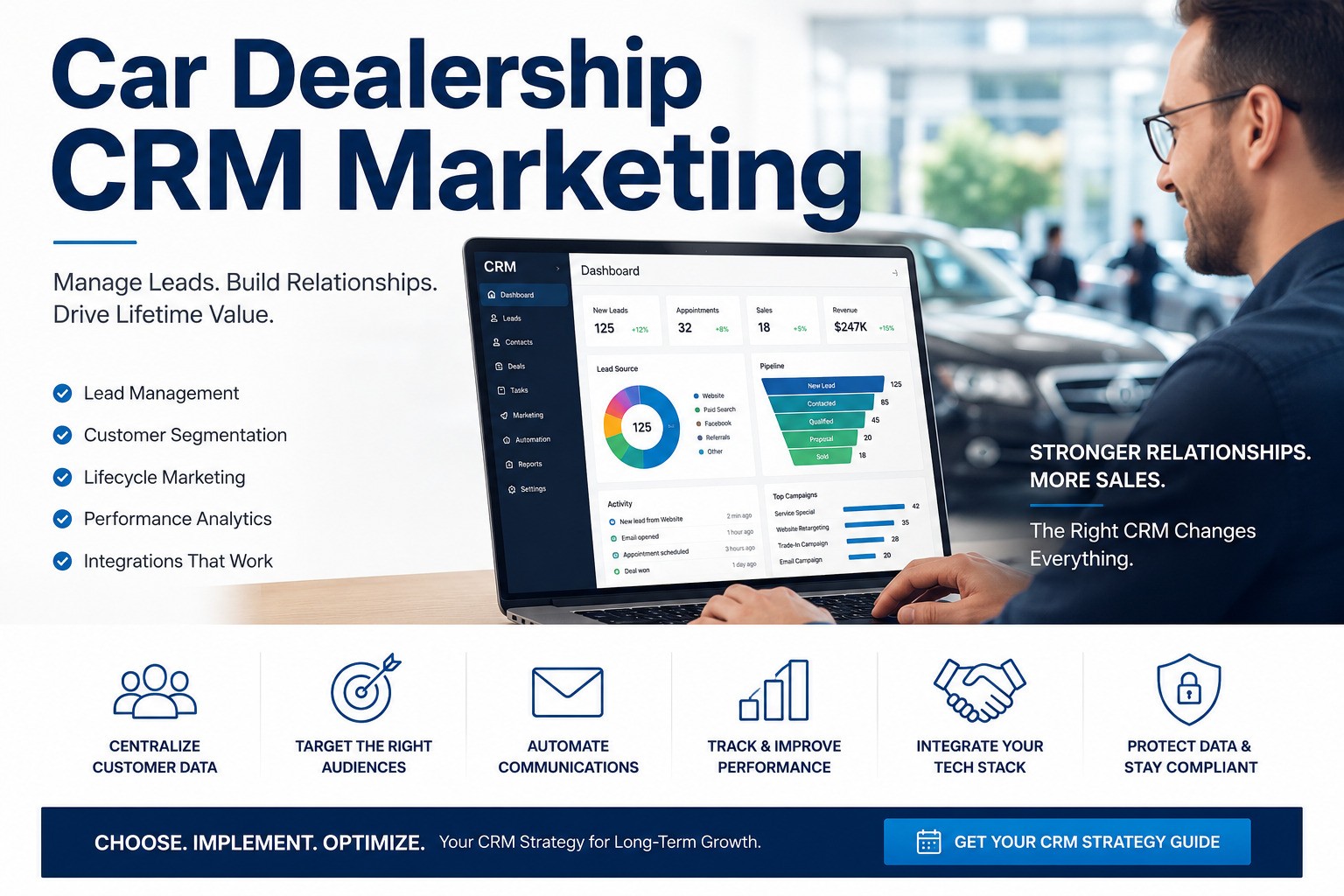
An automotive CDP is a customer data platform for dealerships, dealer groups and automotive marketers that unifies customer identity, CRM records, DMS/service history, website behavior, lead sources, inventory interest, campaign engagement and sales or service outcomes into usable first-party data.
Quick answer: an automotive CDP works when identity resolution, CRM/DMS integrations, consent, segmentation, audience activation, lifecycle marketing, attribution and reporting operate as one system. The goal is not simply to store more data. The goal is to help dealerships understand customers, activate audiences, improve marketing relevance and measure which campaigns influence appointments, sales, service retention and revenue.
This hub is built for dealership owners, dealer group marketing leaders, CRM managers, data teams, automotive SaaS vendors, CDP platforms, attribution providers, agencies and strategic buyers evaluating first-party data as part of the automotive digital marketing stack.
Page role: this Automotive CDP hub explains the operating model for identity resolution, activation, governance and attribution. The Dealer Customer Data Platforms guide focuses on platform-category evaluation and is linked in the procurement action below. Dealer CRM Marketing covers lifecycle execution. Lead Management covers routing, BDC follow-up and appointments.
Reviewed by the Automotive Digital Marketing Editorial Team · Updated July 18, 2026 · Originally published June 8, 2026.
Evaluating customer data platforms? Start with the CDP bottleneck map, then use the vendor scorecard and 90-day implementation plan.
Start Here: Automotive CDP Routes
| Data task | Best starting point | Use it when |
|---|---|---|
| Unify customer identity | Identity resolution and customer profiles | Customer data is fragmented across CRM, DMS, website, lead providers, marketing tools and service systems. |
| Build useful audiences | Segmentation and lifecycle audiences | You need better targeting for equity, lease maturity, service retention, reactivation or conquest campaigns. |
| Activate campaigns | Audience activation across channels | You want customer data to improve email, SMS, paid media, website personalization or BDC workflows. |
| Improve attribution | Attribution and outcome reporting | Reports show clicks and leads but not which campaigns influence appointments, repair orders or sold units. |
| Evaluate vendors | Automotive CDP vendor selection | You are comparing CDPs, CRM data tools, attribution vendors, marketing automation platforms or managed providers. |
| Manage risk | Governance, consent and data ownership | You need clear rules for customer data access, privacy, suppression, ownership and vendor transition. |
What an Automotive CDP Includes
A dealership CDP should make customer data usable across marketing, sales and service. The strongest platforms do not merely collect records. They connect customer identity, vehicle ownership, service behavior, website activity, campaign engagement and outcomes so marketers can create better audiences and leadership can see which actions produce business value.
- Identity resolution: matching people, households, emails, phones, vehicles, CRM records, service records and website behavior.
- Data integrations: CRM, DMS, website analytics, call tracking, email, SMS, paid media, chat, trade-in tools and service systems.
- Segmentation: sales leads, sold customers, service customers, lease maturity, equity position, inactive owners and conquest audiences.
- Activation: email, SMS, paid media audiences, website personalization, BDC workflows, equity campaigns and service retention.
- Attribution: linking campaigns to calls, forms, appointments, repair orders, sold units and revenue influence where data allows.
- Governance: consent, suppressions, role access, vendor permissions, data ownership, privacy and transition rules.
Automotive CDP Bottleneck Map
| If the bottleneck is | CDP focus | What to inspect first | Commercial signal |
|---|---|---|---|
| Customer records are fragmented | Identity resolution | CRM, DMS, email, phone, household, vehicle and service record matching | Cleaner profiles, fewer duplicates and better audience accuracy |
| Campaign targeting is generic | Segmentation | Vehicle owned, lead source, lifecycle stage, service history, lease timing and equity position | Higher relevance, lower opt-outs and stronger appointment quality |
| First-party data is not activated | Audience activation | Email, SMS, paid media, website personalization, BDC workflow and suppression rules | More qualified opportunities and better campaign efficiency |
| Attribution is unclear | Outcome reporting | Campaign tags, calls, forms, appointments, repair orders, sold units and CRM source feedback | Clearer revenue influence and smarter budget allocation |
| Service retention is weak | Lifecycle data | Service history, mileage, declined work, recall signals, owner status and appointment paths | Service bookings, repair orders, repeat visits and retention lift |
| Vendor risk is high | Governance and ownership | Contracts, data access, export rights, privacy, consent and vendor transition process | Lower lock-in risk and cleaner operational control |
Identity Resolution and Customer Profiles
Identity resolution is the foundation of an automotive CDP. Dealership customers often appear as separate records across CRM, DMS, service, website, email, SMS, call tracking, chat and trade-in tools. A CDP should reduce fragmentation and help the store understand the customer relationship across departments.
For dealer groups, identity resolution also supports multi-rooftop governance. A customer may buy from one store, service at another and interact with a group-level campaign. The platform should help marketers avoid duplicate messaging and should support rooftop-level relevance without losing group-level insight.
Segmentation and Lifecycle Audiences
Segmentation turns raw data into useful audiences. Common dealership audiences include active leads, unsold showroom prospects, sold customers, service-only customers, lease-maturity customers, equity opportunities, high-mileage owners, inactive service customers, declined-service customers and customers likely to defect.
This connects directly to dealership equity mining, lease maturity marketing, service retention and dealer customer data platform comparisons. Those routes are linked once in the related data section below.
Audience Activation Across Channels
A CDP becomes valuable when data can be activated. That may mean sending a service-retention audience into email, passing a lease-maturity audience to SMS, creating paid media audiences, personalizing website experiences, creating BDC tasks, or suppressing customers who should not receive a campaign.
Activation should connect with automotive email marketing, automotive SMS marketing, automotive inventory ads and attribution. Those routes are linked once in the related data section below.
Attribution and Outcome Reporting
Automotive CDP reporting should connect audiences and campaigns to dealership outcomes. Engagement metrics are not enough. Leadership needs to understand calls, forms, appointments, repair orders, appraisals, trades, sold units, service retention and revenue influence where data is available.
The best attribution view separates sales from service, lead nurture from owner marketing, conquest from retention, and channel activity from customer lifecycle movement. It should support better budget decisions, not just prettier dashboards.
Governance, Consent and Data Ownership
Customer data is a strategic asset. A CDP should clarify consent, suppressions, role permissions, export rights, data retention, vendor access and transition rules. A dealer group should know what data the vendor uses, what the store owns, how audiences are built and what happens if the vendor relationship ends.
Governance is especially important when email, SMS, paid media audiences, website personalization and BDC workflows all draw from the same data layer. Without rules, the store risks duplicate outreach, compliance problems, customer fatigue and vendor lock-in.
How to Choose an Automotive CDP Vendor
An automotive CDP vendor should be evaluated by data integration depth, identity resolution quality, audience usefulness, activation options, reporting, privacy governance and dealership operating fit. A generic CDP may be powerful, but a dealer-focused CDP should understand CRM, DMS, service history, inventory, lead sources, BDC workflows and automotive lifecycle marketing.
Automotive CDP Vendor Fit Matrix
| Dealer problem | Best CDP capability | What to inspect | Weak vendor signal |
|---|---|---|---|
| Records are duplicated | Identity resolution | Matching logic across CRM, DMS, email, phone, vehicle and household records | Cannot explain how identities are stitched |
| Audiences are too broad | Segmentation | Lifecycle stage, vehicle ownership, service history, lead source and suppression rules | Only offers generic sales and service lists |
| Campaigns are disconnected | Activation | Email, SMS, paid media, website, BDC and CRM task workflows | Stores data but cannot activate it cleanly |
| Attribution is weak | Outcome reporting | Calls, appointments, repair orders, sold units, trades and revenue influence | Reports engagement without business outcomes |
| Dealer group governance is messy | Permissions and controls | Rooftop access, group roles, suppression rules, templates and data access policies | Cannot separate group and rooftop workflows |
| Vendor lock-in risk is high | Data ownership | Exports, transition support, contract rights, audience history and performance records | Unclear ownership or difficult exports |
Automotive CDP Scorecard for Dealership Buyers
Score each CDP vendor from 1 to 5. Dealer groups may weight governance, integrations and multi-rooftop reporting higher. Single rooftops may weight ease of activation, CRM fit and lifecycle campaign value higher.
| Category | What a strong vendor shows | What to ask for |
|---|---|---|
| Dealership specialization | Understands CRM, DMS, service, inventory, BDC and dealer group operations | Dealer-specific data model and first-90-day priorities |
| Identity resolution | Can match customers, households, vehicles and interactions across systems | Explanation of matching logic and confidence levels |
| Integration depth | Connects CRM, DMS, website, email, SMS, paid media, call tracking and service data | Integration map and implementation requirements |
| Audience quality | Builds lifecycle, ownership, equity, lease, service and reactivation segments | Sample audience library for dealerships |
| Activation options | Pushes audiences into channels and workflows the dealership actually uses | Activation examples for email, SMS, ads, website and BDC |
| Attribution quality | Connects campaigns to calls, appointments, repair orders, trades and sold outcomes | Sample report with business outcomes |
| Governance | Controls consent, suppressions, access, templates and multi-rooftop permissions | Governance model and compliance workflow |
| Implementation effort | Has a clear onboarding plan and realistic data-cleanup process | 30/60/90-day implementation plan |
| Data ownership | Dealer owns customer data, audience history and performance records | Written ownership and export policy |
| Strategic fit | Supports CRM, lifecycle, attribution, inventory and first-party data strategy | Roadmap for the dealership’s actual bottlenecks |
Procurement action: review Dealer Customer Data Platforms and use the Dealer Vendor Selection framework before the first vendor call.
Automotive CDP Checklist Before Buying
- List every customer data source: CRM, DMS, website, service, call tracking, email, SMS, chat, trade-in tools and paid media.
- Define the first three use cases: retention, equity mining, lease maturity, reactivation, attribution or audience suppression.
- Confirm consent, privacy, unsubscribe and suppression requirements.
- Ask how identity matching works and what confidence levels are used.
- Require examples of activation into channels your store already uses.
- Confirm export rights, transition rules and data ownership.
- Evaluate reporting by appointments, repair orders, trades, sold units and revenue influence.
First 90 Days of an Automotive CDP Implementation
| Period | CDP work | Dealer input | Output |
|---|---|---|---|
| Days 1–15 | Audit data sources, integrations, consent, suppressions, reporting gaps and priority use cases | CRM/DMS access, vendor list, current reports, marketing goals and compliance constraints | Data baseline and implementation map |
| Days 16–30 | Connect priority data sources, define identity logic, clean core segments and set governance rules | Data approvals, user roles, audience priorities and channel access | Identity and audience foundation |
| Days 31–60 | Launch first activation use cases for service retention, equity mining, lease maturity or reactivation | Campaign approvals, BDC process and service/sales feedback | Initial audience activation and early signals |
| Days 61–90 | Measure campaign outcomes, refine audiences, document governance and set next-quarter roadmap | Appointments, repair orders, sold feedback and leadership priorities | 90-day CDP review and lifecycle roadmap |
Automotive CDP Red Flags
- The vendor cannot explain identity resolution in plain dealership terms.
- It stores data but does not activate audiences into useful workflows.
- It ignores CRM, DMS, service history or dealer website constraints.
- It reports dashboards without appointments, repair orders, trades or sold outcomes.
- It cannot manage consent, suppressions or multi-rooftop permissions.
- It requires heavy implementation before proving a useful first use case.
- Data ownership, exports and transition rules are unclear.
- It sells AI personalization without clean first-party data foundations.
Related Automotive Data and Lifecycle Guides
- Dealer CRM Marketing — linked in the page-role explanation above.
- Dealership Equity Mining
- Lease Maturity Marketing
- Automotive Email Marketing
- Automotive SMS Marketing
- Dealership Service Retention
- Dealer Customer Data Platforms — linked in the procurement action above.
- Automotive Inventory Ads
- Automotive AI Marketing
- Dealer CRM Reporting Template
- Digital Strategy for Car Dealers
Final Verdict
The best automotive CDP is not just a data warehouse or dashboard. It is a first-party data operating layer that helps dealerships unify customer identity, build useful audiences, activate lifecycle campaigns, protect data ownership and connect marketing to real sales and service outcomes.
Next step: define the first three dealership CDP use cases, then contact ADM for a structured platform or vendor review.
Sources and Operating References
Frequently Asked Questions About Automotive CDPs
What is an automotive CDP?
An automotive CDP is a customer data platform designed to unify dealership customer data from CRM, DMS, website, service, lead sources and marketing systems so the dealership can build audiences, activate campaigns and measure outcomes.
How is an automotive CDP different from a CRM?
A CRM manages leads, customer records and sales or service workflows. A CDP unifies data from multiple systems, resolves identity, builds audiences, activates those audiences across channels and supports reporting across the customer lifecycle.
What data should a dealership CDP use?
A dealership CDP can use CRM records, DMS/service history, website behavior, lead sources, call tracking, email and SMS engagement, inventory interest, trade-in activity, lease maturity, equity signals, appointments, repair orders and sold outcomes.
What are the best automotive CDP use cases?
High-value automotive CDP use cases include service retention, equity mining, lease maturity, inactive customer reactivation, audience suppression, paid media activation, website personalization, BDC prioritization and attribution reporting.
What should dealerships ask before buying a CDP?
Dealerships should ask how identity resolution works, which systems integrate, how audiences are activated, how consent and suppressions are managed, what outcomes are reported, who owns the data and what happens if the vendor relationship ends.
Do dealer groups need a CDP?
Dealer groups are often stronger CDP candidates because they manage multiple rooftops, larger customer databases, overlapping sales and service relationships, and more complex reporting needs. Single rooftops can also benefit when they have clear lifecycle or attribution use cases.