
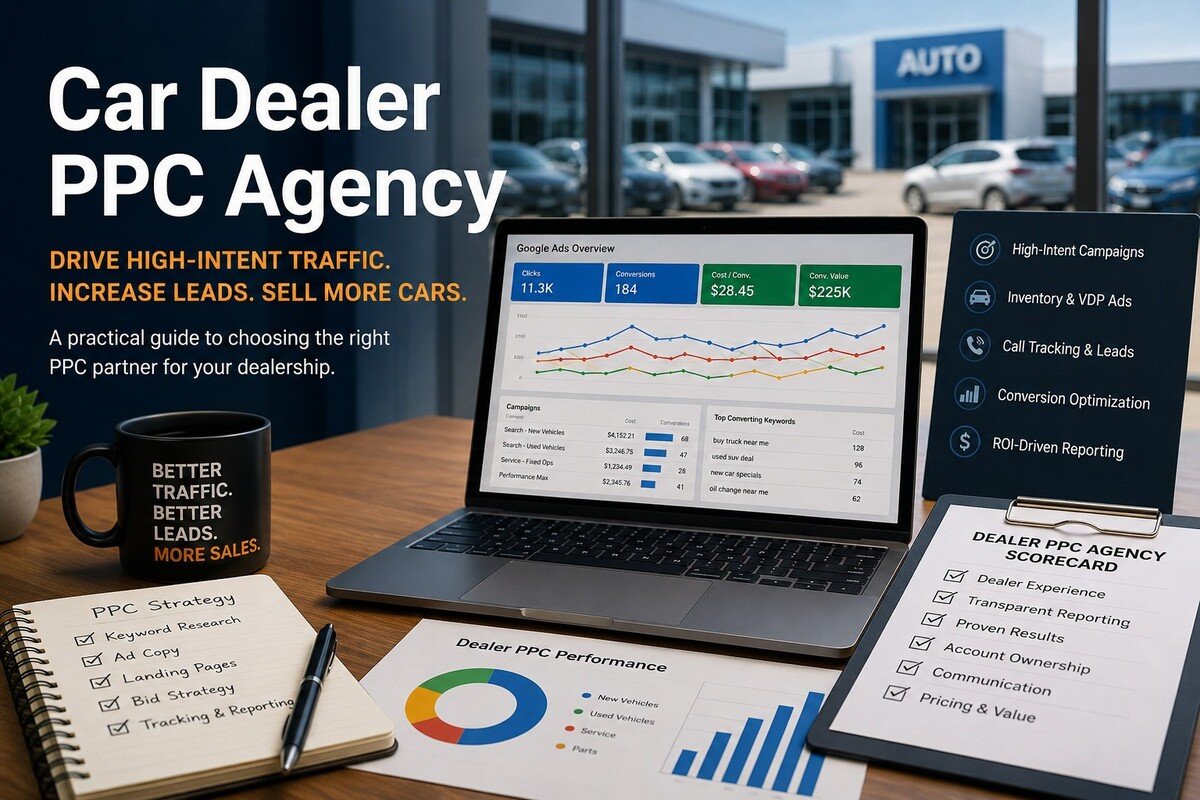
Dealer PPC reporting should show whether paid search, inventory ads, paid social and service campaigns are creating qualified dealership opportunities, not just clicks, impressions or platform conversions.
Quick answer: a dealer PPC report should separate campaign spend by intent, show search-term quality, track calls and forms, connect landing pages to SRPs, VDPs and service pages, and compare paid media performance against CRM feedback such as appointments, show rate, sold units and service bookings.
This template is built for dealership owners, GMs, marketing directors, automotive PPC agencies, dealer website providers, paid media vendors and automotive SaaS teams that need cleaner reporting before budget is renewed or increased.
Use this template before your next vendor review. Copy the sections below into a monthly report, agency scorecard, spreadsheet or dashboard. The goal is to make PPC performance readable for dealership leadership, not only for media buyers.
Dealer PPC Report Template: Monthly Sections
| Report section | What it should show | Why it matters |
|---|---|---|
| Executive summary | Spend, leads, qualified opportunities, cost per qualified opportunity, major wins, major risks and next actions | Gives leadership a fast answer before channel details |
| Budget by intent | Brand, non-brand, model, used inventory, service, competitor, remarketing and paid social spend | Prevents blended reporting from hiding waste |
| Search-term quality | Useful queries, wasteful queries, negative keyword changes and match-type issues | Shows whether the account is buying the right demand |
| Inventory and VDP performance | SRP traffic, VDP entrances, aged-unit support, calls, form starts and inventory-priority campaigns | Connects paid media to available vehicles and sales priorities |
| Service campaign performance | Service calls, appointment requests, maintenance queries, cost per service opportunity and landing-page results | Protects fixed-ops demand from being treated as leftover budget |
| Landing-page conversion | SRPs, VDPs, service pages, finance paths, trade-in paths, mobile performance and conversion friction | Shows whether paid traffic has a realistic path to action |
| Call and form quality | Call duration, answered calls, missed calls, form type, duplicate leads and lead-quality notes | Separates real opportunities from inflated conversion counts |
| CRM feedback | Appointments, show rate, sold feedback, service bookings and lead disposition by source | Turns platform reporting into dealership outcome reporting |
| Account changes | Budget shifts, negatives added, campaigns paused, tests launched, landing pages changed and tracking fixes | Creates accountability for the work performed |
| Next-month action plan | What to scale, cut, fix and test next | Turns the report into a management tool |
One-Page Executive Summary Template
| Metric | This month | Last month | What changed | Action |
|---|---|---|---|---|
| Total paid media spend | Budget, pacing or mix shift | Keep, reduce, reallocate or scale | ||
| Qualified opportunities | Lead quality, appointment quality or call quality | Inspect campaign and landing-page source | ||
| Cost per qualified opportunity | Efficiency change after waste removal or budget shift | Move spend to stronger intent groups | ||
| Sales appointments | CRM feedback from paid leads | Review follow-up and source quality | ||
| Service appointments | Fixed-ops campaign impact | Scale or rebuild service campaigns | ||
| Sold units or influenced sales | Closed-loop signal where available | Compare to spend and lead quality | ||
| Top issue | Tracking, waste, landing page, phone handling or CRM gap | Assign owner and deadline |
Budget by Paid Media Intent
A dealership PPC report should never blend all paid media into one line. Brand search, non-brand search, used-car demand, model campaigns, service campaigns, competitor campaigns, remarketing and paid social all have different jobs.
| Intent group | Spend | Primary KPI | Secondary signal | Decision |
|---|---|---|---|---|
| Brand search | Cost per qualified lead | Impression share and competitor pressure | Protect, reduce or separate | |
| Non-brand sales search | Cost per qualified opportunity | Search-term quality and appointment rate | Scale or clean up | |
| Used inventory campaigns | VDP entrances and calls | Aged-unit movement and form starts | Align with inventory priorities | |
| Model and offer campaigns | Qualified leads and showroom intent | Landing-page conversion and CRM quality | Refresh offers or landing pages | |
| Fixed-ops campaigns | Service calls and appointments | Maintenance query quality and cost per service opportunity | Scale, segment or rebuild | |
| Competitor and conquest campaigns | Qualified opportunity cost | Search-term relevance and lost-budget risk | Cap, refine or pause | |
| Remarketing | Return visits and assisted conversions | VDP returns, finance starts and service actions | Control frequency and audience quality | |
| Paid social | Lead quality or assisted demand | Creative performance and audience quality | Test, segment or cut |
Search-Term Quality Review
Search-term quality is one of the fastest ways to find wasted spend. The monthly report should show which queries produced useful actions, which queries were excluded, and which campaign structures need tightening.
| Search-term item | What to include | Dealer question |
|---|---|---|
| Top useful queries | High-intent terms that generated calls, forms, VDP visits or appointments | Are these queries worth buying again? |
| Wasteful queries | Irrelevant, low-intent, wrong-market, job-seeker, research-only or competitor-noise terms | Why did we pay for these? |
| Negative keywords added | Negatives added by campaign or intent group | Is waste being reduced every month? |
| Match-type changes | Broad, phrase or exact changes with reason | Are we controlling reach or buying noise? |
| Geography issues | Out-of-market clicks, nearby market overlap and radius problems | Are we spending in the right places? |
Call, Form and CRM Feedback Template
Dealer PPC reports should treat call and form quality as a management issue. A short call, missed call, duplicate form, vendor spam lead or poor appointment opportunity should not be valued the same as a real sales or service opportunity.
| Lead signal | What to measure | How to use it |
|---|---|---|
| Calls | Answered calls, missed calls, duration, department, source and campaign | Find phone-handling gaps and campaign quality issues |
| Forms | Form type, vehicle or service topic, duplicate rate, spam rate and appointment intent | Separate lead count from lead usefulness |
| Chats | Qualified chat conversations, handoff quality and appointment requests | Decide whether chat is helping paid media conversion |
| Appointments | Booked appointments, shown appointments and source quality | Compare ad platform conversions with dealership reality |
| Sold or serviced outcomes | Sold units, repair orders, service bookings or influenced opportunities where available | Guide budget allocation and vendor accountability |
Landing Page Review Checklist
- Does each high-spend campaign land on the best SRP, VDP, model page, service page, offer page, finance page or trade-in path?
- Are phone calls, forms, chat and appointment actions visible on mobile?
- Does the page match the search term and ad promise?
- Are used-car, service and model campaigns separated instead of routed to generic pages?
- Are VDPs fast enough and clear enough for paid traffic?
- Are forms short enough for the shopper’s intent?
- Does CRM source tracking preserve campaign and landing-page context?
Monthly PPC Report Questions for the Agency
- Which campaign group produced the best qualified opportunities this month?
- Which campaign group wasted the most budget?
- What search terms were excluded and why?
- How did brand, non-brand, used-car, service and remarketing performance differ?
- Which landing pages limited performance?
- Which calls or forms were low quality?
- What did CRM feedback show about appointment quality?
- What budget should be shifted next month?
- What tracking problem still needs to be fixed?
- What should leadership expect in the next 30 days?
Related Paid Media Guides
- Automotive PPC Hub
- Automotive Inventory Ads
- Google Ads for Car Dealers
- Fixed-Ops PPC and Service Campaigns
- Automotive PPC RFP Template
- Car Dealership SEO Hub
Final Verdict
A dealer PPC report should help leadership decide what to scale, what to cut and what to fix. The best reports connect paid media spend to search intent, inventory priorities, service demand, landing-page quality, calls, forms, CRM feedback and next-month decisions.
Next step: use this template in the next paid media review, then compare the agency’s report against the Automotive PPC hub scorecard.
Frequently Asked Questions About Dealer PPC Reporting
What should a dealer PPC report include?
A dealer PPC report should include spend by campaign intent, search-term quality, calls, forms, landing-page performance, inventory and service campaign results, CRM feedback, account changes and next-month actions.
What is the most important PPC metric for dealerships?
The most useful metric is cost per qualified opportunity, supported by appointment quality, service bookings, call quality and sold or serviced feedback where available. CPC and CTR are operating metrics, not final business outcomes.
How should PPC reports handle phone calls?
PPC reports should separate answered calls, missed calls, call duration, department, campaign source and call quality. Not every call should be counted as an equal conversion.
Why should dealer PPC reports separate brand and non-brand search?
Brand search often captures existing demand, while non-brand search is more useful for incremental demand. Blending them can make performance look better than it is and hide wasted spend.
How often should a dealership review PPC reporting?
Dealership leadership should review a concise PPC summary monthly, while the agency or marketing manager should inspect search terms, budget pacing and conversion quality more frequently.