
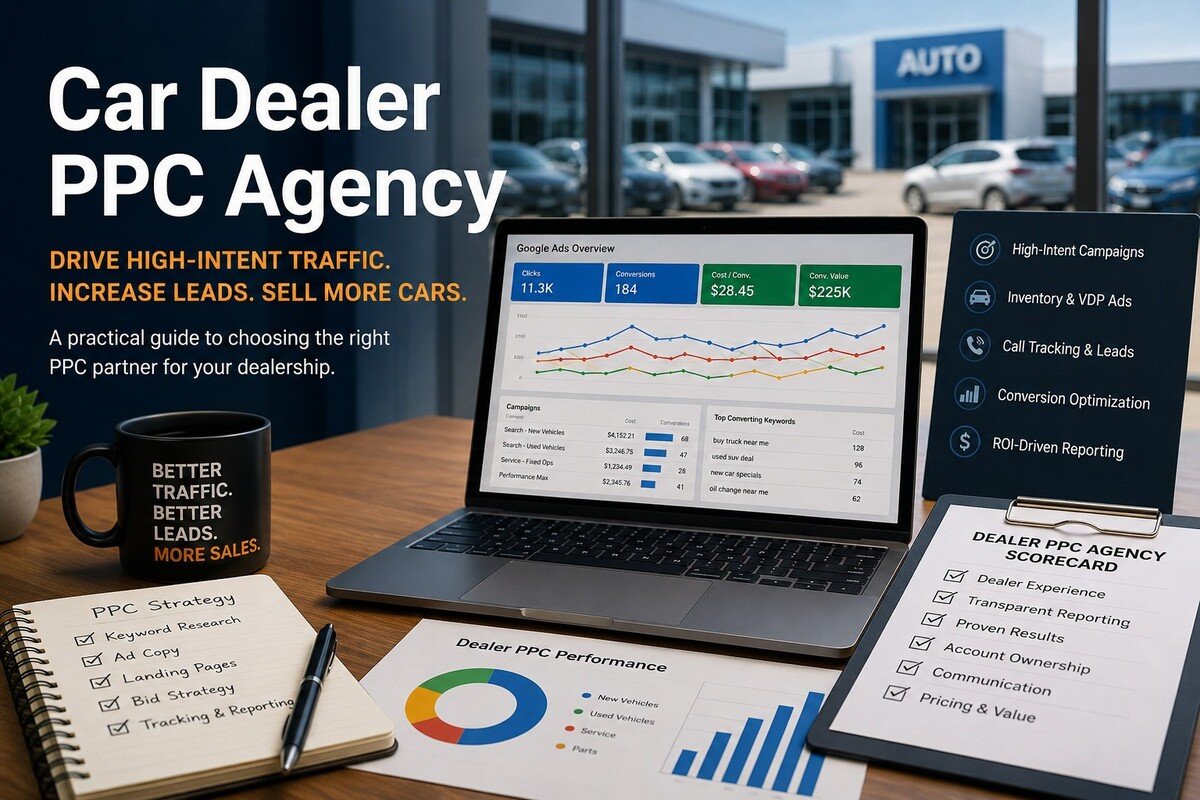
Automotive PPC is paid search and paid media built around dealership inventory, local shopper intent, service demand and dealership business outcomes. A strong 2026 program connects campaign structure, live vehicle data, landing pages, phone and form tracking, CRM feedback and offline sales/service outcomes so budget decisions are based on qualified demand rather than clicks alone.
A 2026 dealership PPC operating guide for Google Ads, Vehicle Ads, campaign structure, feed QA, search-term control, landing pages, offline conversions, budgets and provider accountability.
Quick answer: most dealerships need a controlled mix of brand defense, model/non-brand search, inventory-led Vehicle Ads or Performance Max, service search and selective video/remarketing. Every campaign should have one job, one appropriate landing path and one declared business outcome. Search-term waste, stale inventory, generic landing pages and weak offline feedback are the fastest ways to burn budget.
2026 automotive PPC demand snapshot
Google Ads Keyword Planner data for the United States, English language and Google Search shows commercial demand for dealership paid-search expertise.
| Keyword | Average monthly searches | High top-of-page bid |
|---|---|---|
| automotive PPC | 70 | $33.94 |
| car dealership PPC | 50 | Not reported |
The volume is smaller than broad automotive marketing categories, but the bid signal is high. That makes this a buyer-intent page: dealers need operating guidance, vendor accountability and clear economics.
Choose the right automotive PPC route
| Priority | Best starting point | Use it when |
|---|---|---|
| Build or repair the core account | Google Ads for car dealers | You need account structure, intent segmentation and search governance. |
| Promote live inventory | Automotive inventory ads | You need Vehicle Ads, VIN-level promotion or feed governance. |
| Grow service demand | Fixed-ops PPC | You need service calls, appointments or maintenance demand. |
| Standardize reporting | Dealer PPC report template | You need repeatable spend, lead, appointment and sold-outcome definitions. |
| Prepare an agency review | Automotive PPC RFP template | You need ownership, scope and comparable proposals. |
| Choose a provider | Car dealer advertising agency guide | You are comparing agency, OEM, website-vendor or in-house models. |
| Set the channel budget | Dealership marketing budget template | You need allocation rules by sales, service, rooftop or inventory priority. |
The 2026 dealership PPC campaign playbook
Current high-performing guides converge on the same principle: separate campaigns by shopper job. DealerSmart emphasizes brand defense, model/offer search, Performance Max with Vehicle Ads, YouTube and service search; 40/40 similarly separates brand, model, conquest and service intent. The practical buyer lesson is to make each campaign accountable to a distinct business purpose.
| Campaign | Primary job | Landing surface | Primary business check |
|---|---|---|---|
| Brand defense search | Protect dealership-name and department demand | Relevant homepage/location/department page | Incrementality, impression share and qualified conversion quality |
| Model / non-brand search | Capture active vehicle shoppers | Model SRP, relevant inventory category or offer page | Qualified calls/forms, appointments and VDP progression |
| Vehicle Ads / inventory PMax | Match current inventory to active shoppers | Current VDP or SRP | Feed eligibility, qualified inventory leads and sold-unit outcomes |
| Conquest search | Reach shoppers comparing alternative models or dealers | Useful comparison/inventory path | Incremental qualified demand after higher CPC |
| Service search | Capture maintenance and repair intent | Specific service page, scheduler or offer page | Useful calls, booked appointments and completed repair orders |
| YouTube / video action | Create and recapture model consideration | Model, inventory or lead-form path | Qualified assisted demand and downstream appointments |
Search-term waste and negative-keyword control
Search-term review should be a management discipline. Every account should be able to explain which queries produced qualified demand and which consumed budget without a dealership outcome.
| Waste source | Control | Evidence |
|---|---|---|
| Irrelevant research queries | Negative-keyword lists and match-type review | Search-term log with reason for exclusion |
| Out-of-market traffic | Location settings and geo-report review | Spend and lead quality by market |
| Employment / DIY / unrelated repair | Shared negative lists by department | Query exclusions reviewed monthly |
| Brand traffic masking acquisition | Separate brand and non-brand budgets/reporting | Cost and conversion quality by intent family |
| Broad automation drift | Conversion-quality feedback and regular query/insight review | Qualified-lead and appointment feedback returned to account decisions |
Vehicle Ads and live-feed QA
Google Vehicle Ads use vehicle data sources in Merchant Center and can run through Performance Max. Google states that Vehicle Ads can optimize for online leads and offline goals such as store visits while showing relevant vehicle listings to shoppers.
| Feed QA control | What to verify | Failure signal |
|---|---|---|
| Availability | Only vehicles the dealership can actually sell are eligible | Sold or unavailable VINs keep serving |
| Price/status | Feed and VDP agree within the operating refresh window | Ad and landing-page price mismatch |
| Images | Useful primary images exist and meet policy/quality requirements | Missing, placeholder or poor-quality photos |
| Store/location | Inventory is associated with the correct dealership/location | Wrong rooftop or geography |
| Landing URL | Destination is current, canonical and useful on mobile | Redirects, stale pages or generic homepages |
| Disapprovals | Merchant Center diagnostics have an owner and response process | Coverage drops with no alert or escalation |
| Aging priority | Dealer can choose when aged/priority units deserve more support | Feed treats every unit as commercially equal |
Landing pages: preserve the shopper’s intent
Paid media cannot compensate indefinitely for weak landing experiences. Route model searches to relevant model inventory, exact-unit demand to current VDPs, service demand to useful service pages or schedulers, finance/trade intent to clear process pages and phone-first demand to visible trackable call actions.
Inspect mobile speed, intrusive overlays, stale inventory, price clarity, form friction, call routing and appointment flow before increasing spend. A low CPC on a weak landing path is still waste.
Offline conversion contract: from click to delivered unit
Google Ads supports enhanced conversions for leads to improve measurement of lead-to-offline outcomes. The dealership should define the business events before sending feedback into bidding systems.
| Event | Definition | Primary source |
|---|---|---|
| Qualified lead | Unique person with a valid need the dealership can act on | CRM plus call/form/chat record |
| Appointment | Qualified lead with scheduled showroom or service appointment | CRM or scheduler |
| Show | Appointment recorded as attended under one reschedule rule | CRM/scheduler |
| Delivered unit | Matched completed vehicle sale under the dealership’s declared attribution rule | DMS/CRM |
| Completed repair order | Matched completed service work | DMS/service system |
Document match keys, attribution window, duplicate handling, unmatched records and whether conversion value represents booked, delivered or estimated revenue. Automation should optimize toward trustworthy events.
Dealership PPC budget allocation
There is no defensible universal PPC budget. Allocate by the dealership constraint, inventory position, service capacity, local competition, gross opportunity and confidence in measurement.
| Condition | Budget implication |
|---|---|
| Strong brand demand, weak non-brand growth | Protect necessary brand coverage and test more qualified non-brand/model acquisition |
| Aging inventory | Increase support for selected VIN/model groups with explicit turn/margin goals |
| Service capacity available | Fund fixed-ops search separately from sales |
| Lead volume strong, quality weak | Reduce expansion until search terms, landing pages and CRM feedback improve |
| Conversion strong, impression share constrained | Increase budget only where qualified outcome economics justify it |
PPC measurement and ROI
| Metric layer | Useful metrics | Bad shortcut |
|---|---|---|
| Platform | Spend, CPC, CTR, impression share, search terms | Calling platform conversions “sales” |
| Landing | Qualified calls/forms, VDP/SRP progression, booking starts | Counting every click or engagement equally |
| CRM | Qualified lead rate, appointments, shows, source disposition | Ignoring lead quality by campaign |
| Business | Cost per sold unit, completed RO, gross or declared outcome | ROAS with unclear revenue matching |
Bidding strategy should follow conversion quality
Automated bidding becomes more useful as conversion data becomes cleaner and more representative of dealership value. Choose the bid objective from the event quality available today, then move deeper into the funnel when CRM and DMS feedback is reliable.
| Bidding approach | Best operating condition | Dealer check before use |
|---|---|---|
| Maximize Clicks / controlled manual discovery | New or sparse account where useful conversion data is still being established | Strict query, geography and budget controls plus a plan to graduate toward outcome bidding |
| Maximize Conversions | Primary lead actions are clean and occur often enough to guide automation | Primary conversions exclude low-value engagement events |
| Target CPA | Qualified conversion volume is stable and the dealership understands an acceptable acquisition cost | CPA target is based on qualified outcomes and adequate recent data |
| Maximize Conversion Value | Different conversions have defensible values | Value rules reflect dealership economics rather than arbitrary scores |
| Target ROAS | Revenue/value feedback is dependable and mature | Imported values reconcile with CRM/DMS records and attribution policy |
Promotion rule: do not move the account deeper into automated value bidding merely because the platform recommends it. Move when the dealership can trust the event, denominator and value being optimized.
Controlled experiments: change one decision at a time
Google’s experimentation guidance starts with a defined hypothesis and a metric that can produce enough observations to evaluate the change. Dealerships should use the same discipline for budget, bidding, creative and landing-page tests.
| Experiment | Hypothesis | Primary metric | Guardrail |
|---|---|---|---|
| Budget lift | A proven campaign can absorb incremental spend without deteriorating qualified outcome cost | Cost per qualified lead or appointment | Hold other major campaign settings stable |
| Bidding change | A different objective can improve qualified volume or value | Qualified conversions, CPA or value per cost | Keep conversion definitions unchanged during the test |
| Creative / offer | A new message improves response from the same intent cohort | Qualified conversion rate | Preserve comparable targeting and landing path |
| Landing path | A more intent-matched SRP/VDP/service page improves progression | Qualified next-step rate | Keep campaign/audience exposure comparable |
| Audience signal | First-party or intent signals improve efficiency | Incremental qualified outcome rate | Inspect overlap and audience size before scaling |
Record the hypothesis, dates, changed variable, baseline, success metric and decision before launch. At the end, scale, revert or run the next controlled test. This creates a dealership learning system instead of a stream of undocumented account changes.
Performance Max, broad match and AI guardrails
- Use primary conversions that represent real business progress.
- Keep vehicle feeds, locations, prices and images current.
- Separate brand-demand analysis from acquisition wherever possible.
- Review search-term insights, placements, assets and CRM lead quality.
- Set rules for offers, legal claims, OEM language and local approvals.
- Require a rollback or pause process when automation drifts.
In-house vs agency vs website-vendor PPC
| Model | Best fit | Main risk |
|---|---|---|
| In-house | Teams with platform expertise, time and tracking access | Limited bandwidth or dependence on one employee |
| Automotive PPC specialist | Dealers needing category depth and structured testing | Can ignore website/CRM bottlenecks |
| Full-service agency | Groups seeking coordinated channels/reporting | PPC depth can vary inside broad retainer |
| Website-vendor package | Dealers prioritizing integration and simplicity | Portability/transparency risk |
| OEM program | Dealers needing approved assets/co-op alignment | Standardized execution may miss local priorities |
Minimum PPC provider criteria
- dealer-owned ad accounts and history;
- clear campaign/naming structure;
- search-term and negative-keyword process;
- inventory-feed QA ownership;
- landing-page review before spend increases;
- call tracking and lead-quality analysis;
- offline conversion and CRM feedback plan;
- rooftop-level budget governance;
- transparent fees and transition terms.
First 90 days of a strong PPC engagement
| Period | Priority | Evidence gate |
|---|---|---|
| Days 1–15 | Audit ownership, tracking, campaigns, search terms, feeds, landing pages and CRM source quality | Baseline, waste map and risk register |
| Days 16–30 | Fix tracking, negatives, intent segmentation, feed issues and business goals | Approved restructuring and measurement plan |
| Days 31–60 | Rebuild campaigns, budgets and landing paths; activate offline feedback | Controlled tests and qualified-lead signals |
| Days 61–90 | Compare cost per qualified lead, appointment, sold/service outcome and budget mix | Strengthen, retarget, consolidate or stop decision by campaign family |
Automotive PPC red flags
- Brand and non-brand demand are blended.
- Search terms and negatives are not reviewed.
- Inventory campaigns ignore feed diagnostics or sold units.
- Every platform conversion is treated as equal.
- Provider does not request CRM or sold feedback.
- Automated campaigns scale before conversion quality is reliable.
- Sales and service share one undifferentiated budget.
- Dealer does not own the account, audiences or history.
Methodology and sources
The September 2026 revision compared current ranking automotive/dealership PPC guides with first-party Google documentation. Competitive review focused on campaign structure, Vehicle Ads, search-term waste, landing-page alignment, bidding, experiments, offline conversion measurement and business-outcome accountability.
- Demand: Google Ads Keyword Planner, United States, English, Google Search, accessed September 6, 2026.
- Platform source: Google Ads Vehicle Ads documentation, enhanced conversions for leads guidance and Google’s experimentation framework.
- Current-market review: DealerSmart, 40/40 Group and current 2026 dealership Google Ads guides reviewed September 6, 2026.
- Evidence standard: channel metrics remain diagnostics; CRM/DMS outcomes determine qualified business value.
Frequently asked questions about automotive PPC
What is automotive PPC?
Automotive PPC is dealership paid advertising across search, Vehicle Ads, Performance Max, Microsoft Ads, remarketing, paid social and video, connected to dealership landing pages and business outcomes.
Which Google Ads campaigns should a dealership run?
Most stores need some combination of brand defense, model/non-brand search, inventory-led Vehicle Ads or Performance Max, service search and selective conquest/video activity. The exact mix depends on inventory, market and department goals.
How do Vehicle Ads work for dealerships?
Vehicle Ads use vehicle data sources in Merchant Center and Google Ads to show relevant new or used inventory to shoppers. Feed quality, location, price, imagery and landing-page accuracy directly affect eligibility and performance.
How often should a dealership review negative keywords?
Search terms should be reviewed continuously enough to catch new waste patterns, with formal account reviews at least monthly and faster review after major campaign or match-type changes.
How much should a dealership spend on PPC?
There is no universal percentage. Budget should follow qualified opportunity economics, inventory priorities, service capacity, local competition and trustworthy conversion data.
How should dealerships track offline PPC outcomes?
Define qualified leads, appointments, shows, delivered units and repair orders in the CRM/DMS, then connect those events to ad activity under a documented matching and attribution rule.
Should dealerships use Performance Max?
Performance Max can be useful when feeds, conversion actions and lead-quality feedback are reliable. It should operate inside explicit brand, budget, feed and conversion governance.
Which Google Ads bidding strategy should a dealership use?
Use a bidding objective that matches the quality and volume of conversion data available. Move from traffic or lead-volume optimization toward CPA or value-based bidding only when the underlying dealership outcomes are reliable enough to guide automation.
How should a dealership test PPC changes?
Define one hypothesis, change one major decision at a time, choose a metric with enough observations, preserve guardrails and record whether the result supports scaling, reverting or another controlled test.
How should dealership PPC ROI be measured?
Use platform efficiency for diagnosis and CRM/DMS outcomes for business value. Cost per qualified lead, appointment, delivered unit or completed repair order is more useful than CPC alone.
Who should own the dealership Google Ads account?
The dealership should retain administrative ownership of its ad accounts, conversion data, audiences, creative assets and reporting history.