
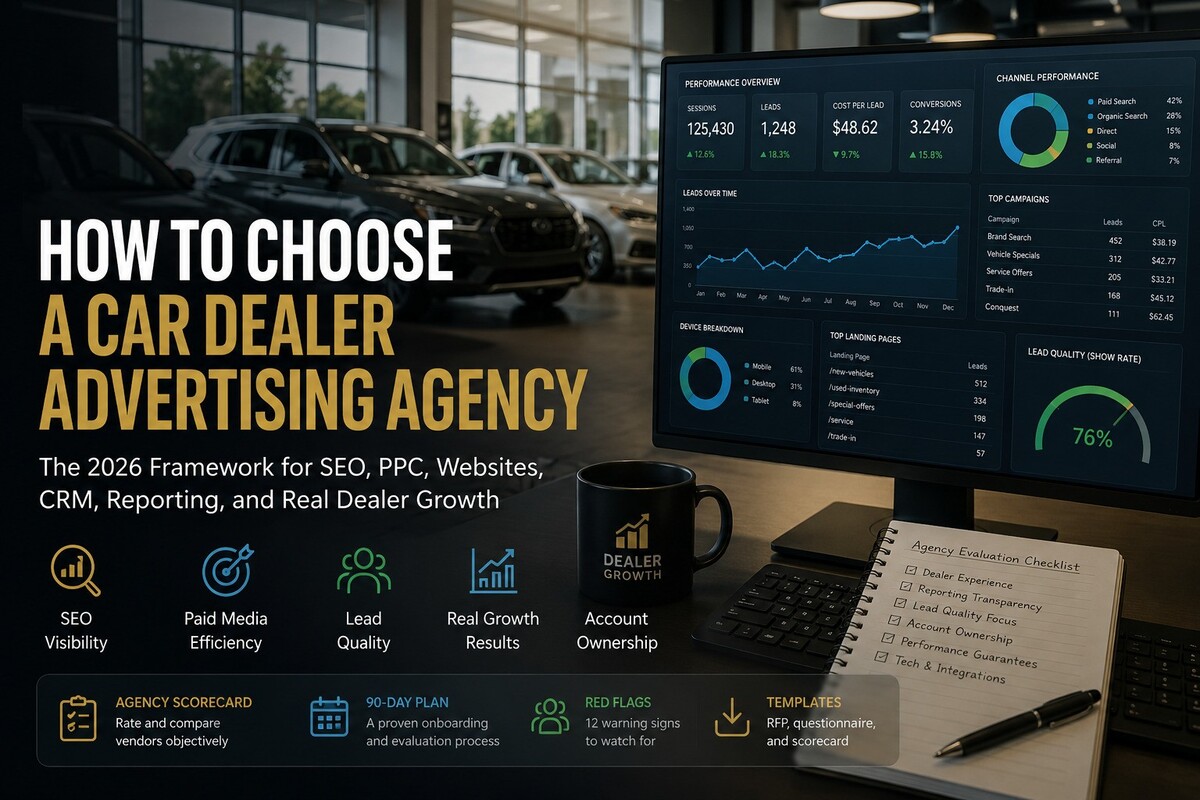
2026 dealer agency selection, proof standards and first-90-day accountability
Choose a car dealer advertising agency by matching the agency model to the dealership’s actual constraint, then forcing every finalist through the same proof gates: live-inventory competence, dealer-owned accounts, CRM/DMS outcome reconciliation, OEM/co-op awareness, transparent pricing, channel ownership and a specific first-90-day plan.
The strongest automotive agency can explain how inventory, local market conditions, SRPs and VDPs, paid media, SEO, website conversion, CRM follow-up, fixed ops and dealer economics connect to sold units or completed repair orders. A polished dashboard, a low cost per lead or a large client logo does not prove that connection by itself.
Reviewed by the Automotive Digital Marketing Editorial Team · Updated September 6, 2026 · Originally published March 10, 2026. This revision benchmarks current automotive-agency search results against dealer-specific requirements for inventory, attribution, pricing, proof, ownership, OEM/co-op and first-90-day execution.
2026 search demand for automotive agency selection
Google Ads Keyword Planner data for the United States, English language and Google Search shows commercial demand around agency selection. These figures indicate market interest and advertiser value; they do not predict traffic or revenue for any dealership.
| Keyword cluster | Average monthly searches | High top-of-page bid | Buyer intent |
|---|---|---|---|
| car dealer advertising agency / car dealership advertising agency | 590 | $27.71 | Dealer-specific agency discovery and comparison |
| automotive digital marketing agency / companies | 320 | $47.57 | Automotive provider discovery |
The useful page for this intent has to do more than publish a vendor list. It should help a dealer determine which agency model fits, how to test claims, how to compare fees and ownership, and how to verify downstream business outcomes.
What a serious car dealership advertising agency should be able to operate
| Operating layer | Dealer-specific requirement | Evidence to request |
|---|---|---|
| Inventory and merchandising | Understand VIN availability, aging, model priorities, SRPs, VDPs, sold-unit handling and feed latency. | Feed workflow, sold-unit rule, campaign examples and inventory-level reporting. |
| Paid media | Structure search, vehicle ads, paid social, retargeting and conquest work around local demand and inventory truth. | Campaign map, negative-keyword process, audience logic and budget rules. |
| SEO and local search | Handle technical, local, model, inventory, service and Google Business Profile visibility. | Page-ownership map, technical audit sample and local/fixed-ops plan. |
| Website conversion | Diagnose SRP/VDP friction, mobile speed, forms, calls, finance, trade, service and digital-retailing paths. | Conversion audit tied to page groups and qualified next steps. |
| CRM and BDC alignment | Receive lead-quality feedback and understand routing, response, appointments, shows and source disposition. | CRM feedback loop and source-quality reporting method. |
| Closed-loop measurement | Reconcile marketing activity with dealership business outcomes under a declared matching rule. | Example CRM/DMS reconciliation showing denominator, window and exclusions. |
| OEM and co-op | Understand applicable brand rules, approvals, reimbursement requirements and creative/disclosure constraints. | Current OEM experience, approval workflow and responsibility matrix. |
| Fixed ops and lifecycle | Separate service economics and retention from vehicle-sales acquisition. | Service campaign, retention cohort or completed-repair-order reporting example. |
Eight pass/fail proof gates before you score an agency
A weighted score can hide a fatal weakness. Run these gates first. A candidate that fails a material ownership, data or proof gate should resolve it before the dealership compares presentation quality or channel breadth.
| Proof gate | Pass condition | Failure signal |
|---|---|---|
| 1. Account ownership | Dealer controls primary ad, analytics, profile, tracking and reporting access and can export historical data. | Agency-owned accounts are used as switching leverage. |
| 2. Inventory truth | Agency can explain feed source, refresh cadence, sold-unit handling, aging logic and failure monitoring. | Campaigns can continue serving unavailable or stale units without a documented control. |
| 3. Business-outcome reconciliation | Agency can match marketing cohorts with CRM/DMS or service outcomes under a written rule. | Reporting stops at clicks, platform conversions or raw leads. |
| 4. Lead-quality feedback | CRM disposition and appointment quality can influence campaign and budget decisions. | Agency optimizes to lead volume while sales teams reject the traffic. |
| 5. OEM/co-op control | Responsibilities for approvals, disclosures, reimbursement and creative compliance are explicit. | Agency promises co-op compatibility without naming the workflow or owner. |
| 6. Pricing transparency | Media, management, technology, creative and pass-through costs are separable. | One blended fee hides media cost or creates unclear spend incentives. |
| 7. Execution ownership | Dealer knows which team performs SEM, SEO, social, creative, reporting and website work and which work is subcontracted. | Sales team cannot identify the operators doing the work. |
| 8. Case-study reproducibility | Case evidence includes dates, baseline, scope, denominator, source system and outcome definition. | Percent lifts or ROAS claims lack the underlying cohort and measurement rule. |
ADM Dealer Agency Fit Score
After the proof gates pass, score each finalist from 1 to 5 in the weighted categories below. The score is designed to expose fit differences among credible candidates, not to rescue a provider with unresolved ownership or attribution risk.
ADM Dealer Agency Fit Score: a weighted comparison tool for dealership agency buyers.
| Criteria | Weight | What a high score means | Proof to request |
|---|---|---|---|
| Dealer specialization | 15% | Understands rooftops, inventory, fixed ops, OEM rules, CRM realities, SRPs and VDPs. | Dealer-specific examples with operating detail. |
| Account ownership | 15% | Dealer controls accounts, analytics, tracking assets, creative and historical data. | Written ownership and transition policy. |
| Reporting quality | 15% | Connects spend and page activity with qualified leads, appointments, shows and completed outcomes. | Sample report with source-of-truth definitions. |
| SEO depth | 10% | Handles technical, local, service, model, inventory and content search issues. | 90-day sales/fixed-ops SEO plan. |
| PPC depth | 10% | Campaigns use intent, geography, inventory, exclusions, landing pages and lead-quality feedback. | Campaign structure and negative-keyword method. |
| Website and CRO competence | 10% | Can diagnose SRP, VDP, finance, trade, service, forms, calls and mobile friction. | Conversion audit before major spend increases. |
| CRM alignment | 10% | Can use routing, disposition, response and appointment feedback. | CRM feedback and outcome-matching plan. |
| Compliance awareness | 5% | Understands pricing, finance, OEM, co-op and disclosure risk. | Offer/creative review workflow. |
| Communication | 5% | Explains tradeoffs plainly and has a useful operating cadence. | Named operators and escalation path. |
| Contract terms | 5% | Scope, deliverables, exit terms and handoff are clear. | Transition plan and termination mechanics. |
Full-service, specialist, platform-adjacent or hybrid?
| Agency model | Best fit | Strength | Risk to test |
|---|---|---|---|
| Full-service automotive agency | Dealer groups or rooftops that want one accountable partner across several channels. | Integrated planning and consolidated reporting. | Channel depth may vary; require named specialists and channel-level proof. |
| Channel specialist | Dealer already has strong internal leadership and a clearly isolated SEO, PPC, social, creative or analytics gap. | Deep expertise in a narrow discipline. | Can optimize its channel while another part of the funnel remains broken. |
| Platform-adjacent services team | Dealer values tight website, CRM, data or ad-tech integration. | Direct platform access and implementation speed. | Provider may be reluctant to identify limitations in its own platform. |
| Strategy/analytics partner | Leadership needs budget governance, attribution, vendor oversight or multi-rooftop consistency. | Independent decision layer across vendors. | Execution responsibility can become fragmented. |
| Hybrid internal + external | Dealer has an internal owner and buys specialist execution where needed. | Dealer retains institutional knowledge and control. | Roles, approvals and source-of-truth rules must be explicit. |
Inventory-aware agency test: prove the campaign sees the lot
Inventory competence should be demonstrated with operating controls. Ask a paid-media agency to walk through one unit from feed ingestion to campaign eligibility, landing page, sold status and reporting. Ask an SEO or website partner to show what happens to the same unit across SRP, VDP, sitemap, internal links and retirement.
| Inventory event | Agency should explain | Evidence |
|---|---|---|
| New unit enters feed | Eligibility, campaign/category assignment and landing-page discovery. | Refresh cadence and activation rule. |
| Unit ages | Whether budget, creative, bid or audience treatment changes. | Documented aging rule tied to dealer priorities. |
| Price/status changes | How quickly ads and landing data reflect the change. | Feed latency and monitoring process. |
| Unit sells | How media stops, VDP state changes and reporting closes the outcome. | Sold-unit suppression and downstream matching. |
| Feed breaks | Who is alerted, what campaigns are paused and how recovery is verified. | Failure alert and owner/escalation path. |
Closed-loop reporting: measure cars and repair orders, not dashboard activity
Automotive agency reporting should define the path from spend to business outcome. For sales, that may mean campaign → visitor → call/form/chat → CRM lead → appointment → show → delivered unit. For fixed ops, it may mean search or lifecycle campaign → service enquiry → appointment → completed repair order.
| Metric | Definition to demand | Source of truth |
|---|---|---|
| Qualified lead | Unique person with a real need the dealership can act on; spam, duplicates and vendor tests follow written exclusion rules. | CRM plus call/form/chat record |
| Appointment rate | Unique qualified leads with a scheduled appointment divided by qualified leads in the same cohort. | CRM or scheduler |
| Show rate | Attended appointments divided by scheduled appointments under one reschedule rule. | CRM or scheduler |
| Cost per sold unit | Declared campaign/program cost divided by matched delivered units under the agreed attribution window. | DMS/CRM reconciliation plus finance/media cost |
| Cost per completed repair order | Declared service-marketing cost divided by matched completed repair orders. | Service/DMS system plus program cost |
Require the agency to state match keys, attribution window, duplicate handling, unmatched records and whether reported revenue is booked, delivered or estimated. Without those definitions, two vendors can report different success from the same customer file.
How to audit an automotive agency case study
| Case-study field | What to require | Why it matters |
|---|---|---|
| Baseline | Pre-period with the same metric definition. | Percent lifts are meaningless without a starting point. |
| Dates and duration | Exact comparison periods and campaign duration. | Seasonality and model-year cycles can distort results. |
| Scope | Channels, stores, inventory groups, spend and landing-page changes included. | Several simultaneous changes can create false attribution. |
| Denominator | Clicks, leads, qualified leads, appointments or sold units used in the rate. | Changing the denominator can manufacture improvement. |
| Source system | Ad platform, GA4, CRM, DMS, call tracking or service system. | Platform-reported conversion and delivered-unit data answer different questions. |
| Business outcome | Delivered units, completed repair orders, gross or another declared completion. | Dealer buyers need proof beyond activity metrics. |
Agency pricing models and the incentives they create
| Pricing model | Potential benefit | Conflict to inspect | Contract evidence |
|---|---|---|---|
| Flat monthly retainer | Predictable fee independent of media growth. | Scope can become vague or static if deliverables are poorly defined. | Named services, cadence, operators and change process. |
| Percentage of media spend | Fee scales with campaign volume and workload. | Provider earns more as spend rises, so budget recommendations need independent outcome evidence. | Percentage basis, included media, minimums and optimization responsibility. |
| Hybrid retainer + media fee | Can separate strategic/channel work from media management. | Dealer may pay twice for overlapping reporting, creative or account work. | Line-item responsibility and pass-through costs. |
| Performance-based | Can align fee with a declared result. | Provider may optimize for the payable event instead of lead quality or margin. | Outcome definition, attribution, exclusions, caps and audit rights. |
| Project-based | Useful for audits, migrations, tracking repair or implementation sprints. | Ongoing accountability may disappear after delivery. | Acceptance criteria, handoff and post-project support. |
OEM and co-op due diligence
OEM and co-op requirements vary by brand and program. A dealership should verify the agency’s current experience with its actual OEM rather than accept a generic “co-op compliant” claim.
- Who owns creative pre-approval and disclosure review?
- Who submits reimbursement documentation and tracks rejection?
- Which media, creative and technology costs are eligible under the current program?
- How are local dealer priorities handled when OEM templates or program rules constrain execution?
- What happens when program rules change during the contract?
- Can the agency provide a recent example for the dealership’s brand without exposing another client’s confidential information?
Decision matrix: match the agency model to the dealership bottleneck
| Dealership problem | Best-fit capability | Inspect first | Weak-fit warning |
|---|---|---|---|
| Low local visibility | Dealer SEO/local search depth | Location, model, service, GBP and technical work. | Agency talks mainly about generic blog volume. |
| Need qualified demand quickly | Paid search/inventory media depth | Campaign structure, negatives, inventory, landing pages and CRM feedback. | Agency reports clicks and CPL without qualified-lead definition. |
| Traffic exists, conversion is weak | Website/CRO + CRM competence | SRPs, VDPs, finance/trade, mobile friction, calls/forms and routing. | Agency requests more spend before inspecting the funnel. |
| Multi-rooftop inconsistency | Governance and analytics | Store-level reporting, budget rules, OEM/co-op, escalation and shared definitions. | One-rooftop operating model is copied across the group. |
| Retention/fixed ops is weak | Lifecycle/service marketing | Service data, completed repair orders, defection, lease maturity and reactivation. | Agency treats every revenue problem as new-sales acquisition. |
| Leadership distrusts reporting | Closed-loop measurement | Source definitions, CRM/DMS matching, denominator and audit trail. | More dashboards are proposed before source disagreement is resolved. |
How to choose and validate a car dealer advertising agency
- Identify the dealership bottleneck. Define the business problem, baseline and completed outcome that matters.
- Run the pass/fail proof gates. Resolve ownership, inventory, outcome reconciliation, OEM/co-op, pricing and execution transparency first.
- Match the problem to an agency model. Decide whether the store needs full-service coordination, a specialist, platform-adjacent execution, analytics oversight or a hybrid model.
- Score credible candidates. Use the ADM Dealer Agency Fit Score only after material proof gates pass.
- Audit case studies. Require dates, baseline, scope, denominator, source system and business outcome.
- Inspect first-90-day execution. Demand a specific access, audit, implementation and reporting sequence.
- Lock ownership and reporting definitions into the agreement. Document accounts, assets, data exports, attribution and transition responsibilities.
First 90 days: what a serious agency should actually deliver
| Period | Agency work | Dealer input | Evidence gate |
|---|---|---|---|
| Days 1–15 | Access, inventory/feed review, website and tracking audit, campaign audit, CRM source review, local/OEM context. | Goals, inventory/service priorities, accounts, CRM/DMS access path, vendor list and approvals. | Baseline, data gaps, ownership matrix and ranked problem list. |
| Days 16–30 | Repair tracking, obvious waste, feed errors, landing friction and routing gaps; establish source definitions. | Offer constraints, co-op rules, approvals and CRM feedback. | Verified change log and first source-quality report. |
| Days 31–60 | Rebuild priority campaigns/pages/workflows and activate lead-quality feedback. | Inventory aging, margin/service priorities, creative approval and sales feedback. | Channel/page cohort results tied to qualified outcomes. |
| Days 61–90 | Reconcile appointments, shows, sold units or repair orders; reallocate resources. | Completed-outcome data and operational feedback. | 90-day business review with strengthen, retarget, consolidate or stop decisions. |
Independent checks before you sign
| Agency claim | Independent check | Buyer use |
|---|---|---|
| “We improve local visibility.” | Google Business Profile accuracy, page ownership and local landing quality. | Confirms the agency understands local entities and dealer intent. |
| “We track phone leads.” | Google Ads call-conversion configuration plus CRM disposition. | Confirms calls exist as measurable opportunities rather than anonymous activity. |
| “Our offers are compliant.” | FTC automobile guidance plus current OEM/dealer review process. | Tests who owns pricing/disclosure risk. |
| “Our plan fits dealer economics.” | NADA Data plus the dealership’s own inventory, gross and fixed-ops context. | Tests whether recommendations survive real dealer economics. |
Red flags that should stop or reset the vendor process
- Guaranteed rankings, lead volume or sales without a reproducible baseline and assumptions.
- Agency-owned ad or analytics accounts with weak export/transition rights.
- Case studies without dates, denominator, source system or campaign scope.
- Inventory campaigns with no documented sold-unit or feed-failure process.
- Lead reporting with no CRM disposition or qualified-lead definition.
- “Co-op compliant” claims with no brand-specific workflow or owner.
- Percentage-of-spend recommendations with no independent cost-per-outcome evidence.
- Generic packages applied across rooftops with different markets, inventory or service capacity.
- Subcontracted channel work that the dealership cannot identify.
- Long lock-ins with vague deliverables or incomplete asset handoff.
Questions that expose agency quality quickly
- Show us how one sold vehicle moves from inventory feed through advertising, VDP, CRM and completed-outcome reporting.
- Which metrics come from ad platforms, which come from our CRM/DMS, and how do you reconcile them?
- Which channels do your employees operate directly, and which are subcontracted?
- What exact dealership data do you need during the first 15 days?
- How do CRM lead-quality dispositions change campaigns or budget?
- How do you handle sold units, aging inventory, feed outages and price changes?
- What is included in management fees, technology fees and media spend?
- Who owns accounts, pixels, call numbers, creative, audiences and reporting history?
- How do you handle our OEM/co-op program today?
- What evidence would make you recommend cutting your own channel budget?
Dealer agency selection checklist
- Define the bottleneck, baseline and completed outcome before vendor calls.
- Run all eight pass/fail proof gates.
- Match full-service, specialist, platform-adjacent or hybrid architecture to the store.
- Score only candidates that pass material ownership/data/proof gates.
- Audit at least one case study using baseline, dates, denominator and source system.
- Review pricing incentives and all pass-through costs.
- Confirm inventory/feed and sold-unit controls.
- Confirm CRM/DMS or service-system reconciliation.
- Verify current OEM/co-op workflow for the dealership’s brand.
- Approve a first-90-day plan with evidence gates and named owners.
- Document transition rights before signing.
How this 2026 agency-selection guide is maintained
The September 2026 revision reviewed current search leaders for automotive dealership agency intent and compared their strongest public claims and operating models with dealership buyer requirements. The page deliberately separates vendor marketing claims from reproducible dealer-side evidence.
- Demand: Google Ads Keyword Planner, United States, English, Google Search, accessed September 6, 2026.
- Current-market review: automotive agency pages and comparison guides were evaluated for inventory competence, dealer economics, closed-loop measurement, pricing, OEM/co-op, proof, services and first-90-day execution.
- Independent checks: Google Business Profile, Google Ads call measurement, FTC automobile guidance and NADA operating data.
- Evidence standard: a vendor claim is stronger when the dealership can reproduce the denominator, source system, time window and completed outcome.
Final verdict
The best car dealer advertising agency for a dealership is the provider whose operating model fits the store’s actual constraint and whose proof survives dealer-side verification. Inventory competence, CRM/DMS reconciliation, account ownership, pricing incentives, OEM/co-op execution and first-90-day delivery matter more than the size of a service menu.
Buyer workflow: run the proof gates, download the ADM Dealer Agency Fit Score, audit each finalist’s case evidence, then put ownership, source definitions and first-90-day deliverables into the agreement.
Frequently asked questions about choosing a car dealer advertising agency
What does a car dealer advertising agency do?
A car dealer advertising agency manages one or more dealership growth disciplines such as paid media, SEO, social, websites, creative, lifecycle marketing and measurement. A serious automotive agency also understands inventory, CRM feedback, local market conditions and the path to sold or service outcomes.
How is a dealership advertising agency different from a general agency?
Dealerships have changing VIN-level inventory, SRPs and VDPs, OEM/co-op rules, trade and finance paths, sales and fixed-ops economics, CRM workflows and local market constraints. Dealer-focused execution has to account for those operating realities.
Should a dealership choose a full-service agency or a specialist?
Use full-service coordination when several channels need one accountable operating layer. Use a specialist when the dealership already has strong internal leadership and can isolate a specific channel problem. A hybrid model often works well when ownership and interfaces are explicit.
What should an automotive marketing agency measure?
Require qualified leads, appointments, shows and completed sales or service outcomes under declared definitions. Channel metrics such as CPC, CTR and platform conversions remain useful diagnostics, while CRM/DMS or service systems verify downstream business quality.
How should an agency prove that advertising sold cars?
The agency should document how marketing cohorts are matched with CRM and delivered-unit records, including match keys, attribution window, duplicate handling, unmatched records, campaign cost and the exact cost-per-sold-unit denominator.
What should I ask about inventory feeds and vehicle advertising?
Ask where the feed comes from, how often it refreshes, how aging or priority inventory changes treatment, how sold units are suppressed, how price/status changes propagate and what happens when the feed fails.
How do I evaluate an agency’s OEM and co-op experience?
Ask for the current workflow for your specific brand: approvals, disclosures, reimbursement, eligible costs, creative ownership and responsibility when rules change. Generic co-op claims are weaker than a current brand-specific process.
How do car dealer advertising agencies charge?
Common models include flat retainers, percentage of media spend, hybrid fees, performance pricing and project work. Compare the incentive each model creates and separate management, technology, creative, media and pass-through costs.
How should I verify an automotive agency case study?
Require the baseline, dates, campaign scope, spend, denominator, source system and completed business outcome. Percent lifts or ROAS claims without these fields are difficult to reproduce.
What are the biggest agency red flags?
Major red flags include agency-owned accounts, vague lead definitions, no inventory-failure process, no CRM/DMS reconciliation, unclear subcontracting, unsupported co-op claims, non-reproducible case studies and long contracts with incomplete handoff terms.